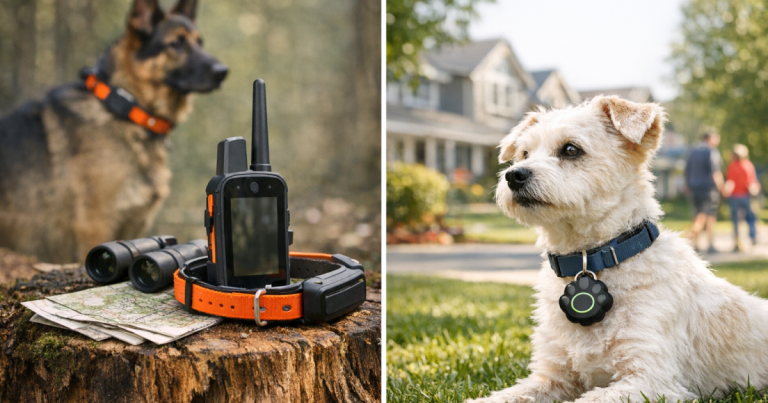
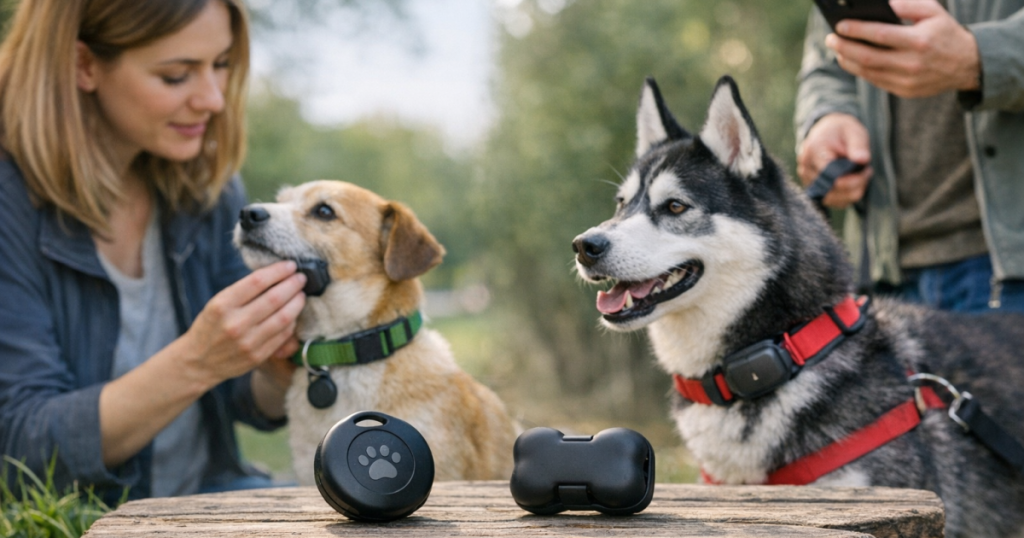
A dog slipping through a cracked gate or hopping out during a gas-station stop creates a very different recovery problem depending on what is attached to the collar. Pawscout vs FitBark is really a choice between short-range Bluetooth/community recovery and real-time cellular GPS tracking. Both can play a role in lost-pet planning, but they are not interchangeable tools.
Quick Buying Links
Pawscout Bluetooth Tag
lower-cost nearby Bluetooth recovery and community alerts, not real-time GPS tracking beyond short range
FitBark GPS 2nd Gen
Better for escape-prone dogs needing real-time GPS, Safe Place alerts, cellular service and published fit specifications
What to know first
The Pawscout Bluetooth Tag is a Bluetooth pet tag and lost-pet recovery device. Pawscout describes it as working with the Pawscout App and other Pawscouters, with a stated 300 ft outdoor range to a phone or another Pawscouter. It is not an onboard GPS or cellular tracker.
The FitBark GPS 2nd Gen is a cellular GPS pet location and health tracker. FitBark lists onboard GPS, mobile phone GPS, Wi-Fi APIs, cell-tower data, 4G LTE-M, Wi-Fi and Bluetooth connectivity, plus real-time GPS tracking and Safe Place enter or exit alerts.
That difference matters more than any tidy feature checklist. A Bluetooth tag can be useful when your dog is nearby or when another Pawscout user comes within range. A cellular GPS tracker is built for a wider search radius, provided network and GPS conditions cooperate. No collar device removes the need for secure gates, solid ID, and a calm recovery plan, but the right device can reduce the amount of guessing when minutes feel long.
Side-by-side differences that actually change the decision
- Tracking method: Pawscout uses Bluetooth communication with the Pawscout App and other Pawscouters. FitBark uses onboard GPS, mobile phone GPS, Wi-Fi APIs and cell-tower data, with 4G LTE-M, Wi-Fi and Bluetooth connectivity.
- Reach: Pawscout lists a 300 ft outdoor range to a phone or another Pawscouter. FitBark lists nationwide embedded LTE Cat M1 cellular coverage and references Verizon, AT&T and T-Mobile on its store page.
- Lost-pet features: Pawscout can broadcast a lost pet alert to nearby Pawscouters. FitBark lists real-time GPS tracking and Safe Place escape alerts.
- Recurring costs: Pawscout Pro is optional, with $0.99 monthly or $9.99 yearly listed. FitBark says an in-app subscription is required, with plans shown from $10/mo for 6 months down to $4/mo for 5 years.
- Water resistance: Pawscout is listed as IPX7 water resistant. FitBark is listed as IP67 waterproof, submersible up to 1 m for up to 30 minutes.
- Fit details: Pawscout’s official pages describe support for cats and dogs. FitBark publishes more specific fit data: 0.56 oz, 1.86 x 1.18 x 0.61 in, for pets from 5 lb and flat collars not wider than 1.5 in.
Where Pawscout makes the most sense
Pawscout is the calmer, lower-cost choice for owners who want an ID-style recovery aid with Bluetooth alerts rather than full GPS tracking. The official device price starts at $19.95, and the optional Pawscout Pro plan adds listed extras such as 30-day location history for the Bluetooth Tag.
Its best fit is a dog whose risk pattern is close-range: slipping out into the front yard, wandering near neighbors, or being found by someone already within the Pawscout community’s Bluetooth reach. The Outdoor Virtual Leash feature alerts when the pet goes in or out of range of the phone or guardians, which suits a nearby boundary-style use case more than a broad search across town.
The editorial catch is simple: 300 ft can feel generous in a park and painfully small when a frightened dog bolts. Pawscout’s lost pet alert depends on nearby Pawscouters, so it should be treated as a community Bluetooth tag, not as the device you choose when you need a moving location point miles away. For more detail on the Bluetooth tag itself, see our Pawscout Bluetooth Tag / Pawscout Smarter Pet Tag profile.
Where FitBark GPS 2nd Gen pulls ahead
FitBark is the stronger choice when the main fear is a dog leaving the immediate area. Manufacturer-stated features include real-time GPS tracking, Safe Place exit or enter alerts, and an embedded LTE Cat M1 cellular SIM with nationwide coverage. Its official store page references Verizon, AT&T and T-Mobile, which is a meaningful distinction from a Bluetooth-only reach model.
FitBark also brings more published hardware detail into the buying decision. The official specifications list a 0.56 oz / 16 g device, dimensions of 1.86 x 1.18 x 0.61 in, compatibility with pets from 5 lb, and flat collars up to 1.5 in wide. For smaller dogs, that published minimum weight is useful because comfort and collar balance matter; a tracker that flops, twists or drags becomes one more nuisance you will eventually stop using.
There is more upkeep, though. FitBark requires an in-app subscription for GPS service and the built-in SIM. FitBark also lists Wi-Fi and mobile always-on location permission requirements, and the device has a lithium-ion polymer battery that recharges in 2 hours without removing the unit from the collar. Its official store lists a sale price of $34.95 and a regular price of $69.95, but the subscription is the bigger long-term difference. Our FitBark GPS 2nd Gen entry breaks out the verified tracker details in one place.
Recovery scenarios: which one fits your dog?
The neighborhood door-dasher
If your dog usually runs only a few houses away, Pawscout can be a sensible low-friction layer. Its Bluetooth range and lost pet alert model are built around nearby recovery, not long-distance tracking. Pairing it with a readable ID tag still matters because the fastest recovery is often a neighbor holding the leash and calling the number on the collar.
The fence-jumper who keeps moving
For a dog that clears a fence and keeps traveling, FitBark is the better match on the verified facts. Real-time GPS tracking and Safe Place escape alerts are directly relevant when the dog is no longer within short Bluetooth range. The practical limitation is that cellular and GPS performance still depends on real-world network and signal conditions, so it should be one layer of a recovery plan, not the whole plan.
The travel dog
Road trips make range matter. A dog loose at a rest stop is not the same as a dog circling the backyard. FitBark’s cellular GPS model is more appropriate when your search area can expand quickly. A tracker also needs to stay attached, so travel dogs should be paired with secure gear; our guide to choosing an escape-resistant harness for road trips is a useful next step if car-door dashes are part of the risk.
The mud-and-water dog
Both devices have manufacturer-stated water resistance. Pawscout is listed as IPX7 water resistant. FitBark is listed as IP67 waterproof, submersible up to 1 m for up to 30 minutes. For dogs that hit puddles, wet grass and creek edges, either rating is more reassuring than an unprotected tag, but FitBark’s published submersion statement is more specific.
Costs and upkeep: cheap tag or ongoing service?
Pawscout has the simpler price story at purchase: buy starting at $19.95, with Pawscout Pro optional at $0.99 monthly or $9.99 yearly. That makes it easier to add as a backup recovery tag without committing to a required service plan.
FitBark has a higher-support model: the official store page lists an in-app subscription as required, with plans ranging from $10/mo to $4/mo depending on term. That recurring cost funds the service side of a cellular tracker, and it is the price of getting features such as real-time GPS tracking and Safe Place alerts away from the owner’s phone.
The plain-spoken version: Pawscout is easier to justify as an inexpensive collar add-on; FitBark asks for more ongoing commitment because it is doing a different job. Comparing them only by device price misses the point, a little like comparing a porch light with a flashlight because both involve seeing things.
The practical recommendation
Choose Pawscout if you want a lower-cost Bluetooth/community lost-pet tag for cats or dogs, your main concern is nearby wandering, and you are comfortable with a 300 ft stated outdoor range to a phone or another Pawscouter. It is best treated as a backup recovery layer and neighborhood alert tool, not a GPS tracker.
Choose FitBark GPS 2nd Gen if your dog’s escape pattern demands real-time GPS location, Safe Place alerts, and cellular coverage beyond your phone’s immediate range. It is the stronger recovery tool for fence-jumpers, travel dogs, and owners who want published fit specs, water-resistance detail, and health/activity monitoring alongside location tracking.
For most escape-prone dogs, FitBark is the more capable lost-location choice because its verified feature set is built around GPS, LTE-M and safe-place alerts. Pawscout still earns a place for short-range, lower-cost community recovery, but it belongs in the Bluetooth tag lane. Pick the tool that matches how your dog actually gets loose, then back it up with secure hardware, clear ID and habits that keep the first opening from becoming the worst five minutes of your day.
Quick Buying Links
Pawscout Bluetooth Tag
lower-cost nearby Bluetooth recovery and community alerts, not real-time GPS tracking beyond short range
FitBark GPS 2nd Gen
Better for escape-prone dogs needing real-time GPS, Safe Place alerts, cellular service and published fit specifications