A backyard dog airlock gives you a pause point between your dog and the open world. Instead of relying on one gate, one latch, or one distracted guest, backyard escape prevention becomes a simple two-barrier habit that buys you time when a dog bolts, spooks, or squeezes through a gap.
Think of it as a mini holding zone: one gate closes before the next one opens. For door dashers, fence jumpers, nervous rescues, and dogs who treat delivery days like a sporting event, that pause can make the difference between a scare and a safe reset.
Fence modifications that require digging posts, altering structural gate supports, or working near utilities should be handled by a qualified fence contractor to meet local code, property-line rules, and safety requirements.
What to know first
A dog airlock prevents backyard escapes by creating two separate closed barriers between your dog and the street, alley, driveway, or front yard. The safest setup is the one your household can use every single time: latch the first barrier, bring the dog into the holding space, confirm the second barrier is closed, then move through.
- Best location: the gate your dog already watches, charges, or slips through.
- Best size: large enough for your dog to turn around calmly, but not so large that people leave both gates open out of convenience.
- Best routine: one gate open at a time, no exceptions for quick chores, trash runs, or visitors.
- Best backup: visible ID and a recovery plan, because even a well-built airlock is not foolproof.
Step 1: Find the exit your dog would choose
Start by watching the yard the way your dog uses it, not the way the fence looks on a calm afternoon. Stand inside the yard and notice where your dog waits when someone approaches, where they sprint during squirrel drama, and which gate family members use when they are carrying groceries, lawn tools, or sports bags.
Most backyard escapes happen at predictable pressure points: a side gate that opens toward a driveway, a latch that almost catches, a gap under a gate, a corner where a dog can jump from a storage bin, or a patio door that sends the dog directly into an unsecured yard. Your airlock should protect the route with the most real-world traffic, not necessarily the prettiest place to build.
Step 2: Pick a layout that fits your yard
You do not need an elaborate kennel run to create an effective dog airlock. The goal is controlled movement through two barriers. Choose the version that fits your property and your dog’s escape style.
Gate-to-gate side yard
This is the classic setup for suburban homes: a short fenced corridor with one gate at the yard and another at the driveway or front approach. It works well when landscapers, guests, kids, or delivery drivers need access without exposing the whole yard at once.
Portable panel holding zone
For renters or owners who cannot alter fencing, a freestanding exercise pen or temporary fence panels can create a small holding space inside the existing yard. This can be useful near a patio door, garage entry, or side gate. The key is stability; lightweight panels that shift when a dog leans on them are not a secure barrier.
Mudroom or porch buffer
If the main risk is a dog blasting from the house into the yard and then out a gate, use the house itself as part of the airlock. A mudroom, screened porch, or enclosed back entry can become the first chamber, as long as people treat it like a real safety zone rather than a place to prop doors open.
Step 3: Make both barriers self-closing and easy to latch
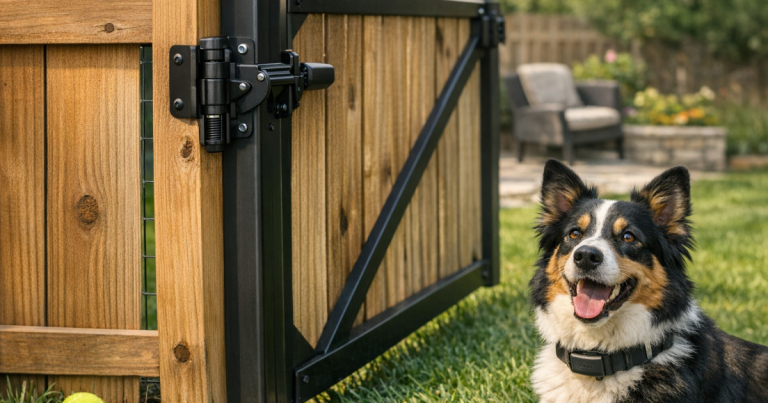
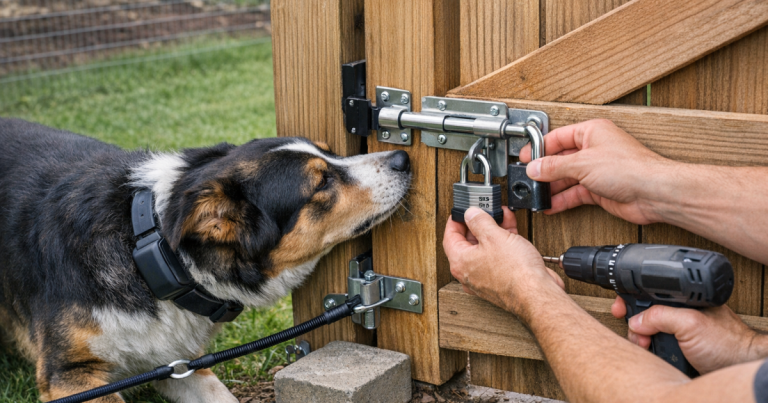
A dog airlock only works when the gates actually close. Spring hinges, gravity latches, and self-closing hardware can reduce the chance that someone leaves a gate swinging while they answer a phone or wrestle with trash cans. If your current latch sticks, sits too low for adults to use comfortably, or can be nudged open by a determined nose, fix that before adding more fencing.
For a deeper walkthrough of latch placement and safe gate behavior, see our guide to installing a dog-safe self-closing backyard gate latch. A smooth, boring latch is exactly what you want here; backyard safety should not depend on a complicated trick only one person in the family understands.
- Open each gate fully and confirm it swings closed without dragging.
- Check that the latch catches from a normal walking pace, not only when you pull it carefully.
- Place latches where children cannot casually play with them, while adults can still operate them easily.
- Avoid tying gates open during yard work unless your dog is indoors or otherwise secured.
Step 4: Close the sneak routes around the airlock
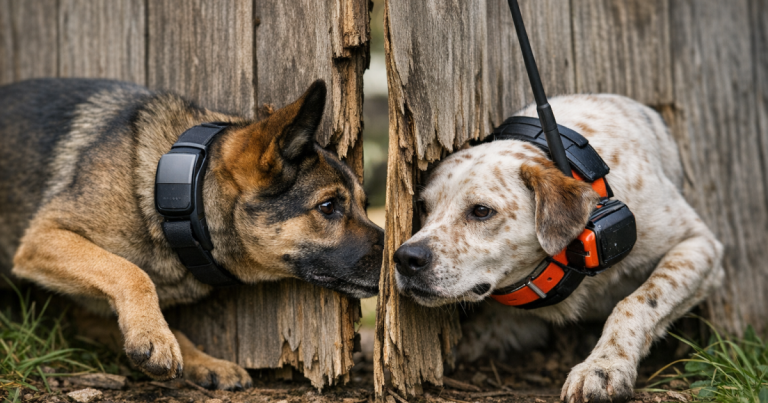
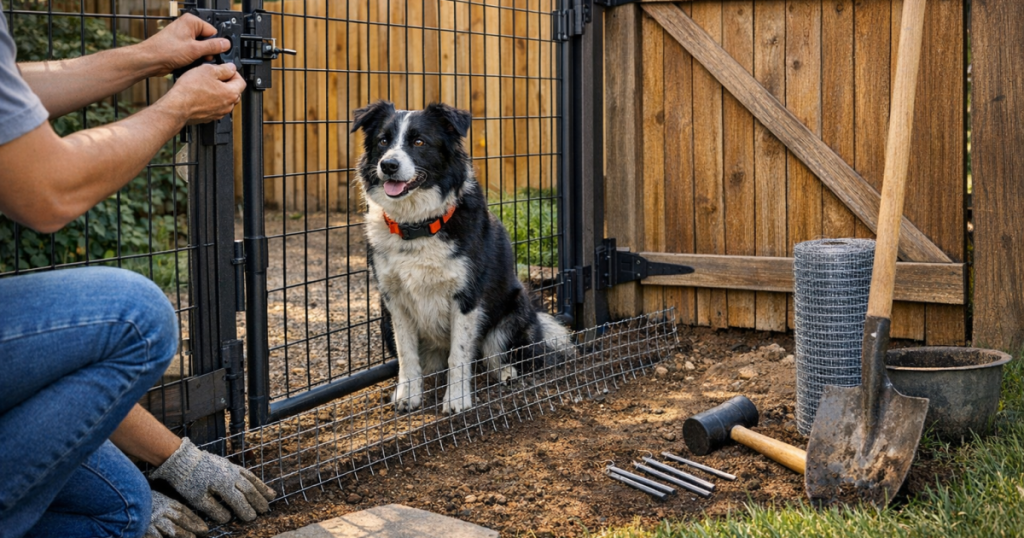
Dogs rarely respect the diagram you had in mind. A serious escape artist may go under, over, around, or through the weak point closest to the new gate. Once the airlock is in place, inspect the surrounding area with special attention to gaps, climb aids, and sightlines.
Under-gate gaps deserve close attention for small dogs, puppies, and narrow-headed breeds. A gap that looks harmless from adult standing height can be a clear invitation at nose level. Along the fence line, look for loose boards, warped pickets, washout spots after rain, and soil that has been scratched into a shallow digging trench.
Also remove launch pads near the barrier. Patio chairs, stacked firewood, storage bins, and raised planters can turn a 5-foot fence into a much easier project for an athletic dog. If your dog is a jumper, keep the airlock calm and uncluttered so it does not become an agility course with consequences.
Step 5: Teach the household the one-gate rule
The most reliable airlock is partly hardware and partly choreography. Everyone who uses the yard needs the same simple sequence: dog behind barrier one, open barrier two, close and latch barrier two, then move on. Visitors should not be expected to guess this during a busy barbecue or a rainy grocery drop-off.
Post a small sign at the gate if guests, cleaners, walkers, or contractors use the yard. Keep leashes near the exit so no one has to cross the yard with an excited dog loose beside them. If your dog gets frantic when people arrive, move them indoors or into a secure room before opening the outer gate. The airlock slows a mistake; it should not be asked to manage full panic by itself.
Nervous dogs need extra care because fear can turn a calm routine into a sudden backward scramble. If your dog has slipped gear before, pair the yard routine with properly fitted equipment and review how to choose an escape-resistant harness for a nervous dog. Fit matters: a harness that is too loose can become another exit route.
Adjust the setup for your dog’s escape style
For gate rushers
Position the inner gate far enough from the outer gate that your dog cannot crowd both openings at once. Ask for a sit, hand target, or calm pause before movement through the chamber. Training does not replace the barrier, but it makes the barrier easier to use.
For diggers
Focus on the base of the fence and gate. Packed soil, buried edging, or pavers along the airlock perimeter can discourage casual digging, but a persistent digger still needs supervision and enrichment. Watch for fresh scratches after rainy days, when softened ground makes tunneling easier.
For small dogs
Look low before you celebrate. Small dogs can exploit gaps under gates, between pickets, behind shrubs, and around uneven ground. If the airlock uses panels, check the spacing at corners where flexible material can bow outward.
For jumpers
Keep the airlock narrow enough to discourage a running start and clear enough that nothing acts as a step. If your dog can already clear your existing fence, the airlock should be part of a larger containment plan, not the only answer.
Add recovery layers without trusting them too much
An airlock is prevention, not a guarantee. Dogs still slip collars, guests still make mistakes, storms still scare animals, and a determined dog may find a weakness you missed. Use visible ID tags, current microchip registration, clear recent photos, and a plan for who searches which direction if your dog gets out.
Tracking tools can support recovery, but they are not magic. GPS trackers, cellular coverage, Bluetooth tags, and neighborhood networks all have limits, and the right backup depends on where your dog is likely to roam. If you are deciding between a tracker and a simpler tag-style backup, this breakdown of GPS tracker or neighborhood backup explains the trade-off without treating any device as foolproof.
Test the airlock before you trust it
Do a dry run without distractions. Walk through the whole sequence with your dog on leash, then repeat it with a family member carrying something awkward, such as a trash bag or laundry basket. That is closer to real life than a calm empty-handed test.
- Can one person enter and exit without both gates open at the same time?
- Does each latch catch when released normally?
- Can your dog reach the outer gate before the inner gate closes?
- Are there gaps at nose height, paw height, and ground level?
- Would a visitor understand the routine without a long explanation?
- Does the setup still work in rain, at night, and when your hands are full?
Repeat the check after storms, freeze-thaw weather, landscaping work, or any fence repair. Gates sag, soil shifts, and hardware loosens over time. A monthly walkaround is less dramatic than a lost-dog search, which is exactly the point.
Questions people ask
How big should a backyard dog airlock be?
It should be large enough for your dog and a person to move calmly without crowding, but small enough that people are not tempted to leave both gates open. For many homes, a short side-yard corridor or compact fenced holding area is more practical than a large enclosure.
Will an airlock stop every escape?
No. A backyard dog airlock reduces common escape moments at gates and doors, but it cannot guarantee containment. Pair it with secure fencing, good latch habits, supervision, ID tags, and a recovery plan.
What is the first thing to fix if my dog keeps getting out?
Fix the known exit point first. If your dog leaves through a side gate, start with latch reliability and a second barrier there. If they dig, jump, or squeeze through gaps, the airlock should be combined with repairs at those specific weak spots.
Why it matters
The best dog safety systems are not dramatic. They are quiet routines that keep working when someone is tired, rushed, or distracted. A backyard dog airlock gives your household a repeatable pause before the risky moment, which is exactly when many escapes happen.
Build it around your dog’s real behavior, not an ideal version of the yard. When the gates close easily, the gaps are sealed, and everyone follows the same sequence, your backyard becomes harder to escape from and much easier to enjoy.