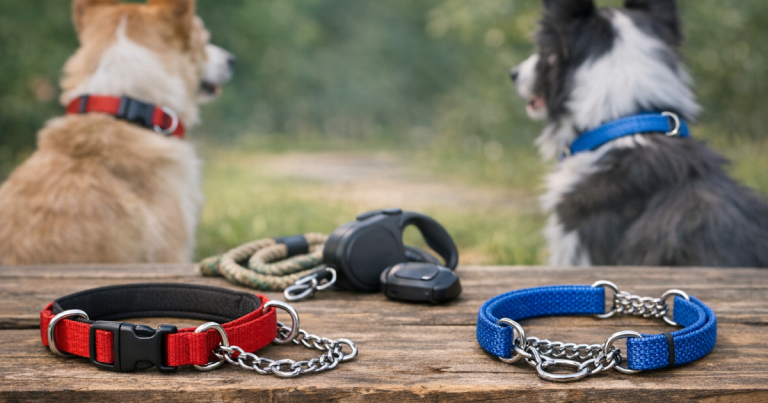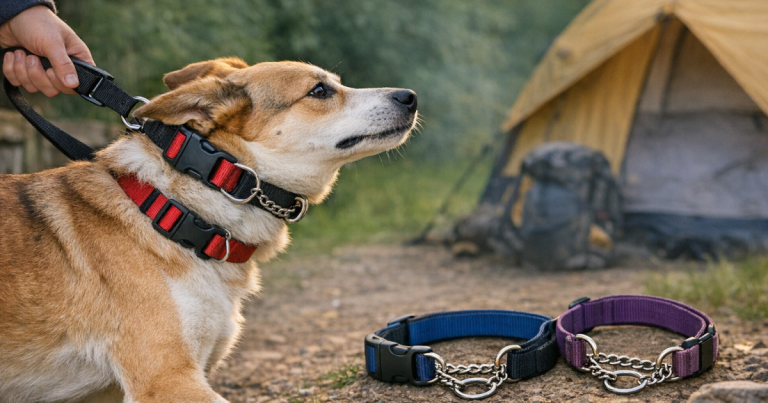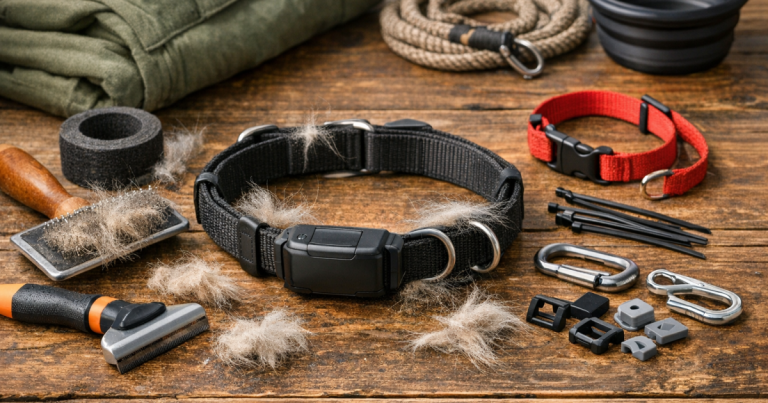
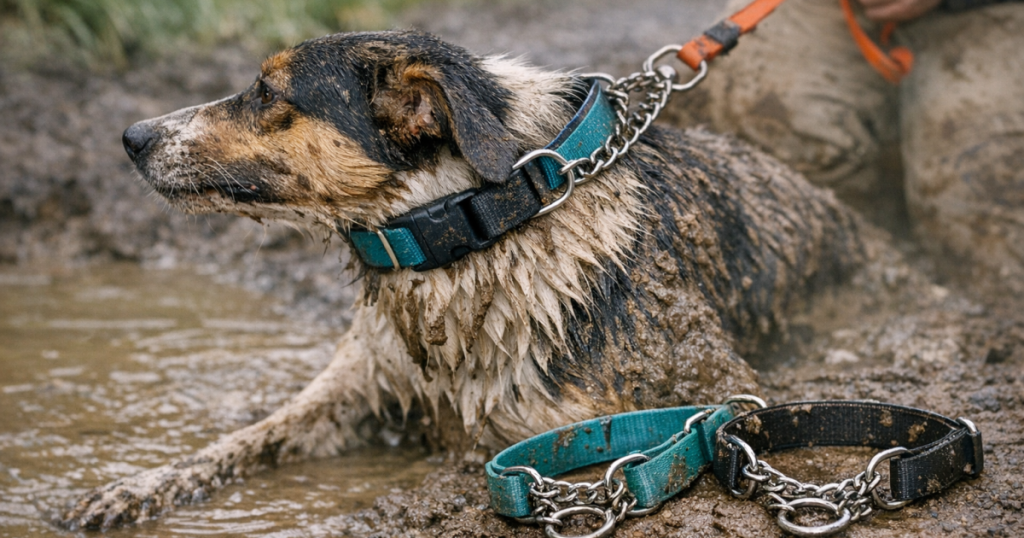
Mud changes the collar decision fast. A standard nylon collar can hold grit, stretch when wet, and slide over a narrow head at the worst possible moment. For many dogs, the best waterproof martingale collars are limited-slip collars made from coated, hose-off webbing with hardware that fits the dog’s size and daily routine.
A martingale collar is not a magic anti-escape device. It is a fit-sensitive tool that tightens only to a set limit when a dog backs up, pulls sideways, or tries the classic “reverse and vanish” move. Used correctly, it can give you more control than a flat collar without relying on constant tightness.
The short version
For muddy escape-prone dogs in 2026, choose a waterproof martingale made from BioThane, Soft Grip, or another coated webbing rather than absorbent fabric. Look for a limited-slip design, smooth edges, corrosion-resistant hardware, and a size range that lets the collar sit high enough to work without staying tight at rest.
The strongest everyday choices are usually coated-webbing martingales from makers such as Tuff Pupper, Mimi Green, If It Barks, and High Tail Hikes. The right one depends less on branding and more on whether the collar can be adjusted precisely for your dog’s neck, head shape, coat thickness, and level of mud-related enthusiasm. Some dogs do not enjoy puddles; others appear to have a professional commitment to them.
Step 1: Decide whether a martingale is the right tool
Martingales are most useful for dogs that can slip a flat collar because their head is narrower than their neck, their coat compresses, or they panic and back out of leash pressure. Greyhounds, Whippets, Salukis, many sighthound mixes, and some slender mixed breeds are common candidates, but any determined escape artist can make a loose flat collar look decorative.
A martingale should tighten enough to prevent slipping, then stop. It should not keep squeezing after the control loop closes. If your dog bolts, spins, or freezes from fear, pair collar decisions with handling and training choices. A nervous dog may also need an escape-resistant harness; this guide to choosing an escape-resistant harness explains when a harness is the safer primary restraint.
Step 2: Choose a waterproof material, not just a “washable” one
Waterproof usually means coated webbing that does not soak through like ordinary woven nylon. BioThane and similar coated straps are popular because mud can usually be wiped or rinsed off, and the collar does not stay damp against the dog’s neck for hours. That matters for dogs who swim, roll, dig, or live where spring thaw turns the yard into soup.
Fabric martingales can still be comfortable and secure, but they are not the easiest choice for a collar that gets caked in mud several times a week. Wet fabric can smell, hold grit, and require more drying time. For a dog that needs daily escape prevention, less drying time is not a luxury; it is one less excuse to grab the wrong collar before a quick walk.
Step 3: Start with these waterproof martingale collar picks
The collars below are practical starting points, not promises that one model fits every escape-prone dog. Always verify current sizing, hardware, return policies, and buckle or slip-on options before ordering, because collar makers can change configurations.
Tuff Pupper Waterproof Martingale Dog Collar
This is the most straightforward pick for owners who want a muddy-walk collar that feels familiar rather than custom or fussy. Tuff Pupper is known for waterproof dog gear, and its martingale option fits the “rinse it and move on” routine many owners need after wet parks, trails, or backyard digging sessions.
- Good fit scenario: medium to large dogs that need a durable limited-slip collar for wet daily walks.
- Why it helps: coated materials are easier to clean than standard nylon after mud, rain, or creek water.
- Check before buying: size range, hardware type, and whether the collar style matches your preference for buckle-on or slip-over use.
Mimi Green Waterproof Martingale Collar
Mimi Green is a strong option when fit matters more than grabbing a generic size. Custom sizing can be useful for dogs with awkward neck-to-head proportions, fluffy coats that compress, or narrow heads that make ordinary collars unreliable.
- Good fit scenario: sighthounds, slim mixed breeds, and dogs between common stock sizes.
- Why it helps: waterproof coated materials reduce the soggy-collar problem while custom sizing can improve security.
- Check before buying: exact neck measurement in inches, collar width, hardware finish, and whether your dog needs a buckle for easy on-off.
If It Barks Waterproof Martingale Collar
If It Barks is worth a look for owners who want a cleaner, more tailored fit without moving into complicated gear. A waterproof martingale from this kind of maker is especially useful for dogs that wear a collar on rainy neighborhood walks but still need a limited-slip backup when startled.
- Good fit scenario: dogs that need precise sizing and a collar that can be cleaned quickly after wet grass or mud.
- Why it helps: coated straps are simpler to maintain than absorbent fabric, especially for repeat daily use.
- Check before buying: measuring instructions, whether the control loop closes correctly on your dog, and current customization choices.
High Tail Hikes BioThane Martingale Collar
High Tail Hikes is a sensible choice for trail, farm, and adventure routines where mud is not an occasional inconvenience but part of the calendar. BioThane-style collars are popular in that world because they handle water and dirt better than many fabric collars.
- Good fit scenario: active dogs that hike, train outdoors, visit muddy fields, or ride along on rural errands.
- Why it helps: waterproof coated webbing is easy to wipe down before it goes back in the car or hangs by the door.
- Check before buying: the width and weight of the collar for small dogs, and hardware strength for larger dogs.
Step 4: Measure for escape prevention, not just comfort
A martingale that is too loose can still slide over the head. One that is too tight can be uncomfortable and unsafe. Measure around the widest part of the dog’s head and the upper neck where the collar will sit. Then follow the maker’s instructions, because martingales are sized differently from flat collars.
After fitting, clip on a leash and gently pull the leash forward until the control loop tightens. The two main rings should not meet completely unless the maker’s instructions specify that design. There should still be a safe stopping point. At rest, the collar should relax and should not stay tight around the neck.
If your dog has already escaped from a martingale, the issue may be style as much as size. A buckle model can be easier to put on without loosening the adjustment, while a slip-on model has fewer parts but must pass over the head. The trade-off matters enough that we break it down separately in buckle vs slip-on martingale collars for escape-prone dogs.
Step 5: Match collar width and hardware to the dog
Small dogs need lightweight hardware and a collar that does not crowd the neck. A waterproof martingale can be overbuilt for a tiny dog if the rings and buckle feel bulky. Large dogs need sturdy hardware and enough width to spread pressure comfortably. Long-necked breeds often do better with wider collars, but width should never interfere with natural movement or breathing.
Coat type changes the answer too. Thick-coated dogs may look properly fitted until the fur compresses in rain. Smooth-coated dogs may need extra attention to edge comfort because there is less padding between collar and skin. After a muddy walk, run your fingers under the collar area and check for rubbing, trapped grit, or damp irritation.
Step 6: Test it before the high-stakes walk
Do not make the first real test a dark, rainy night beside traffic. Fit the collar at home, then practice in a fenced yard or quiet area. Let the dog move, sniff, shake, and back up while you keep light leash contact. You are checking whether the collar tightens smoothly, stops safely, and relaxes again without sticking.
- Watch for a collar that rotates so far the control loop sits under the throat awkwardly.
- Check whether mud or sand jams around the rings after an outdoor walk.
- Confirm the adjustment does not creep looser after repeated use.
- Rinse and dry the collar, then inspect stitching, rivets, and hardware before the next outing.
Waterproof does not mean maintenance-free. Mud is persistent, and dog gear lives a harder life than most owners admit.
Do not let the collar carry the whole recovery plan
A secure collar reduces one escape risk, but it does not identify your dog if a leash clip fails, a gate opens, or the collar comes off during play. Every escape-prone dog should also wear readable ID when appropriate, and owners should keep contact details current. For the low-tech layer that still helps strangers act quickly, see our advice on choosing dog ID tags for faster lost-pet recovery.
For dogs that bolt, travel, hike, or spend time on rural properties, a tracker can add another layer of recovery support. Just be realistic: trackers depend on fit, coverage, battery, and setup. The collar is the physical control point; identification and tracking are backup plans for the day something still goes sideways.
Fast answers
Are waterproof martingale collars safe for everyday walks?
They can be safe for leash walks when fitted correctly and used under supervision. A martingale should tighten only to its set limit and relax when leash pressure stops. It should not be left on during crate time or rough play where the collar could snag.
Are BioThane martingale collars better than nylon for mud?
For frequent mud and water, BioThane and similar coated webbing are usually easier to rinse and dry than woven nylon. Nylon can still work, but it tends to hold moisture, grit, and odor longer.
Can a martingale stop every collar escape?
No collar can guarantee that. A properly fitted martingale reduces the chance of a dog backing out, but dogs can still escape through poor fit, damaged hardware, leash failure, panic, or handling mistakes.
What to remember
For muddy escape-prone dogs, start with coated waterproof webbing, precise sizing, smooth limited-slip action, and hardware that suits the dog’s weight and strength. Then test the collar in a low-pressure setting before trusting it on a busy sidewalk, trailhead, or parking lot.
The best waterproof martingale collars are the ones that stay clean enough to use every day, fit well enough to prevent backing out, and remain comfortable enough that you are not tempted to swap back to an easier but less secure collar. That is the real win: fewer dramatic leash moments, fewer soaked collars by the door, and one more layer between your dog and a lost-pet search.