A harness can be a better home for a tracker than a loose collar, but only if the device stays upright, secure, and able to report reliably while your dog moves. The point of testing dog GPS tracker placement is to catch twisting, strap interference, weak updates, and comfort problems before the setup has to matter.
Do the test on an ordinary day, not ten minutes before a road trip or a trail walk. Dogs have a gift for finding the one strap you forgot to check.
The short version
After moving a GPS tracker onto a harness, do not assume the new position works just because the mount clips on. A useful test checks four things: the device stays attached, it is not buried under the dog’s body or coat, it updates acceptably in the places your dog actually goes, and it does not rub, bounce, or change the harness fit.
Most consumer dog GPS trackers do not need true calibration after a collar or harness change in the way a compass or scale might. What owners usually mean by “calibration” is placement validation: confirming the tracker sits securely, has a practical view of the sky and network, and reports locations consistently from the new position. If the tracker’s app includes a setup step, home zone setting, firmware prompt, or mounting instruction, follow the manufacturer’s directions first, then run the real-world checks below.
Start with the harness before the tracker
A tracker cannot make a poorly fitted harness reliable. Before you attach anything, put the harness on your dog without the tracker and check the normal fit.
- Neck and chest straps: They should be snug enough that the harness does not rotate but not so tight that they pinch when your dog sits, turns, or lowers their head.
- Shoulder movement: Watch your dog walk a few steps. The harness should not block the shoulder blades or pull into the armpits.
- Attachment point: Choose a tracker position that does not compete with the leash clip, ID tag, handle, or adjustment buckle.
- Coat clearance: Long fur, thick ruffs, and seasonal shedding can hide looseness. Lift the coat and check the actual strap tension underneath.
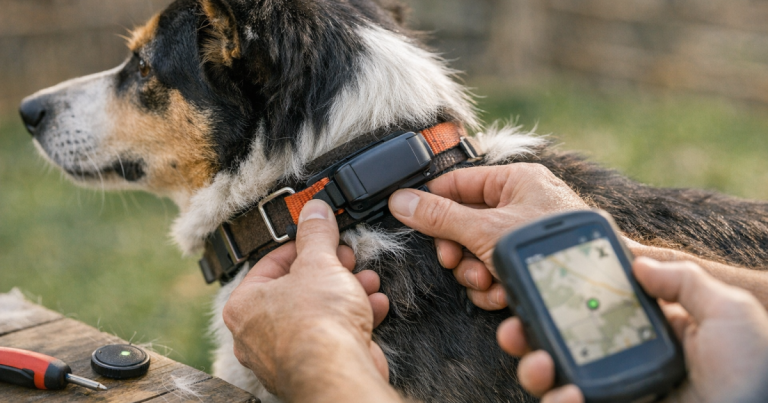
If you recently moved the tracker from a collar to a harness, it is worth comparing the mount behavior against a collar-based setup. The same habit used to test GPS tracker mounting after changing dog collars applies here: change one thing, then verify it before trusting it outside.
Pick a practical tracker position
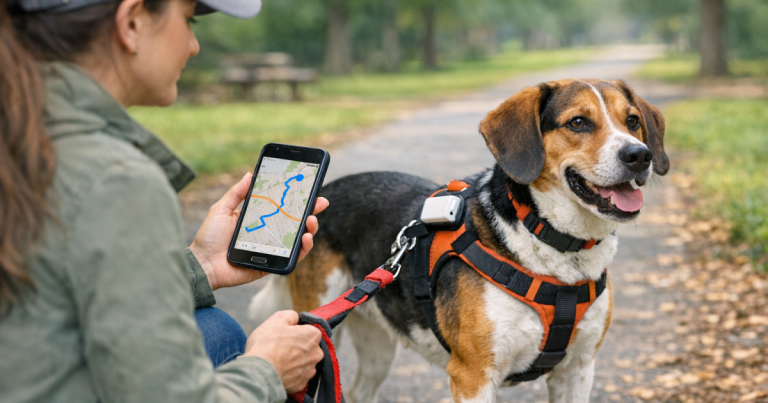
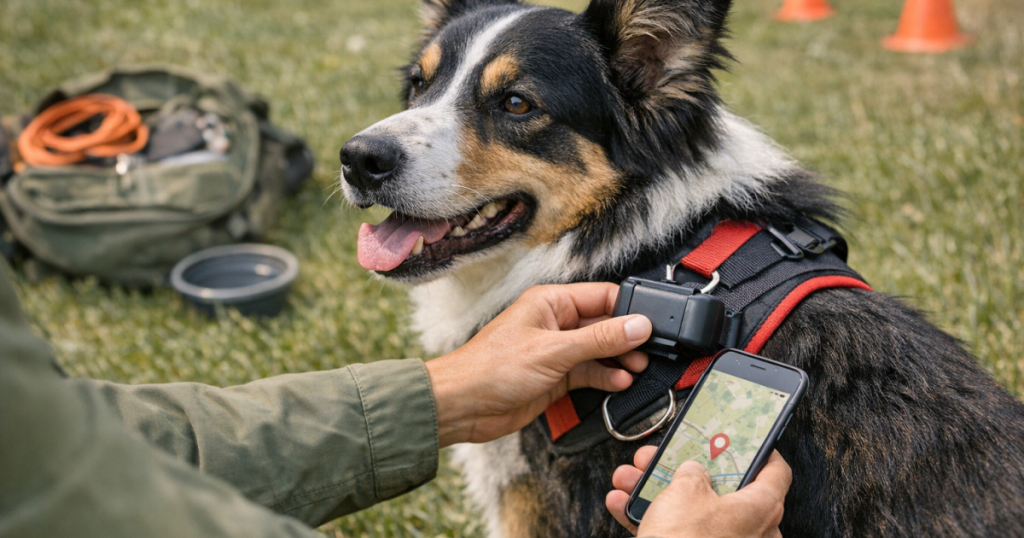
For most harness setups, the best starting point is high on the dog’s back, centered between the shoulder area and the mid-back, where the tracker is less likely to drag, strike furniture, or sit under the chest. That does not mean every harness will cooperate. Some have a handle, leash ring, or narrow webbing exactly where you would like the tracker to sit.
Avoid placing the device where it hangs under the dog’s chest, swings from a side strap, or presses into the armpit. Those spots may look secure while the dog stands still but shift quickly once the dog trots, rolls, or squeezes through brush. Side-mounted trackers also tend to catch on door frames, crate openings, and low branches more easily.
For small dogs, weight and bulk matter more than neatness. If the device makes the harness list to one side or changes your dog’s gait, it is the wrong placement even if the signal looks fine. For deep-chested or heavy-coated dogs, pay attention to whether the tracker disappears into fur or tilts downward when the harness settles.
Run the five-minute indoor fit check
Start indoors or in a fenced area. You are not testing GPS accuracy yet; you are testing whether the setup survives normal dog behavior.
- Attach the tracker exactly as you plan to use it outside.
- Ask your dog to walk, sit, lie down, turn, and shake off.
- Check whether the tracker slides, flips, or pulls one harness strap tighter than the others.
- Run two fingers under the nearest straps after movement, not before.
- Look for contact points where plastic, clips, or mount edges press into fur or skin.
Repeat the check after ten minutes of ordinary movement around the house. Harnesses settle once a dog relaxes. A mount that looked tidy during the first minute can migrate sideways after one couch jump and a dramatic full-body shake.
Do a controlled outdoor walk
Once the physical fit passes, test the tracker outdoors in a low-risk setting. A quiet block, fenced yard, or open park edge is better than a busy trailhead. Keep your dog leashed and move through several ordinary positions: next to you, a few feet ahead, sniffing at ground level, turning back, and pausing near trees or buildings.
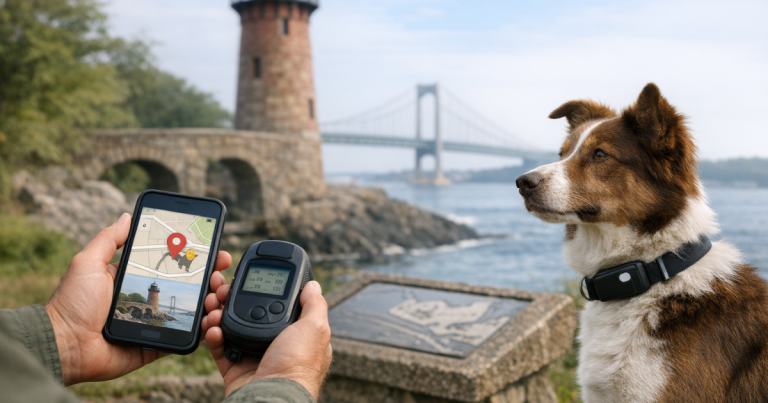
Use the tracker’s app or handheld receiver as you normally would, but keep expectations realistic. A GPS device may update differently depending on network availability, sky visibility, buildings, tree cover, terrain, and battery-saving behavior. The goal is not perfect dot-on-the-map precision every second. The goal is to learn whether the harness placement creates obvious dropouts, delayed updates, or odd position jumps compared with how the tracker normally behaves.
If you want more distance without giving up control, use the same cautious approach you would use for recall practice. A long line can help you create movement and separation while keeping the dog safe; the key is to handle it calmly and avoid tangles, as explained in this guide to using a long line safely for recall practice.
Check for harness-specific problems
A collar mostly moves with the neck. A harness moves with the chest, shoulders, and spine, so the tracker has to tolerate more angles. Watch for these common failure points:
- Rotation: The tracker starts centered but ends up on one side after your dog pulls, sniffs, or turns.
- Bounce: The device lifts and taps against the harness with each stride. This is annoying for some dogs and hard on mounts.
- Leash conflict: The leash clip knocks the tracker or twists the mount when tension comes on the lead.
- Body blocking: The tracker sits under the chest, under thick coat, or against the dog’s side for long stretches.
- Escape behavior: A dog who backs out, rolls, or paws at the harness may loosen the tracker even if normal walking looks fine.
For thick-coated dogs, repeat the check during heavy shedding seasons. Coat blowouts can change how straps sit and how much slack appears under the fur. If coat changes are part of your dog’s normal year, the same principles behind keeping a GPS collar secure during coat blowouts can help you think through harness fit as well.
Test the recovery scenario, not just the gadget
A tracker on a harness is useful only if it fits into your recovery routine. Run a small drill while your dog is safely under control.
- Have one person walk the dog around the block or across a park while another watches the location feed.
- Confirm that the person holding the phone or receiver knows how to refresh, interpret, and share the location.
- Check whether notifications, sound, or map settings are easy to understand under mild stress.
- Make sure the harness also carries visible ID, not just electronics.
- Practice removing and reattaching the tracker so charging or cleaning does not become a weak point.
This drill often reveals the boring problems that matter: the tracker is mounted well, but the phone battery is low; the harness is secure, but the ID tag is on yesterday’s collar; the app is working, but only one family member knows how to use it. None of that is glamorous. All of it counts.
When to move the tracker
Change the tracker position if it repeatedly rotates, sits under the dog’s body, interferes with the leash, or seems to bother your dog. Also move it if location updates are noticeably worse from the harness than from the collar in the same area and conditions.
Try small changes before abandoning the harness setup. Move the tracker one strap segment higher, center it more carefully, shorten excess webbing, or choose a point that avoids the leash hardware. Then repeat the indoor movement check and the same outdoor route so you are comparing like with like.
If the harness cannot hold the tracker without twisting or rubbing, use a different mounting location or return to a collar-based setup with a properly fitted collar. A tidy setup that your dog ignores is better than a clever one that needs constant fiddling.
Common questions
Do I need to calibrate the tracker after moving it to a harness?
Usually, no special calibration is needed simply because the tracker moved from a collar to a harness. What you should do is verify the new placement: secure the mount, confirm the device is not blocked by the dog’s body or coat, check the app or receiver for normal updates, and repeat a short outdoor route before relying on it.
Is a harness better than a collar for a GPS tracker?
It depends on the dog and the harness. A harness can be more stable for some dogs and more comfortable for dogs who should not carry extra bulk on the neck. A collar can be simpler and may keep the tracker higher and more exposed. The better choice is the one that stays secure, does not bother your dog, and works reliably in your normal environment.
Can I put the tracker on the leash ring?
Usually, the leash ring is not ideal. It may twist under leash tension, collide with the clip, or point the tracker in awkward directions. If the harness has a dedicated patch, strap, or mount-friendly area away from the leash hardware, start there instead.
Main points
Test the harness first, then the tracker. The safest process is simple: fit the harness, attach the tracker high and centered if the harness allows it, run an indoor movement check, walk a controlled outdoor route, and look for rotation, rubbing, blocked positioning, or unreliable updates.
No GPS tracker is a guarantee, and placement cannot overcome every network, terrain, or battery limitation. But a careful harness test gives you a better chance of noticing the weak spots while your dog is still beside you, which is exactly when you want to find them.