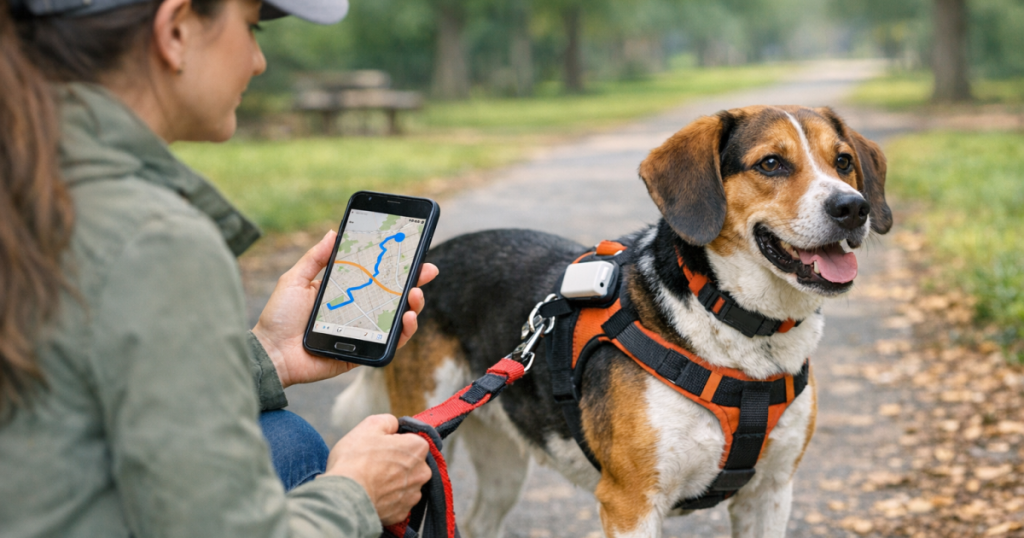
A leashed walk is the safest place to test dog GPS tracker accuracy because you can compare the app’s map against where your dog actually goes without adding escape risk. The goal is not to prove the tracker is perfect; it is to learn how it behaves on your streets, trails, and property edges before you rely on it during a stressful moment.
GPS drift is the gap between your dog’s real location and the position shown in the tracker app. Some movement on the map is normal, but repeated jumps to the wrong street, slow updates after turns, or location points that fail to settle can change how much confidence you should place in the device.
In brief
To check dog tracker GPS drift, leash your dog, start from a known location, let the tracker settle, walk a simple route with clear turns, pause at landmarks, and compare the app’s path with your actual path afterward. A tracker that stays on the correct street, trail, or side of a property line is more useful for recovery than one that repeatedly jumps across blocks or shows old positions as current.
- Use a familiar route first, not a new park or busy trail.
- Keep your dog leashed so you are testing the tracker, not recall.
- Pause in a few known places and see whether the map catches up.
- Repeat the walk in the environments where your dog is most likely to bolt.
- Treat results as a confidence check, not a guarantee.
Before you start the walk
Choose a route where you know the exact path: around your block, across a school parking lot after hours where permitted, or along a short trail with visible turns. Avoid testing in traffic-heavy areas or near open gates if your dog is nervous, reactive, or prone to backing out of gear.
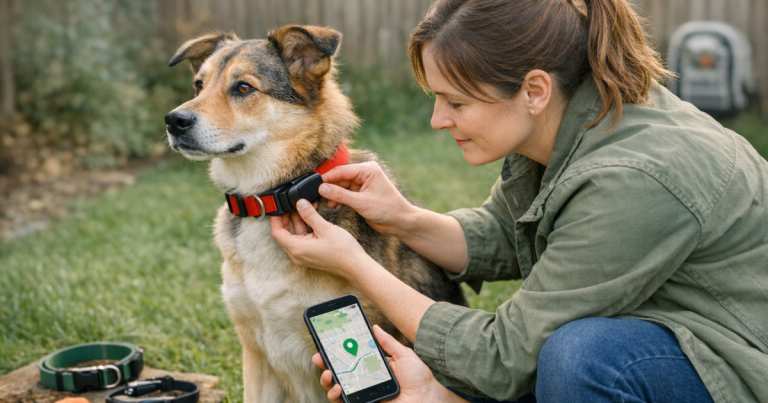
Before leaving, check that the tracker is charged, attached securely, and sitting where it normally rides on your dog’s collar or harness. A test is less useful if the device is clipped differently from real life. Also confirm that the app is open, signed in, and able to show your dog’s current location before you move.
Fit matters as much as signal. If your dog wears a harness and has ever twisted, planted their feet, or reversed suddenly, do a quick escape-gap check before the walk; our guide to checking a dog harness for escape gaps pairs well with any tracker test.
Step 1: mark a clean starting point
Stand still at a location you can identify later on the map: the end of your driveway, a mailbox, a trail sign, or the corner of a parking lot. Give the tracker time to settle before judging it. If the app initially places your dog nearby and then moves closer to you, that is different from a position that keeps wandering after you have not moved.
Take a screenshot if your app allows it, or simply note the start time. You are creating a reference point, not conducting a lab test. The question is practical: if your dog slipped loose from this spot, would the tracker send you toward the right place?
Step 2: walk a route with obvious turns
Walk a short loop or out-and-back route with at least three clear direction changes. Straight-line walks are easier for a tracker to appear accurate because there are fewer moments where delay becomes obvious. Corners, trail bends, and driveway turns show whether the app follows your movement or lags behind it.
Keep your pace steady. Do not sprint, stop every few seconds, or weave across the street unless that matches how you would search with your dog. A normal neighborhood pace gives you a better picture of everyday performance.
If the tracker has a live mode or more frequent update setting, use the mode you would use during an actual escape. Do not test on a battery-saving mode and then expect emergency-style responsiveness later. On the other hand, remember that more frequent updates may drain a battery faster, so the best setting depends on the scenario.
Step 3: pause at landmarks and watch the map settle
Stop at three landmarks for a short pause: a stop sign, a trail entrance, a bench, or a driveway. During each pause, look for two things. First, does the location point move toward the place where you are standing? Second, does it stay reasonably stable once it gets there?
Small movement around your actual position can happen, especially near trees, buildings, hills, or parked vehicles. The more serious problem is a pattern: the marker keeps landing on a parallel road, behind a row of houses, or far enough away that a helper would search the wrong area.
Do not only watch the dot in real time. After the walk, review the route trace if the app provides one. A route line that cuts through houses, jumps over blocks, or misses major turns tells you the tracker may be struggling in that environment.
Step 4: test the places where your dog would really disappear
A tracker can behave well on an open sidewalk and less reliably under tree cover, between tall buildings, or along a rural road with weak cellular service. Once the basic walk looks acceptable, repeat the test in the situations that match your dog’s risk profile.
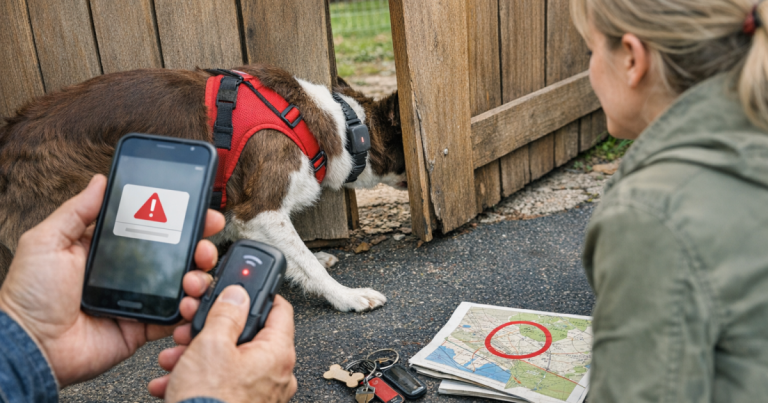
- Fence dashers: walk the outside edge of your yard or property line and see whether the marker stays on the correct side.
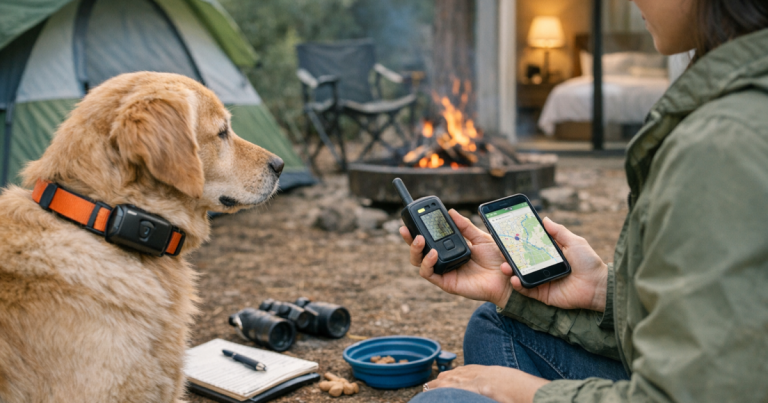
- Trail dogs: test near tree cover, bends, and trailheads rather than only in the parking area.
- Car bolters: test around the places you unload, such as rest stops, driveways, and campground loops.
- Wildlife chasers: test on leash near open fields or wooded edges, without allowing pursuit.
For dogs who lose focus around deer, squirrels, or other animals, tracker testing should sit alongside prevention work. The safest recovery plan starts before the chase, and our guide to preventing wildlife chases from becoming lost-dog emergencies covers that side of the routine.
How much drift is too much?
Judge drift by the decision it would cause you to make. If the tracker briefly floats near you but consistently points to the correct block, trail segment, or property edge, it may still be useful as one part of your recovery plan. If it repeatedly sends the marker to the wrong street, updates long after you turn, or cannot distinguish your yard from a neighbor’s, treat that as a warning.
For off-leash decisions, the standard should be higher than for casual peace of mind. A tracker that is “close enough” while your dog is beside you may feel much less helpful when your dog is moving fast, crossing cover, or disappearing behind terrain. Do not use the app as permission to skip recall work, leash management, ID tags, or secure gear.
Common reasons a tracker drifts on a walk
- Obstructed sky view: dense trees, tall buildings, steep hills, and covered areas can make location fixes less stable.
- Network limits: many dog GPS trackers depend on cellular coverage to send location data to your phone. Weak coverage can make updates late or inconsistent.
- Device position: a tracker hanging under the neck, buried under thick fur, or crowded by metal tags may behave differently than one sitting cleanly on top or to the side.
- App refresh behavior: the map may not update every second. A delayed map is different from a bad location fix, but both matter in a real search.
- Battery-saving settings: some modes reduce update frequency. That can be helpful for routine wear but less helpful during active recovery.
When the tracker is not ready for off-leash practice
Hold off on off-leash time if the tracker cannot maintain a usable position on a simple leashed route, if updates are delayed enough that the route is confusing, or if the app fails to load in places where you actually walk. Repeat the test after charging the device, checking app permissions, moving the tracker attachment, and trying a route with better sky view.
If your long-term goal is controlled freedom, pair tracker testing with structured recall work and a backup plan. A tracker can help you respond faster after a mistake; it should not be the only reason a dog is allowed off leash. For dogs practicing controlled distance work, the guide to GPS training collars for off-leash recall practice explains how tracking and training support differ.
Keep a simple drift log
You do not need a spreadsheet, but a few notes can make patterns obvious. Record the date, route, weather, environment, battery level, and whether the tracker stayed on the correct street or trail. If the same location causes repeated drift, mark it as a weak zone in your dog’s safety plan.
That log is also useful for household members. If one person knows the tracker struggles behind the back fence or under a wooded ridge, everyone who walks the dog should know it too. Recovery plans work better when the people involved share the same expectations.
What people usually ask
Can I test dog GPS tracker accuracy without taking my dog off leash?
Yes. A leashed walk is the preferred first test because you can compare the tracker’s map to your real position while keeping your dog physically controlled. Off-leash testing should come later, only after the tracker, gear fit, recall, and environment are all better understood.
Is GPS drift the same as a slow update?
No. GPS drift means the reported position is offset from the real location. A slow update means the app may be showing an older position. In a lost-dog situation, both can mislead you, so your walk test should look for accuracy and update timing.
Should I test in the same place every time?
Start with the same route so you can compare results. Then test in the places that matter most for your dog: your fence line, favorite trail, campground loop, family driveway, or neighborhood route. Repeating the test in real conditions is more useful than relying on one good map trace.
Key takeaways
A good leashed drift check is calm, repeatable, and tied to real escape scenarios. Start from a known point, walk a route with turns, pause at landmarks, review the map afterward, and repeat the test where your dog is most likely to run. The result is not a promise that the tracker will always be right, but it gives you a clearer, safer basis for deciding how much trust to place in it.