A dog who slips a collar at the curb, trailhead, or campground does not need harsher equipment; they need a setup that stays secure while you teach calmer movement. The most useful training collars for dogs who back out are usually properly fitted martingale collars, used with a harness backup and steady leash skills rather than constant pressure.
Assessment of neck pain, breathing trouble, or severe leash panic should be carried out by a licensed veterinarian or credentialed trainer, and restraint plans for public spaces should comply with local leash laws and safety requirements.
Main points before you choose a martingale
A martingale collar is a limited-slip collar. When the leash is relaxed, it sits like a normal collar. When a dog reverses, plants their feet, or tries to pull backward, the control loop tightens only to a set point. That limited tightening is what makes it useful for dogs with narrow heads, loose flat collars, thick ruffs, or a practiced habit of backing out.
The best setup is not the tightest collar. It is the collar that cannot slide over the dog’s head when adjusted correctly, while still releasing pressure immediately when the leash goes slack. For most escape-prone dogs, that means a martingale for supervised leash time, a well-fitted harness as backup, visible ID, and a calm training plan that reduces the moments when the dog feels trapped enough to reverse.
Do not leave a martingale on an unsupervised dog, use it for tie-outs, or rely on it as your only lost-dog prevention plan. It is a training support tool, not a guarantee.
When a martingale collar is the right tool
A martingale makes sense when the main failure point is collar escape: the dog drops their head, pulls backward, and the flat collar slides over the ears. This is common with sighthounds, young dogs still learning leash pressure, recently adopted dogs, nervous dogs at busy trailheads, and thick-coated dogs whose collar looks snug but is actually floating on top of the coat.
It is less useful when the dog is lunging forward with force, chewing equipment, panicking on leash, or reacting aggressively. Those situations need training work first, and sometimes different equipment under professional guidance. A martingale should help prevent a predictable slip-out while you practice, not mask a bigger handling problem.
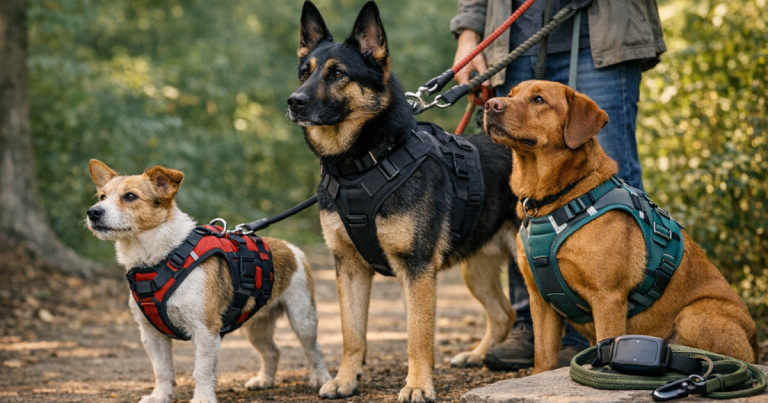
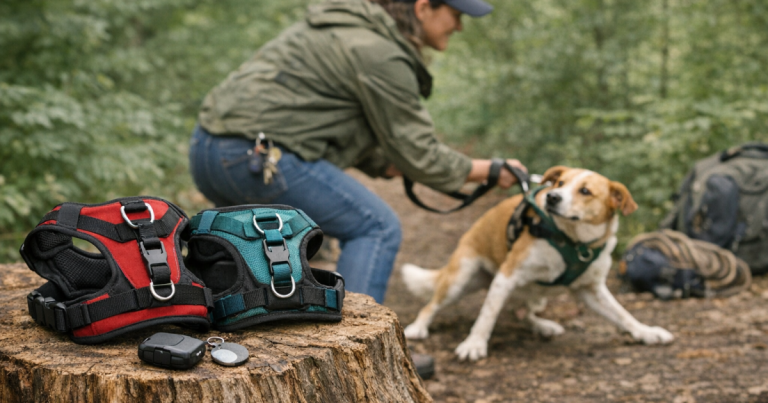
If your dog has already escaped more than once, think in layers. A collar gives you an attachment point for ID and leash control. A harness adds body security. A GPS tracker or tag adds recovery support if prevention fails. For dogs who have learned to reverse out of gear, the safest routine usually includes both escape-resistant equipment and rehearsed handling skills.
The collar styles that work best for slip-out dogs
Fabric martingale collars
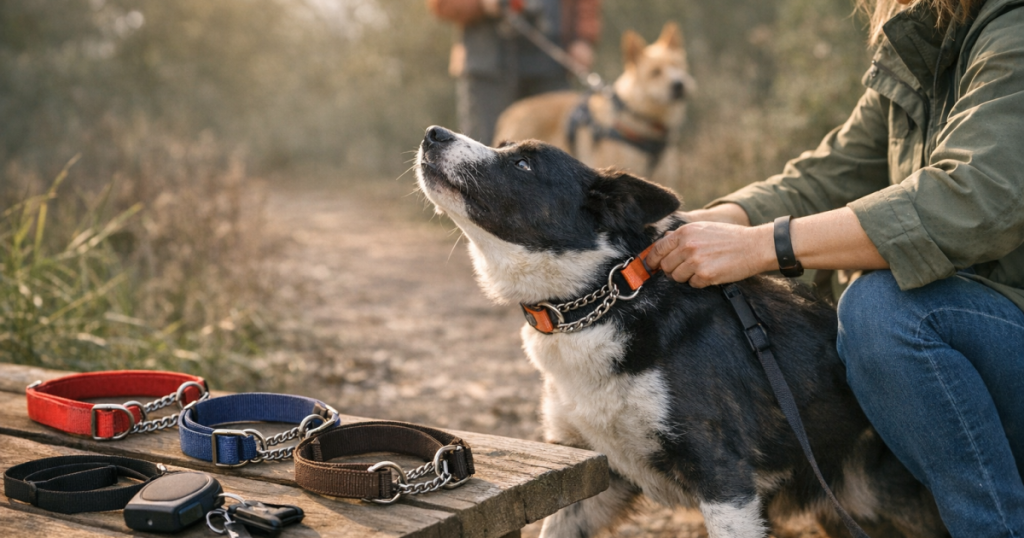
A fabric martingale is the simplest version: a collar body plus a smaller control loop. It is quiet, familiar, and easy for many dogs to accept. The main fit issue is adjustment. The collar must be loose enough to relax comfortably, but not so loose that the tightened position still clears the head.
Fabric martingales are a sensible starting point for daily neighborhood walks, dogs who dislike chain sounds, and owners who want a low-drama training aid. They still require supervision, because any limited-slip collar can catch on objects if left on during play or crate time.
Chain-loop martingale collars
A chain-loop martingale uses chain for the tightening loop. Some handlers like the clear movement and sound of the chain because it gives immediate feedback when leash tension changes. Other dogs find that sound worrying. If your dog is noise-sensitive, recently adopted, or already anxious outdoors, a fabric loop may be kinder and easier to train with.
Buckle martingales versus slip-on martingales
Slip-on martingales go over the dog’s head, so they must be adjusted with care. Buckle martingales open and close like a standard collar, which can be easier for dogs who dislike gear passing over their ears. The buckle does not remove the need for correct fit; it simply changes how you put the collar on.
Strong real-world examples to compare
These are recognizable martingale collar examples, not universal answers. The right choice depends on your dog’s neck shape, coat, sensitivity, handling routine, and whether you need a buckle-style design. Always verify the current size chart and construction details before relying on any collar for an escape-prone dog.
- PetSafe Martingale Collar: A straightforward limited-slip option for owners who want a simple martingale for supervised leash walking. It is best treated as a fit-first collar rather than a training shortcut.
- Ruffwear Web Reaction Collar: A martingale-style collar to consider for outdoor routines where leash manners, visibility gear, and backup equipment are part of the same safety system. Check the neck measurement carefully, especially on coated dogs.
- Blueberry Pet Essentials Solid Color Martingale Dog Collar: A common everyday martingale style for dogs who need limited-slip security without moving to more complex gear. Confirm whether the exact version you choose matches your preferred closure style.
- Max and Neo Stainless Steel Chain Martingale Collar: A chain-loop martingale example for handlers who prefer more obvious leash feedback. It may not be the calmest choice for dogs who startle at metallic movement or sound.
For a dog who has slipped a collar in a parking lot or campground before, the collar is only one part of the decision. A secure harness connection can buy you time if one attachment point fails. The site’s guide to collar-and-harness setups for dogs who back out is a useful next step if your dog needs more than a collar alone.
How to fit a martingale without making it too tight
Start indoors when your dog is calm. Put the martingale high enough on the neck that it cannot slide loosely over the shoulders, but not so high that it presses into the throat when relaxed. Attach the leash, gently draw the control loop closed, and look at the hardware. The collar should tighten enough to stop escape, but the two sides of the collar should not close completely into a choking loop.
A practical check is to test both states: relaxed and tightened. Relaxed, the collar should sit comfortably and allow normal movement. Tightened, it should prevent the collar from passing over the widest part of the head. If it can still slip over the ears when tightened, it is too loose or the wrong shape. If it stays tight after the leash slackens, it is adjusted poorly, twisted, or not moving freely.
Coat matters. On a thick-coated dog, a collar can look snug while the strap is actually sitting on top of dense fur. Part the coat with your fingers, settle the collar against the neck, then recheck after a few minutes of movement. If your dog also wears a GPS unit, the same coat problem can affect tracker stability; the guide to fitting a GPS collar on a thick-coated dog explains why placement and contact matter.
Step-by-step: turning the collar into a safer walking routine
1. Practice before the stressful place
Do not make the first test a crowded trailhead, vet parking lot, fireworks weekend, or busy sidewalk. Start in a fenced yard, hallway, or quiet driveway. Clip the leash to the martingale, let your dog move naturally, and reward soft turns toward you. The goal is not to let the dog hit the end of the leash repeatedly; it is to show them that leash pressure predicts guidance and release.
2. Add a harness backup for escape-prone moments
For dogs with a real escape history, use a second connection point. Many owners use one leash with two clips, or a primary leash on the harness and a short safety connector to the collar. This reduces the chance that a single equipment failure or fit mistake becomes a lost-dog event.
3. Teach a calm reset cue
Pick a simple cue such as “this way” or “with me.” Practice it when your dog is not scared. Turn your shoulders, move a few steps away from the trigger, and reward the dog for following. This matters because many collar escapes start when the handler keeps pulling forward while the dog is trying to retreat. A reset cue gives you a practiced way to reduce tension before the backing-out sequence begins.
4. Rehearse the places where escapes happen
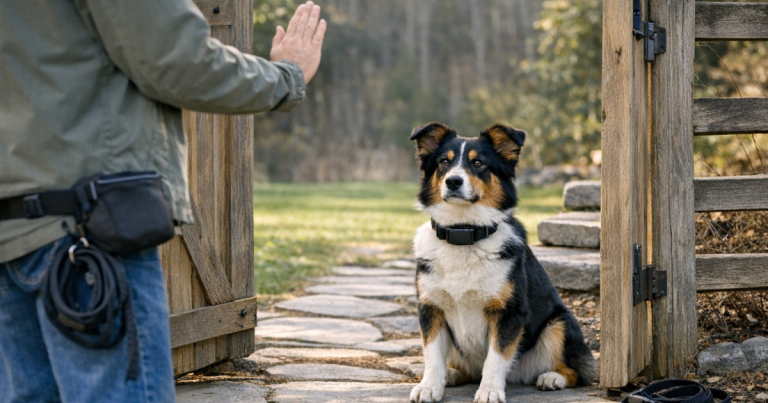
Dogs often back out at thresholds: front doors, car doors, trailhead kiosks, campground check-in areas, outdoor cafes, and vet entrances. Pause before these spots. Shorten your leash without lifting upward, position your dog beside you rather than out in front, and move through the transition calmly. If your dog freezes, turn away and reset instead of dragging them through.
5. Check the collar every few walks
Martingales can loosen with wear, coat changes, bathing, and seasonal weight shifts. Recheck fit after grooming, after switching leashes, and before travel. If the control loop twists, the collar rides low, or the tightened position no longer stops the collar at the head, adjust it before the next outing.
Common mistakes that make martingales less safe
- Using it as an all-day collar: A martingale is for supervised leash use. Remove it when your dog is loose at home, crated, roughhousing, or unsupervised.
- Fitting it like a flat collar: A martingale has two important positions, relaxed and tightened. Both need to be checked.
- Pulling upward during panic: Upward leash tension can increase fear and pressure on the neck. Create distance and reset instead.
- Skipping ID and recovery tools: Even excellent equipment can be misfitted, unclipped, chewed, or defeated by panic. Keep ID tags current and consider a tracking plan for higher-risk dogs.
- Ignoring the harness: A dog who has escaped once deserves redundancy, especially around traffic, travel, and unfenced outdoor spaces.
Where GPS tracking fits into the plan
A GPS tracker does not make a collar escape harmless. It can help you respond faster if your dog gets loose, but it depends on fit, power, coverage, and the behavior of a frightened dog. Treat tracking as recovery support, not permission to take more risk with equipment.
Once your leash setup is stable, run a calm test at home. Walk your dog around the yard, check how the tracker sits with the collar or harness, and confirm that your recovery routine makes sense before you need it. A simple backyard GPS tracker accuracy check can reveal fit and workflow problems while your dog is still safely contained.
Common questions
Are martingale collars humane for dogs who slip out?
A properly fitted martingale used for supervised leash walking can be a humane safety tool because it limits how far the collar tightens. It becomes risky when it is left on unsupervised, adjusted too tightly, used to drag a fearful dog, or treated as a replacement for training.
Can a dog still escape from a martingale?
Yes. A martingale can still fail if it is the wrong size, adjusted too loosely, clipped incorrectly, damaged, or used during a high-panic situation. Dogs with a history of slipping gear should also wear a secure harness backup in risky environments.
Should the leash clip to the collar or harness?
For routine training in a controlled area, some handlers clip to the martingale to practice gentle leash communication. For higher-risk environments, many escape-prone dogs are safer with a harness as the primary attachment and the martingale as a backup point, or with a dual-clip leash system.
Is a martingale enough for hiking or camping?
Usually not by itself. Hiking and camping add wildlife, unfamiliar noise, car doors, loose dogs, and low-light handling. Use a secure harness, visible gear, updated ID, and a recovery plan alongside the martingale.
What stands out
The best martingale collar for a dog who slips out is the one that fits correctly, releases instantly when the leash relaxes, and supports calmer training instead of adding fear. Fabric martingales are often the easiest starting point, buckle versions can help dogs who dislike over-the-head gear, and chain-loop versions suit some handlers but not every dog temperament.
For serious escape artists, think beyond the collar. Pair the martingale with a harness backup, rehearse calm resets, test your gear before travel, and keep recovery tools ready. The goal is not just to stop one dramatic backward move. It is to build a walking routine where your dog feels guided, your equipment has redundancy, and a small mistake does not turn into a lost-pet emergency.