A dog who has learned the backward twist can make an ordinary sidewalk feel like a magic act with traffic. For many escape-prone dogs, buckle martingale collars offer a calmer way to keep leash pressure from turning into a loose collar on the pavement.
At a glance
The best martingale collars for escape-prone dogs in 2026 are adjustable, correctly fitted, easy to open with a buckle, and limited enough that they tighten only to the dog’s neck size rather than choking. A good one is not a replacement for training, supervision, ID tags, or a GPS tracker, but it can be an important layer in a lost-dog prevention setup.
- PetSafe Martingale Collar with Quick Snap Buckle: a sensible everyday choice for owners who want a familiar, no-drama buckle design and a traditional martingale shape.
- Country Brook Petz Martingale Dog Collar with Buckle: a good option to evaluate when you want a broad collar-style selection and a buckle closure instead of sliding the collar over the dog’s head.
- Mighty Paw Martingale Collar 2.0: worth considering for handlers who prefer a training-oriented martingale design for controlled leash walks.
How a buckle martingale helps a dog who backs out
A standard flat collar keeps the same opening all the time. If a dog plants their front feet, drops their head, and pulls backward, that fixed opening can slide over the ears. A martingale collar has a limited-control loop that closes when leash tension appears, reducing the gap just long enough to stop the collar from slipping off.
The buckle matters because many dogs who need martingales are also sensitive about gear going over their head. A side-release or quick-snap buckle lets you open the collar, place it around the neck, and close it without turning the start of every walk into a wrestling match.
Use a martingale for supervised leash walks, training sessions, potty breaks, and transitions from house to car. Do not leave a martingale on for crate time, rough play, tie-outs, or unsupervised yard time, because any collar with a control loop can snag or tighten in the wrong situation.
Step 1: Measure the dog, not the old collar
Start with a soft tape measure and measure around the middle of your dog’s neck in inches, where the collar will normally sit. Then measure the widest part of the head if the collar also needs to pass over it during fitting. Even with a buckle, the collar still needs enough adjustment range to sit correctly on the neck.
For long-necked dogs, narrow-headed dogs, and dogs with thick coats, coat compression matters. Measure when the dog is standing naturally, then check the fit again after a few minutes of movement. A collar that seems snug in the kitchen can shift once the dog lowers their head to sniff or startles at a truck.
Step 2: Set the collar before the first walk
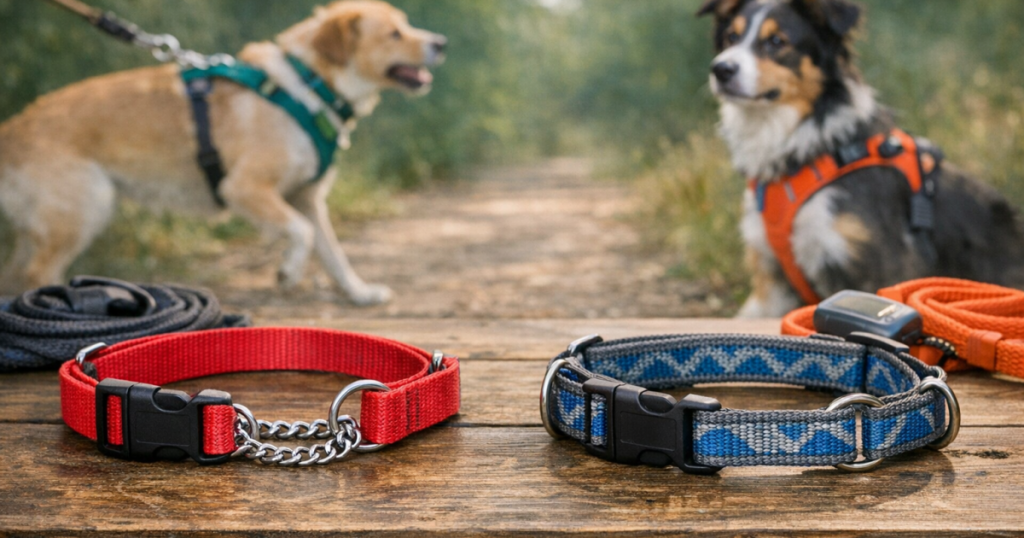
Clip the leash to the martingale ring and gently pull upward until the control loop closes. The two metal or fabric slides on the main collar should not meet completely. If they touch, the collar may continue tightening beyond the intended limit and needs adjustment.
When tension is off, you should be able to slide two fingers comfortably under the collar. When tension is on, the collar should narrow enough that it cannot pass over the ears. That is the whole job: secure under pressure, comfortable when relaxed.
If your dog has already slipped gear more than once, practice the fit test inside a fenced area or closed room first. Clip the leash, let the dog move around, then gently guide them backward and sideways. You are not trying to scare them; you are checking whether the collar shifts toward the skull or stays where it belongs.
Step 3: Match the collar to the escape pattern
The sidewalk backer-upper
This dog reverses when a bus hisses, a stranger bends down, or another dog appears. A buckle martingale can help keep leash pressure from becoming a collar escape, but your handling matters just as much. Keep the leash angle low and relaxed when possible, and avoid steady pulling that teaches the dog to brace harder.
The doorway and car-exit dasher
For dogs who explode through openings, a martingale collar should be paired with a second point of control such as a well-fitted harness during high-risk transitions. If the car door opens before the leash is ready, the collar alone may not buy you enough time. Dogs who bolt at stops may also need a restraint routine before anyone unclips the leash.
The collar Houdini with a narrow head
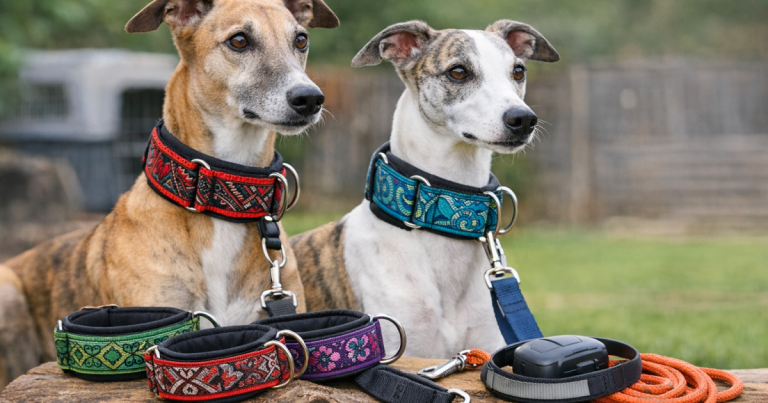
Greyhound-type builds, young dogs in lanky growth stages, and some mixed breeds can have neck-to-head proportions that make flat collars unreliable. A martingale is often the better collar style for supervised walks, but the fit must be precise. Too loose, and it behaves like an ordinary collar; too tight, and it becomes uncomfortable.
If backing out is part of a bigger training issue, pair the collar decision with training-collar features that help dogs who back out so the gear supports a safer routine instead of masking the behavior.
Where the 2026 picks fit best
The PetSafe Martingale Collar with Quick Snap Buckle is the easy starting point for many households because it keeps the concept simple: a buckle closure, an adjustable collar, and a limited-slip design. It is the one to look at first if you want a familiar walk collar rather than a more specialized training setup.
The Country Brook Petz Martingale Dog Collar with Buckle is useful for owners who care about getting the right collar style without giving up everyday wearability during supervised walks. As with any patterned or fabric collar, prioritize correct sizing and hardware position over looks. A pretty collar that rotates into the wrong place is not doing the job.
The Mighty Paw Martingale Collar 2.0 is the pick to consider when your main use is structured leash work: neighborhood walks, controlled practice around triggers, and sessions where you are actively handling the leash. It should still be fitted as a limited-slip collar, not used as a shortcut for force.
Across all three, verify the current manufacturer sizing chart before ordering, because collar names and size ranges can change. Measure in inches, check the return policy, and do not assume your dog’s size in one brand transfers neatly to another.
Step 4: Build the collar into a recovery plan
A secure collar reduces one failure point; it does not make a dog unlosable. For escape-prone dogs, the safest setup is layered: a well-fitted walking collar, a harness when the situation calls for it, visible ID, and a tracker plan that has been tested before you need it.
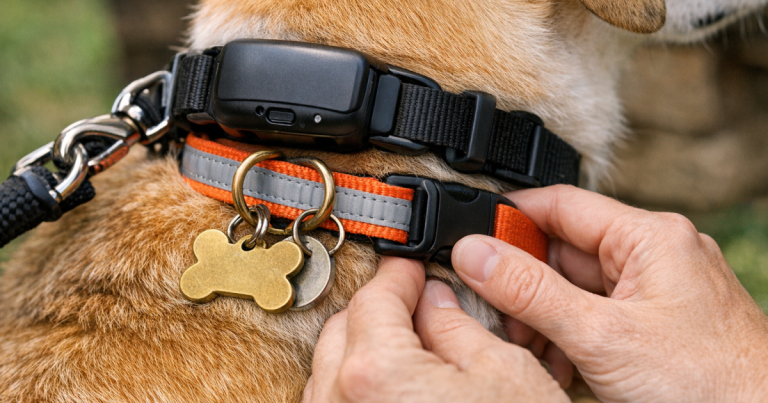
If you move a GPS device from one collar to another, take a few minutes to calibrate a dog GPS tracker after switching collars. The device should sit securely, avoid rubbing, and stay positioned so it can perform as intended during normal movement.
Also, do not let the tracker become the only identification on the dog. Batteries die, collars come off, and helpful neighbors still need a fast way to call you. A simple engraved tag remains one of the most useful backups; here is how to back up a GPS collar with physical ID tags.
Fit checks before you trust the collar outside
- Close the buckle and tug each side gently to confirm it is fully latched before leaving the house.
- Pull the leash until the martingale loop closes; the main collar should stop tightening before it becomes harsh.
- Check whether the collar can slide over the ears when the dog lowers their head.
- Watch for rubbing, coughing, gagging, or repeated pawing at the collar, and stop using that setup if it appears uncomfortable.
- Recheck fit after grooming, weight changes, coat changes, or growth spurts.
- Remove the collar during unsupervised rest, crate time, and rough play with other dogs.
What people usually ask
Are martingale collars safe for escape-prone dogs?
They can be safe for supervised leash use when correctly fitted as limited-slip collars. They are not safe for tie-outs, unsupervised wear, or any situation where the control loop could catch on something.
Is a buckle martingale better than a slip-on martingale?
For many household dogs, the buckle is simply easier. It lets you open the collar instead of passing it over the head, which can be helpful for nervous dogs, dogs with large heads, and owners who remove the collar after each walk.
Should an escape-prone dog wear both a harness and martingale?
In higher-risk moments, yes, many owners use both: the harness for body control and the martingale as a collar backup. The leash setup should be simple enough that you can manage it calmly, especially near roads, trailheads, parking lots, and open doors.
Practical takeaway
The right buckle martingale is the one that fits your dog’s actual escape move: backward slipping, startle lunging, narrow-head sliding, or door-dashing. Choose a real limited-slip design, set it carefully, test it indoors, and treat it as one layer in a broader recovery plan. For an escape-prone dog, that quiet extra layer can be the difference between a startled shuffle and a missing-dog search.