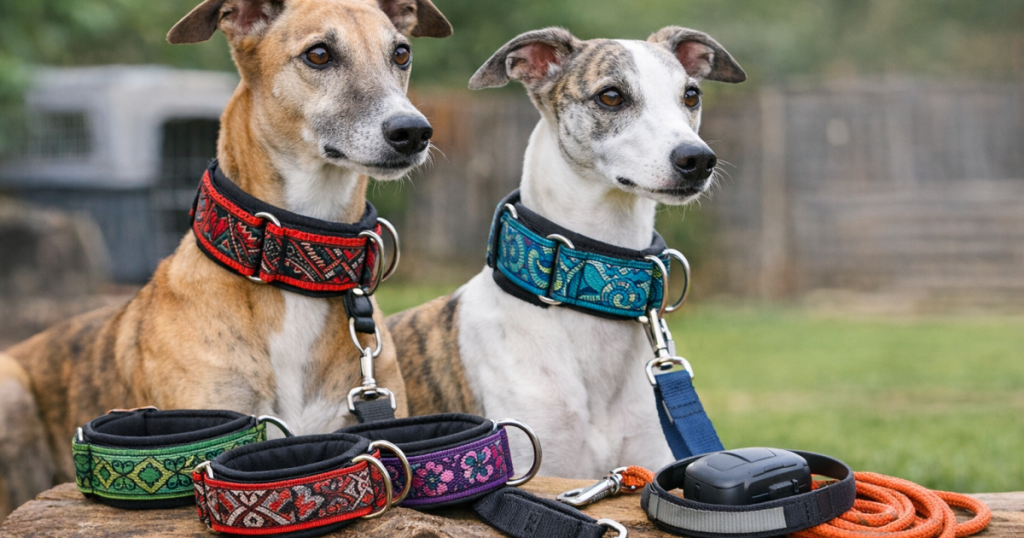
Greyhounds and Whippets can make an ordinary flat collar look loose even when it seemed right five minutes ago. Their narrow heads, long necks, and sudden reverse gear are exactly why wide martingale collars remain a sensible everyday tool for escape-prone sighthounds in 2026: they tighten only to a set limit, spread pressure over more neck area, and give you a few extra seconds to keep the leash under control.
The short answer for 2026
The best martingale collar for a Greyhound or Whippet is a well-fitted, limited-slip collar with a broad neck band, smooth edges, strong hardware, and an adjustment range that lets the control loop close before the collar becomes tight enough to choke. It should sit high on the neck during leash use, relax when the leash is slack, and never be left on unsupervised if the dog could snag it.
For most sighthound owners, the strongest shortlist starts with 2 Hounds Design Wide Martingale Collar, If It Barks Wide Martingale Collar, and Houndstown Wide Martingale Collar. Each is worth considering because the maker is closely associated with martingale-style collars and offers sighthound-friendly formats, but you should still confirm current sizing, width, material, and closure details before ordering.
How a martingale prevents the classic sighthound slip
A standard collar depends on the dog’s head being wider than the neck. That logic breaks down with Greyhounds and Whippets. When a dog plants their feet, ducks their head, and backs up, a loose flat collar can slide forward and over the ears before the handler has time to react.
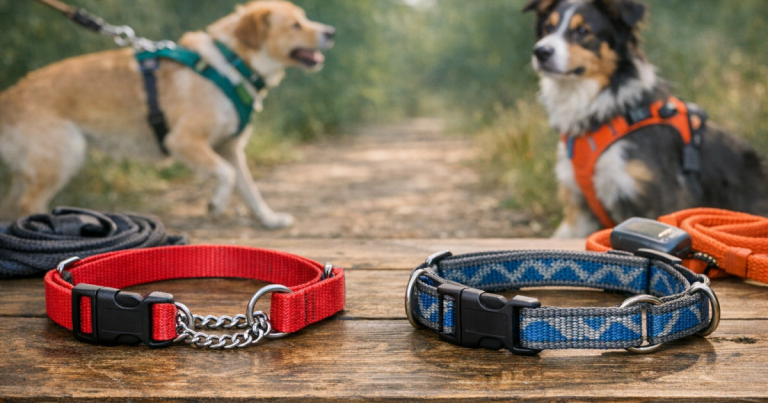
A martingale has two parts: the main collar loop and a smaller control loop. When the leash is loose, the collar relaxes. When the dog pulls backward or forward, the control loop shortens the main loop to a preset limit. The goal is not correction or punishment; it is controlled reduction in slack so the collar cannot simply peel off over the skull.
Width matters because sighthounds have long, delicate-looking necks and little extra coat padding. A broader collar spreads leash pressure across more surface area than a narrow strap. That does not make it automatically safe, but it does make fit quality more forgiving when the dog startles at a truck, squirrel, skateboard, or strange gate clang.
Three collars to put on your shortlist
2 Hounds Design Wide Martingale Collar
The 2 Hounds Design option is a strong starting point for owners who want a traditional fabric martingale from a brand many sighthound people already recognize. It is a good candidate when your priority is an everyday walking collar that looks like a normal collar but gives you limited-slip control during those awkward backing-out moments.
Check the current size chart carefully rather than buying by breed name. A small female Whippet and a large retired racing Greyhound are not close enough in neck size for breed labels to do the work. Measure the neck where the collar will sit, then measure around the widest part of the head so you know the collar can go on and still be adjusted securely.
If It Barks Wide Martingale Collar
If It Barks is worth a look when fit precision is your main concern. Martingales are only as good as their adjustment range, and dogs with very narrow heads can fall between generic sizes. For a deep-chested, slim-necked dog, a collar that adjusts cleanly without leaving a long loose tail can make daily walks easier.
This is the sort of collar to consider for a Whippet who slips ordinary collars but finds bulky gear annoying. Confirm the width, closure style, and whether the collar is intended to slip over the head or open with a buckle, because those details affect both handling and escape resistance.
Houndstown Wide Martingale Collar
Houndstown belongs on the list because it is sighthound-focused rather than simply offering martingales as one small part of a general collar catalog. That can be useful if you are fitting a long-necked dog and want a collar style that starts from the realities of Greyhound and Whippet anatomy.
It may be a particularly sensible place to look for a retired racing Greyhound, a foster dog still learning neighborhood walks, or a dog whose old collar worked in the house but failed outdoors. As with any collar, the important test is not the product photo. It is how the collar behaves when your dog turns, lowers their head, and backs up gently under controlled conditions.
Fit it before the first real walk
Do not discover the fit on a busy sidewalk. Set the collar at home first, then test it in a fenced yard or quiet room with a leash attached. When the control loop is fully tightened, the two metal rings should come closer together but not meet with extra tightening left over. If the rings touch and the collar is still loose enough to slide over the ears, the collar is too large or adjusted incorrectly.
Use these checks before relying on the collar outdoors:
- Relaxed fit: With no leash tension, the collar should sit comfortably without gaping far down the neck.
- Limited-slip stop: Under leash tension, it should tighten enough to prevent escape, then stop.
- Head check: Gently test whether the collar can pass over the ears when tightened to its limit.
- Skin and coat check: Look for rubbing, hair breakage, or redness after short walks.
- Hardware check: Inspect rings, stitching, and adjustment points regularly, especially after wet walks or rough play.
If your dog has a history of neck injury, breathing trouble, collapsing episodes, or pain around the throat, talk with your veterinarian before relying on any neck-worn walking gear. A harness-based setup may be more appropriate for some dogs.
When a collar alone is not enough
A martingale is a useful anti-slip tool, not a complete lost-dog plan. The riskiest dogs are often the ones who freeze, twist, and backpedal when startled. In that scenario, even good equipment can fail if the handler has only one attachment point and no recovery backup.
For nervous sighthounds, consider pairing the collar with an escape-resistant harness and a secondary leash connection. A backup connection gives you redundancy if one piece of gear shifts or a clip opens at the wrong moment. The setup should be tidy, not tangled; the goal is controlled backup, not a leash spaghetti dinner.
For step-by-step leash redundancy, see our guide to backup leash attachments for dogs that back out of collars. If you are deciding whether a martingale, slip lead, or training-style collar is appropriate for your dog’s behavior, our training collar safety guide explains the trade-offs in plain terms.
Using a martingale with ID and tracking gear
Many owners want the martingale to do every job: leash control, ID, GPS tracker mount, and style statement. That is tempting, but it can overload the one collar your dog most needs to function cleanly. For sighthounds, it is often better to separate jobs.
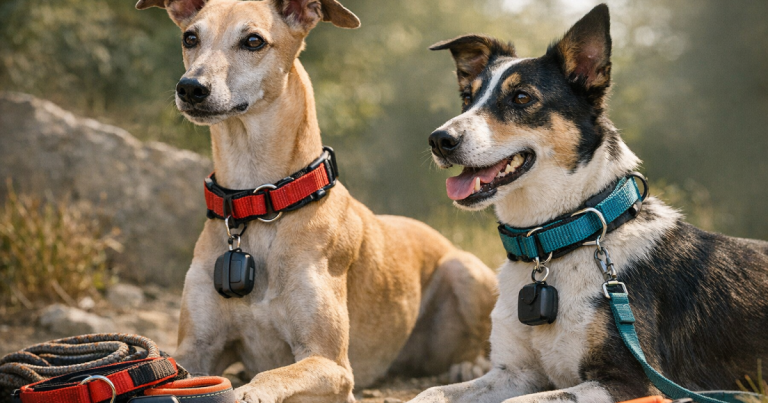
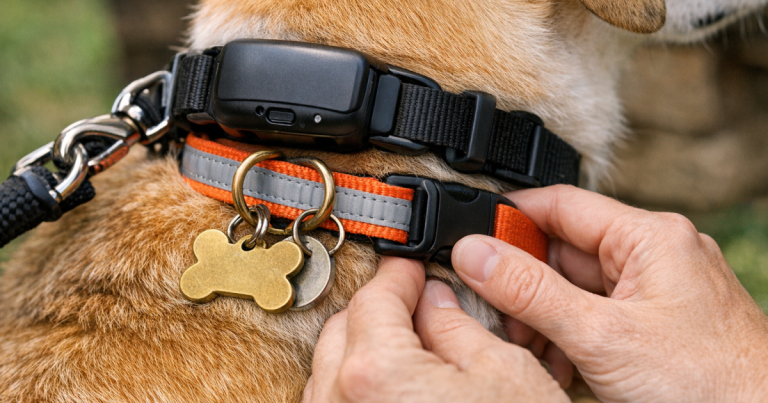
Use the martingale as the leash-control collar during supervised walks. Use a separate flat ID collar if your dog tolerates one, or attach ID in a way that does not interfere with the martingale’s control loop. If your dog wears a GPS tracker, check that the tracker’s weight and position do not pull the collar off-center or keep the martingale partly tightened when the leash is slack.
A GPS tracker can help you respond faster after an escape, but it does not replace collar fit, ID tags, recall practice, or careful leash handling. Batteries, coverage, attachment strength, and finder cooperation all matter. For a calmer layered setup, read how to fit a backup ID collar alongside a tracker without crowding your dog’s neck.
Common fitting mistakes to avoid
- Buying too large for comfort: A roomy martingale feels kind, but it can still slip over a narrow head.
- Leaving it tightened all day: A martingale is for supervised use. Remove it or switch collars when appropriate.
- Clipping tags to the control loop: Extra weight can affect how the loop moves and relaxes.
- Assuming all wide collars fit the same: Band shape, stiffness, lining, and adjustment range change how the collar feels.
- Skipping practice: Let your dog wear the collar briefly indoors before asking them to handle a noisy street.
In brief
The best wide martingale collars for Greyhounds and Whippets in 2026 are not chosen by appearance alone. Start with a sighthound-appropriate width, measure the dog rather than guessing by breed, and confirm that the limited-slip action stops at the right point. 2 Hounds Design, If It Barks, and Houndstown are sensible names to shortlist, provided the current size and construction match your dog.
For escape-prone sighthounds, the safest routine is layered: a correctly fitted martingale for supervised leash control, a backup attachment for high-risk outings, visible ID, and a tracker when it fits comfortably. The collar buys you time; the full system helps bring your dog home if that one frightening moment still happens.