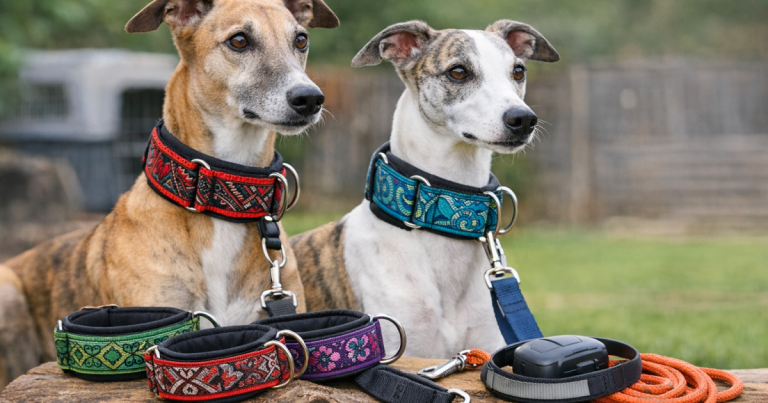
A narrow-headed dog does not need a tighter collar; they need a collar that changes shape when they back up. For most Greyhounds, Whippets, Italian Greyhounds, Salukis, and other slim-headed dogs, the best no-slip dog collars are properly fitted martingale or limited-slip collars used with calm leash handling and backup identification.
No collar is escape-proof. The right one reduces the classic backward slip, but it still has to fit the dog in front of you: neck size, coat thickness, confidence level, walking environment, and how hard they panic when startled.
At a glance
- Most narrow-headed dogs: choose a fabric martingale that tightens only to a preset limit.
- Dogs who hate collars pulled over the ears: choose a buckle martingale, then fit it with the same escape-gap test.
- Strong, alert walkers: a limited-slip collar with a responsive leash connection may feel clearer, but it is not a substitute for training.
- Flight-risk dogs: use the collar with a well-fitted harness, ID tag, and recovery plan. The collar is one layer, not the whole fence.
The 2026 picks that make sense for narrow heads
These collars are not ranked as magic fixes. They are useful examples of the collar styles that usually work better than a standard flat collar on a dog whose head is close to the same width as the neck.
1. Ruffwear Chain Reaction Collar
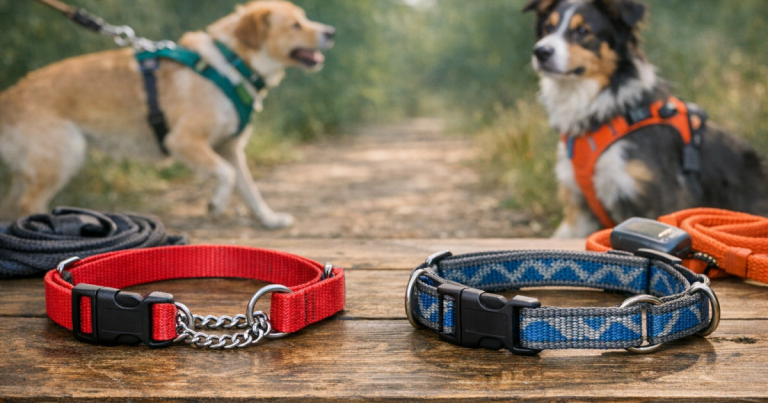
Ruffwear Chain Reaction Collar is a good example of a limited-slip collar for owners who want a familiar everyday-collar feel with a martingale-style action. It is best suited to dogs who walk on leash regularly and need help preventing the backward slide without wearing a bulky collar all day.
The trade-off is feel. Chain-style limited-slip sections can give clearer feedback through the leash, but they are less forgiving in careless hands than a soft fabric loop. If your dog startles, freezes, or spins, your leash handling matters as much as the collar.
2. LupinePet Originals Martingale Collar
LupinePet Originals Martingale Collar represents the simple fabric martingale category many narrow-headed dogs do well in. It is the calmer choice for a dog whose main trick is backing out of a flat collar at the front door, by the car, or during a sidewalk hesitation.
This style is easiest to understand: the collar sits loose when your dog is relaxed, then the control loop shortens when tension appears. The fit still has to be checked carefully. Too loose, and the dog can reverse out. Too tight, and you have simply made an uncomfortable collar with a fancier name.
3. Max and Neo Nylon Martingale Collar
Max and Neo Nylon Martingale Collar is another straightforward martingale option for owners who want a plain no-slip walking collar without turning every outing into an equipment project. It belongs in the same practical lane: useful for slim heads, not a cure for panic, poor leash habits, or an unfenced yard.
Choose this type when your dog needs a limited-slip collar for ordinary leash walks and you are willing to do the fitting checks every time the collar is adjusted, washed, or moved between dogs.
Step 1: Decide whether your dog needs a martingale, not just a smaller collar
The common mistake is tightening a flat collar until two fingers barely fit. That may stop some slipping, but it can also rub the throat, irritate the skin, and make nervous dogs fight the gear even harder. A narrow-headed dog can still escape a tight flat collar if the head shape allows it.
A martingale works differently. It has a fixed collar section and a smaller control loop. When the leash tightens, the loop closes to a set point, reducing the gap that lets the head slide through. When the leash relaxes, the collar loosens again. That limited movement is the whole point.
If you want a deeper look at buckle designs for dogs that slip gear, our guide to buckle martingale collars for escape-prone dogs explains when a buckle is easier than a collar that slips over the head.
Step 2: Fit the collar while your dog is calm
Do the first fitting indoors, away from the door, driveway, other dogs, and the squirrel who has apparently signed a lease in your yard. Your goal is to fit the collar before excitement changes your dog’s posture.
- Place the collar high enough to test it, then let it settle naturally. Do not fit it only when it is bunched up behind the ears.
- Adjust the main loop so it rests comfortably when relaxed. It should not hang like a necklace or press constantly into the throat.
- Pull the leash ring until the martingale loop closes. At full closure, the two metal or fabric adjustment points should not smash together unless the maker’s instructions say that is correct for that design.
- Check the escape gap behind the ears. Try to slide the collar forward over the narrowest part of the head. It should resist without requiring force.
- Watch your dog’s reaction. Coughing, pawing, frantic twisting, or refusal to move means the setup needs to be reassessed.
Step 3: Test the exact escape move your dog uses
Most slim-headed escape attempts are not dramatic leaps. They are quiet geometry. The dog plants their front feet, drops their head, and moves backward while the owner keeps tension on the leash. A flat collar turns into a ramp.
To test safely, stand indoors or in a fenced area with a second person nearby. Clip the leash to the collar. Let your dog face you, then apply gentle, steady leash tension while they step backward. Do not jerk the leash or frighten the dog. You are checking fit, not staging a rodeo.
If the collar slides toward the ears and keeps going, tighten the martingale within the manufacturer’s fitting range or choose a different size. If the collar closes hard against the throat before it controls the slip, the size or style is wrong for that dog.
Step 4: Pair the collar with a harness when the risk is real
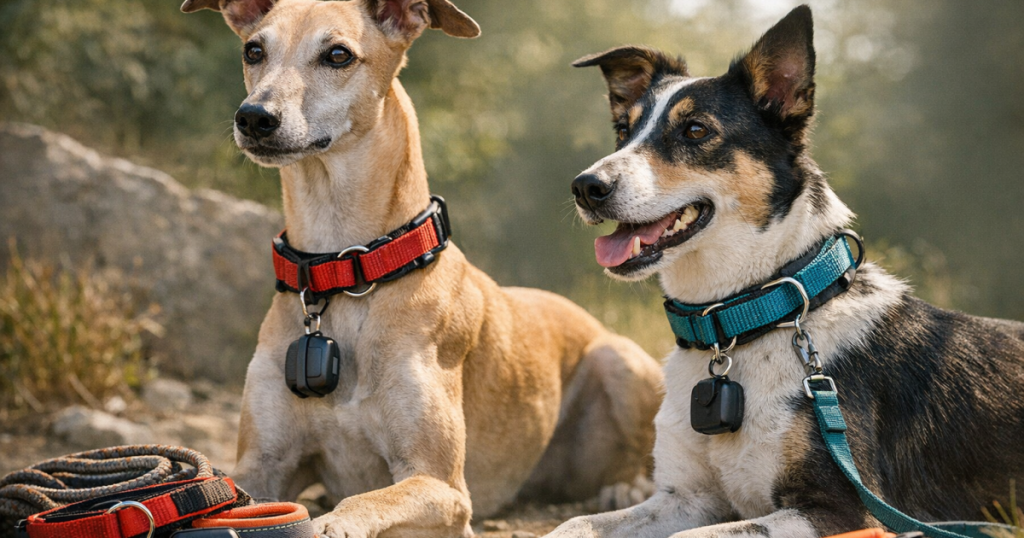
For a dog with a known escape history, a martingale collar should usually be paired with a secure harness and a backup connection. A short safety strap can connect the harness to the collar so one piece of gear has a second chance if the other shifts.
This is especially important for newly adopted sighthounds, dogs fresh from transport, fearful rescues, dogs visiting busy places, and any dog who has slipped gear before. Before a walk, run a separate harness escape-gap check instead of assuming the harness is secure because it looked fine last week.
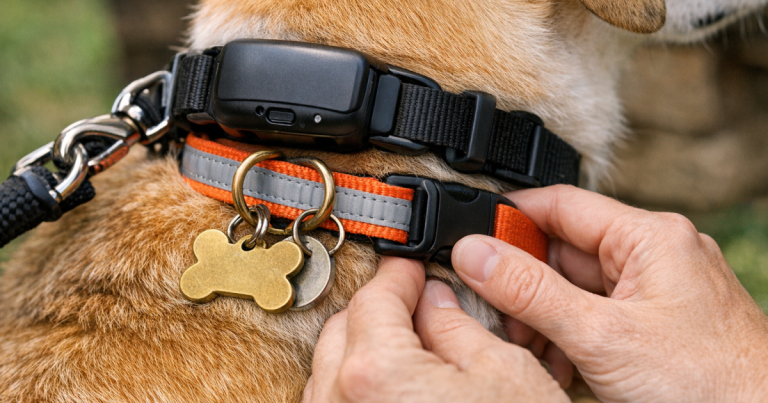
For tracking-minded owners, collar fit also affects recovery gear. A GPS tracker, ID tag, or light is only useful if it stays attached to the dog. Keep the collar comfortable enough for routine wear, but do not load a narrow neck with heavy accessories that make the collar rotate, sag, or rub.
Step 5: Match the collar to the walking scenario
- Neighborhood walks: a soft martingale is usually enough if the dog’s main risk is backing out during hesitation.
- Busy sidewalks and parking lots: use a martingale plus harness backup. Cars, carts, air brakes, and automatic doors can trigger sudden reverse pulls.
- Hiking and trailheads: use collar identification, a fitted harness, and a leash system you can manage with gloves or cold hands.
- Car exits: clip the leash before the door opens. A perfect collar does not help if the dog launches from the back seat unclipped.
- Training sessions: avoid relying on collar pressure alone. Dogs who have learned to back out need calm handling, reward timing, and controlled exposure to triggers.
If your dog backs out during training, the collar is only part of the setup. Our page on training collar features that help dogs who back out covers the handling side in more detail.
Common fitting mistakes that cause escapes
- Buying by weight instead of neck measurement. Two dogs of the same weight can have very different neck and head shapes.
- Leaving the control loop too large. A martingale cannot help if it never closes enough to reduce the escape gap.
- Using a martingale for unsupervised tie-out. Limited-slip collars are walking tools, not unattended restraint gear.
- Ignoring coat changes. A fresh groom, seasonal coat loss, or wet fur can change the fit more than owners expect.
- Clipping tags where they interfere with the moving loop. Keep ID visible, but do not block the collar’s limited-slip action.
Things readers ask
Are martingale collars safe for narrow-headed dogs?
A properly fitted martingale can be a safer walking choice than an overtightened flat collar for many narrow-headed dogs because it tightens only to a set limit. It should not be left on for rough play, crate time, or unsupervised situations where the loop could snag.
Should a Greyhound or Whippet wear a wide collar?
Many sighthound owners prefer wider collars because they spread pressure over more of the neck. Width alone does not prevent slipping, though. The collar still needs a limited-slip design and correct adjustment.
Can a no-slip collar replace a GPS tracker?
No. A no-slip collar helps prevent one type of escape, while a tracker helps after separation has already happened. Recovery reliability depends on fit, power, signal coverage, owner response, and whether the device stays attached.
What stands out
For narrow-headed dogs in 2026, the safest answer is not the tightest collar. It is a well-fitted martingale or limited-slip collar, tested against the exact backward move your dog uses, then backed up with a harness, ID, and a sensible walking routine.
If your dog has already slipped a collar once, treat that as useful information rather than bad behavior. Measure again, test indoors, remove escape gaps, and build redundancy before the next walk. The best setup is the one that still works when your dog gets surprised.