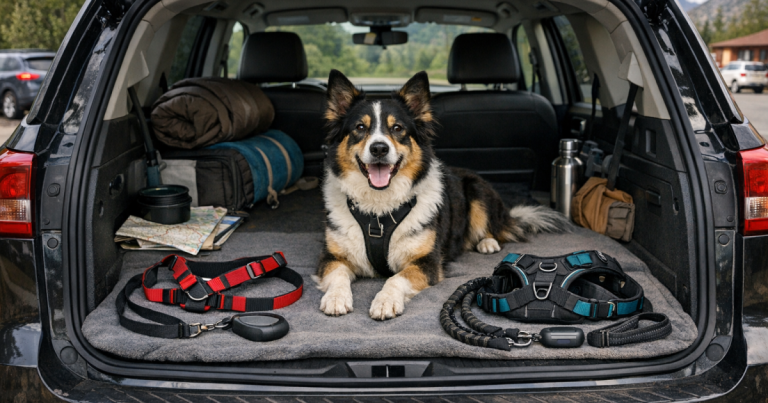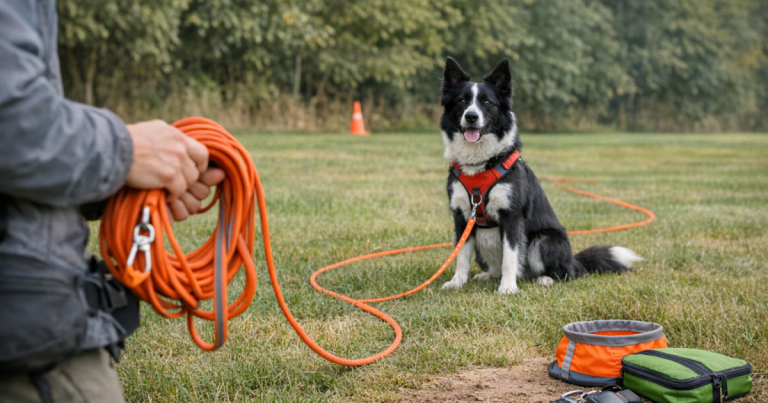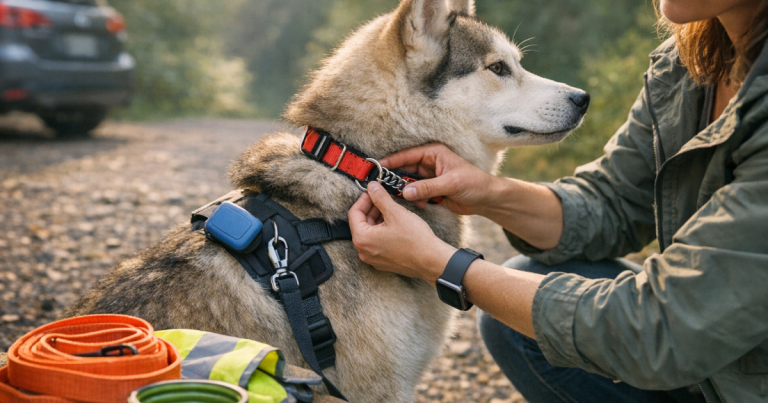
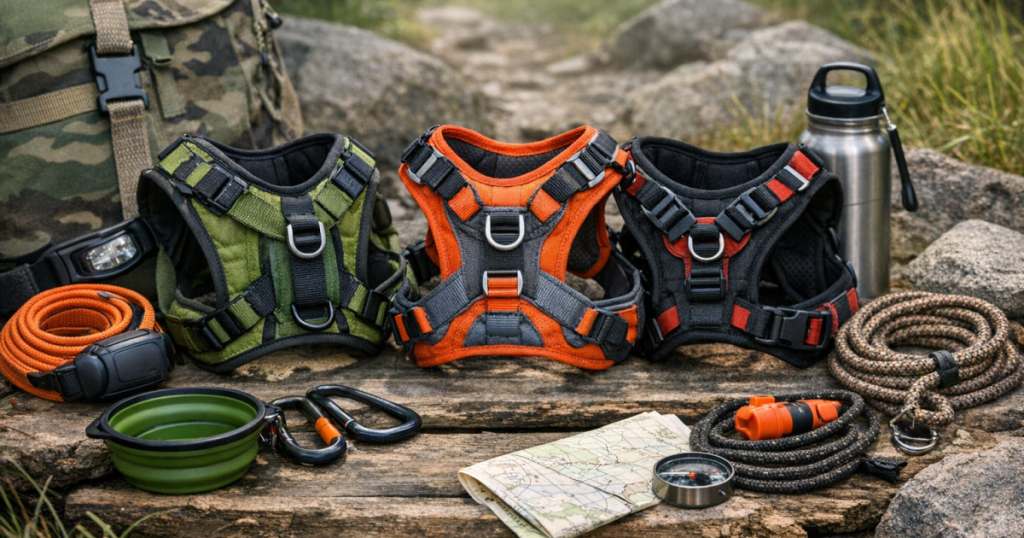
When a dog panics at a busy trailhead or twists backward during a gas-station stop, the best escape-resistant dog harnesses are not simply the toughest-looking ones. For hiking and road trips, the safer choice is usually a three-point harness: one that secures around the neck or shoulders, the main chest area, and a rear belly point behind the rib cage.
That rear strap matters because many dogs escape by backing out, dropping their shoulders, and letting a standard harness slide forward. A well-fitted three-point design creates an extra pause in that motion. It does not make a dog unlosable, but it can give you enough control to clip a leash, close a car door, or step away from a trail edge.
At a glance
For most escape-prone hiking dogs, the strongest shortlist is the Ruffwear Web Master Harness for secure everyday trail use, the Ruffwear Flagline Harness for a lighter hiking-and-travel setup, and the Rabbitgoo Escape Proof Dog Harness for owners who want a rear-belly-strap style without moving into specialty expedition gear.
- Most secure everyday trail pick: Ruffwear Web Master Harness, because its structure is built around stability, a rear belly strap, and a top handle for controlled moments.
- Best lighter trail-and-road-trip pick: Ruffwear Flagline Harness, because it keeps the multi-point security idea in a slimmer hiking-friendly shape.
- Best budget-conscious starting point: Rabbitgoo Escape Proof Dog Harness, because it offers the key three-strap escape-resistant layout many owners are looking for, though fit checking is especially important.
The real decision is less about brand loyalty and more about body shape, behavior, and where escapes happen. A narrow-chested sighthound, a barrel-chested bully mix, and a wiry adolescent shepherd can all need different adjustment habits even when the harness category is the same.
Why three-point harnesses help on hikes and road trips
A standard back-clip harness often relies on one girth strap behind the front legs. That can be fine for steady walkers, but it leaves a clear escape path for dogs who stop, plant their paws, and reverse. A three-point harness adds a second body strap farther back, usually behind the deepest part of the rib cage, making it harder for the harness to slide over the shoulders.
This design is especially useful in three common scenarios: unloading from the car, passing dogs or bikes on narrow trails, and pausing near picnic areas where smells, kids, and dropped food compete for your dog’s attention. Those are the moments when a secure harness is not just gear; it is part of your recovery-prevention plan.
Fit still does the heavy lifting. Even a well-designed harness can fail if it is too loose, sits too far forward into the armpits, rubs during a long climb, or is attached to a leash in a way that lets the dog spin out of position. If your dog travels often, pair this article with our deeper road-trip routine for choosing an escape-resistant harness for road trips.
Three standout harnesses to shortlist
Ruffwear Web Master Harness
The Web Master is the safest editorial starting point for many hiking dogs who have a history of backing out of basic harnesses. Its appeal is not flash; it is control. The longer body shape, rear strap, and top handle all support the same goal: keeping the dog connected when the environment gets exciting.
It makes the most sense for trail dogs, nervous travelers, strong pullers who need more structure, and dogs whose owners want a harness that feels purposeful rather than decorative. The trade-off is that more coverage means more surface area on the dog, so warm-weather comfort, coat type, and chafing checks matter. For deep-chested dogs, pay close attention to where the rear strap lands after ten minutes of walking, not just while standing in the living room.
Ruffwear Flagline Harness
The Flagline is the more agile-feeling choice for owners who like the security concept of a rear belly strap but want something lighter for long walks, weekend travel, and moderate hiking. It is still a multi-point harness with a handle, but it has a less bulky personality than heavier trail designs.
This is the pick I would look at first for dogs who are athletic but sensitive to heavy gear, or for road trips where the harness may be worn during repeated rest stops. The sensible caution is that lighter does not mean automatic escape-proofing. If your dog has a dramatic reverse-and-roll escape style, test the fit slowly in a fenced area before trusting it near traffic, overlooks, or a crowded campground.
Rabbitgoo Escape Proof Dog Harness
The Rabbitgoo Escape Proof Dog Harness is a practical option for owners who want the three-point idea without starting at the premium end of the hiking shelf. Its value is the layout: it gives you the neck, chest, and rear body control points that are missing from many everyday walking harnesses.
It is best treated as a fit-dependent option. Check that the webbing lies flat, the rear strap stays behind the rib cage without drifting into the soft belly, and the chest panel does not restrict shoulder movement. For occasional hikes, hotel stops, and controlled trail walks, it can be a useful step up from a simple harness. For rugged daily hiking or dogs with repeated serious escapes, prioritize structure, adjustability, and comfort over savings.
The fit test that matters more than the label
Before using any harness on open trail, run a calm home-and-yard check. Clip the leash to the harness, let your dog walk naturally for a few minutes, then watch what happens when the dog turns away from gentle leash pressure. Do not yank or scare the dog. You are looking for sliding, shoulder escape, twisting, rubbing, or the rear strap creeping forward.
- Two-finger check: You should generally be able to fit two fingers under straps, but not an entire hand. Tiny dogs and thick-coated dogs may need more careful judgment.
- Shoulder movement: The front should not pin the shoulders or force a shortened stride.
- Rear strap placement: It should sit behind the rib cage area without pressing into soft belly tissue.
- Leash angle: Test from behind, beside, and slightly in front of the dog, because escapes often happen when leash pressure comes from an awkward direction.
- Ten-minute recheck: Many harnesses look fine at first and shift once the dog starts sniffing, pulling, and climbing.
For very small dogs, weight and bulk can become the problem. A secure harness that overwhelms a 7-pound dog may create awkward movement or rubbing. For large, powerful dogs, hardware feel, strap width, and handle control deserve more attention. No harness replaces leash handling, recall work, and good judgment around triggers.
Build a safer trailhead routine
The most secure harness can still be defeated by a rushed unload. Before opening the car door, attach the leash while your dog is still inside or behind a barrier. Use a second connection if your dog has a known escape history, such as a leash clipped to the harness and a backup slip lead or collar connection during transitions.
At trailheads, avoid unclipping to “adjust for a second” unless the dog is contained. If the harness needs a reset, step back into the vehicle, use a fenced area, or have another adult hold a backup leash. The goal is to reduce the number of seconds when your dog is free, excited, and not yet under control.
A harness also belongs with identification and recovery planning. A visible ID tag, current microchip information, and a tracker can all help if the worst happens. Trackers differ sharply by network, range, and recovery usefulness, so it is worth reading how a Bluetooth tag compares with a GPS tracker for lost-dog recovery before relying on one device as your only backup.
Where escape-resistant dog harnesses are not enough
Some dogs are not just wiggly; they are flight risks. Noise-sensitive dogs, newly adopted dogs, intact adolescents, prey-driven breeds, and dogs with separation anxiety may need layered management rather than a single piece of gear. That can mean double leashing, practicing calm car exits, choosing quieter trail times, or skipping busy overlooks until your dog has more reliable coping skills.
Home routines matter too. Many trail escapes start with a dog already rehearsing door dashing or gate rushing at home. If your dog bolts through thresholds, a harness should be one layer in a wider plan that includes gates, latches, and controlled transition zones. A simple backyard dog airlock setup can reduce those everyday rehearsals before they show up on a trip.
Main lessons
The best three-point harness for an escape-prone hiking dog is the one that stays stable when your dog reverses, twists, sniffs, climbs, and gets startled. For many owners, the Ruffwear Web Master is the most reassuring starting point, the Ruffwear Flagline is the more streamlined travel-friendly choice, and the Rabbitgoo Escape Proof Dog Harness is a reasonable fit-first option for lighter use.
Whichever harness you choose, test it before the big hike. Adjust it after movement, watch your dog’s body language, and build a routine that assumes the risky moments will happen at doors, parking lots, and trail pauses. The right harness is not a magic lock. It is a few extra seconds of control when those seconds matter most.