When the leash suddenly goes light and your dog is facing you with the collar halfway over their ears, the next few seconds matter. For training collars for dogs who slip out, the safest answer is usually a correctly fitted martingale-style collar used for supervised leash work, paired with a secure harness or backup leash connection for dogs with a real escape history.
That answer is less exciting than a gadget and more useful than simply tightening a collar. The goal is not to make a collar impossible to escape at any cost. The goal is to prevent the common backward-duck move while keeping pressure controlled, predictable, and comfortable enough that your dog can still learn.
The safest answer for most collar-slipping dogs
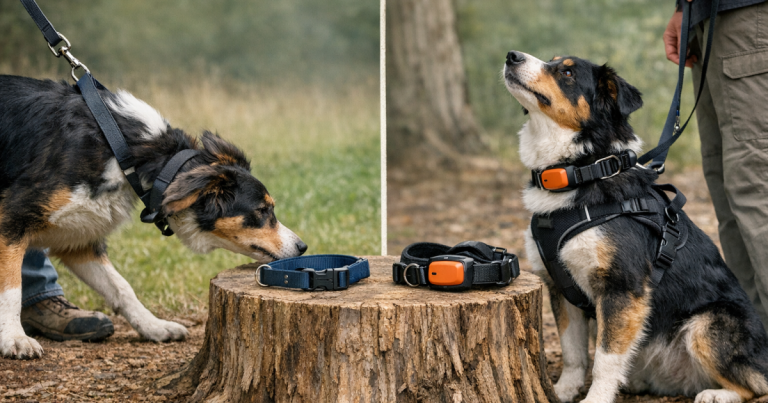
A flat buckle collar is fine for ID on many dogs, but it can slide over the head of a dog with a narrow skull, thick neck, loose coat, or panic-reverse habit. A martingale collar closes by a limited amount when the leash tightens, which helps stop that backward escape without the free-running action of a slip lead or choke chain.
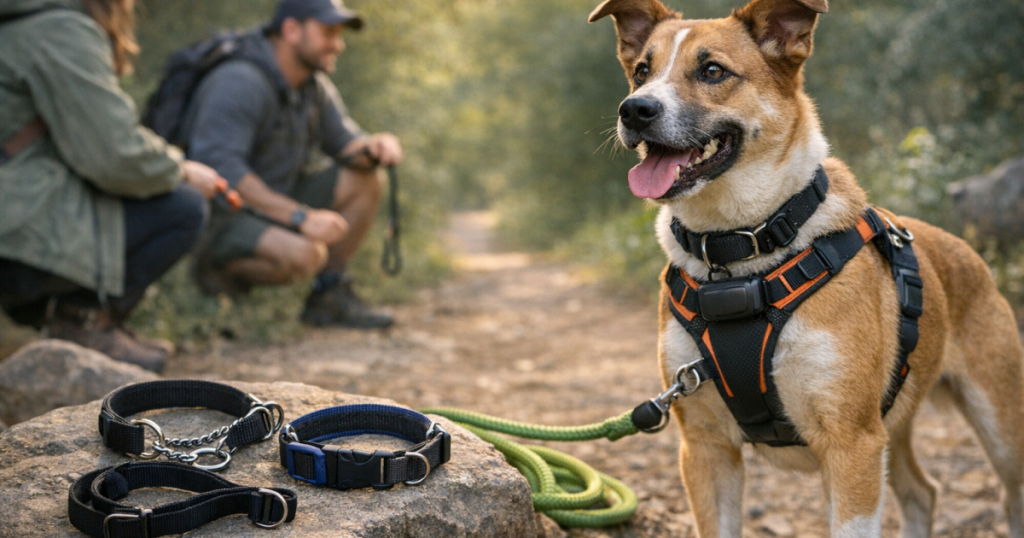
The safest setup for an escape-prone dog is usually three-part: a properly adjusted martingale for leash communication, an escape-resistant harness for body security, and a backup connection between the two. The collar is not the whole safety system. It is one controlled contact point within a setup that assumes dogs can make sudden, athletic, deeply inconvenient choices.
Examples of the category include the PetSafe Martingale Collar and the LupinePet Martingale Collar. Treat those as examples of the design, not automatic fits for every dog. The safer collar is the one that adjusts correctly on your dog’s neck and stays comfortable during normal movement.
Step 1: decide what the collar is supposed to do
Before choosing the collar, separate three jobs that often get mixed together:
- A training contact point helps you guide turns, pauses, and leash pressure during calm practice.
- An escape-prevention setup keeps your dog connected if they plant their feet, spin, or reverse out of equipment.
- A recovery backup helps someone identify or locate your dog if equipment fails or a door-dash happens.
A collar alone should not carry all three jobs for a known flight-risk dog. If your dog has already slipped gear, add a second point of connection. The safest starting place is a collar-to-harness or collar-to-leash backup, and this guide to backup leash attachments for dogs who slip out explains the logic in more detail.
Step 2: fit the martingale so it limits escape without choking
A martingale collar is only safer when it is adjusted correctly. Too loose, and your dog can still back out. Too tight, and it becomes stressful and physically risky.
- Start with the collar high enough on the neck that it cannot simply fall toward the shoulders during a backward pull.
- Adjust the main loop so it is snug but not tight when the leash is slack.
- When the control loop closes, the two metal or fabric points should not fully meet. If they touch, the collar has run out of adjustment and may still be too loose.
- Check fit with your dog standing, not only sitting. Neck shape changes with posture.
- Remove martingale collars for crate time, rough play, and unsupervised lounging.
For small dogs, look for a light, soft collar that does not overwhelm the neck. For large, muscular dogs, focus on secure hardware and a width that spreads pressure without rubbing. For long-coated dogs, part the fur with your fingers during fitting; otherwise, the collar may seem snug while sitting on coat rather than the neck.
Step 3: use a harness when fear changes the physics
A dog who slips collars because of excitement is different from a dog who slips because of fear. Skittish dogs often reverse hard, flatten their bodies, and twist away from pressure. In that moment, leash manners are not the issue. Body security is.
For those dogs, a harness with more coverage around the torso can be safer than relying on any collar. Many escape-prone dogs do better with a harness that has an additional belly strap behind the rib cage, because it is harder to back out of than a simple step-in or front-clip style. If your dog freezes at traffic noise, startles at strangers, or has slipped gear on walks before, read the guide to escape-resistant harnesses for skittish dogs before making the collar your primary restraint.
The collar still has a role. It can hold ID, support light leash cues, and serve as one end of a backup strap. But when panic is the pattern, the harness should carry the real containment job.
Collar types to treat carefully
Not every item sold as a training collar is a good answer for a dog who slips equipment. Some may help in a narrow training context, but they do not solve the escape problem by themselves.
- Flat collars are simple and comfortable for ID, but many dogs can reverse out of them if the fit, head shape, or coat type makes escape easy.
- Slip leads and choke chains tighten without the same built-in stopping point as a martingale, so they require careful handling and are not a casual fix for a panicking dog.
- Prong collars can be misused easily and do not replace secure fit, backup attachment, or behavior work.
- Head halters can give gentle directional guidance for some dogs, but they should not be used as the only restraint for a dog who lunges, bolts, or twists suddenly.
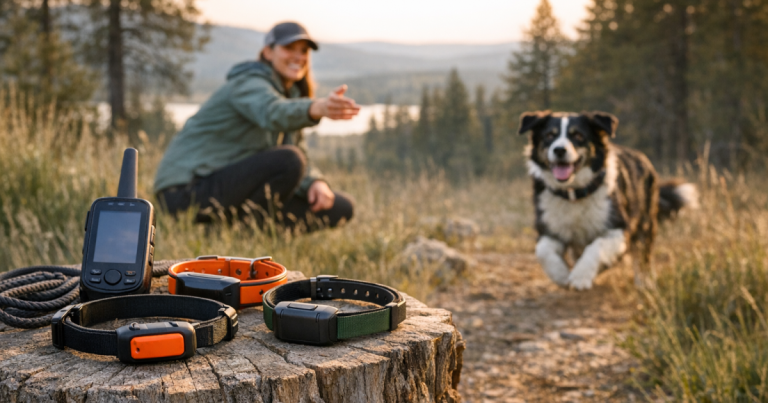
- Remote training collars do not physically prevent a dog from slipping a collar. If escape prevention is the problem, solve the equipment connection first.
Step 4: add a backup before training in hard places
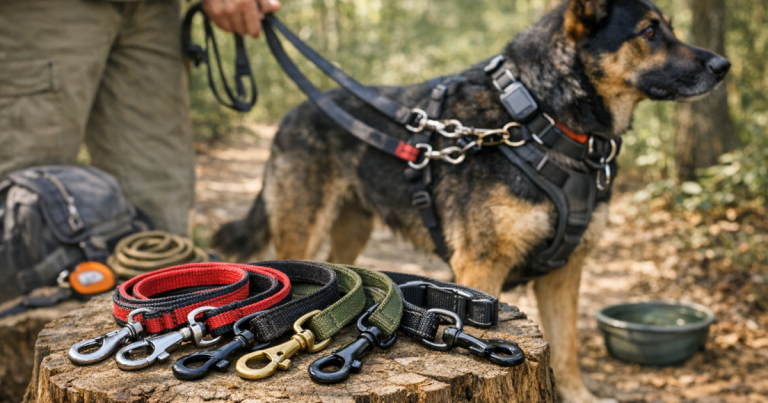
Once you have the collar and harness fitted, connect them before practicing near traffic, trailheads, parking lots, vet clinics, fireworks, or unfamiliar neighborhoods. A short safety strap, leash splitter, or second leash can keep your dog attached if one piece shifts out of position.
Hardware matters here. A weak snap, poorly angled clip, or overloaded ring can create a false sense of security. If you use a carabiner, choose and position it carefully; this walkthrough on how to use a locking carabiner with a dog leash shows how to avoid turning the backup into the weak point.
Step 5: train the escape moment at low intensity
The best collar setup still needs practice. Start somewhere boring: a fenced yard, quiet driveway, or empty stretch of sidewalk. The goal is to teach your dog that leash pressure predicts guidance and rewards, not a tug-of-war.
- Practice “turn with me” before your dog reaches the end of the leash. Reward the turn generously.
- If your dog plants their feet, move sideways instead of pulling straight forward. Sideways motion is often less confrontational.
- Use treat scatters to lower arousal after a startle. Sniffing can help some dogs reset.
- Handle the collar and harness briefly every day, then reward calm stillness. This makes gear checks less dramatic.
- Do short sessions around mild distractions before trying crowded trails, outdoor dining areas, or school pickup chaos.
If your dog repeatedly panics, injures themselves, or cannot recover after a startle, equipment alone is not enough. Work with a qualified positive-reinforcement trainer or veterinary behavior professional for a plan that addresses the fear pattern, not just the leash hardware.
Step 6: run a two-minute safety check before each walk
Make the pre-walk check boring and repeatable. That is the point. Before opening the door, confirm:
- The martingale closes to a safe stopping point and cannot slide over the ears.
- The harness is snug around the chest and belly without rubbing the armpits.
- All leash clips are fully closed and facing a direction that will not press them open.
- ID tags are readable and attached to a secure ring.
- Any GPS tracker or Bluetooth tag you use is attached firmly and ready for the outing.
- Your leash length matches the environment; shorter control near roads, more room only in safer open areas.
GPS trackers and smart tags are recovery tools, not restraints. They can help after separation, depending on the device type, network, battery, and environment, but they should never be the reason you accept a weak collar fit.
A simple decision path
- If your dog has never slipped a collar and walks calmly, a well-fitted flat collar or martingale may be enough for everyday leash practice.
- If your dog has a narrow head, thick neck, or backward-duck habit, use a martingale for supervised walks and check the closing point carefully.
- If your dog startles, freezes, bolts, or has escaped before, use an escape-resistant harness plus a collar backup.
- If your dog is newly adopted, traveling, or walking in an unfamiliar area, use the more secure setup even if they seem calm at home.
- If your dog is strong and reactive, prioritize professional training support alongside safer gear, because equipment should reduce risk while learning happens.
Why it matters
When people ask about training collars for dogs who slip out, the safest answer is not a single magic collar. It is a system: a limited-slip martingale fitted correctly, a harness when the dog’s behavior calls for it, a backup connection for high-risk moments, and enough calm practice that the gear is not doing all the work.
That combination gives you more than control. It gives you repeatability. You know what to check before the walk, how the collar should behave under pressure, and when to add backup instead of hoping the next scare goes better. For escape-prone dogs, that steady routine is often the difference between a nervous walk and a preventable lost-dog search.