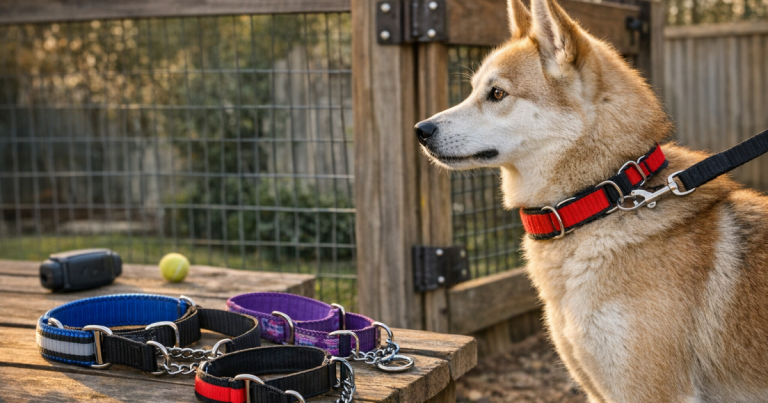
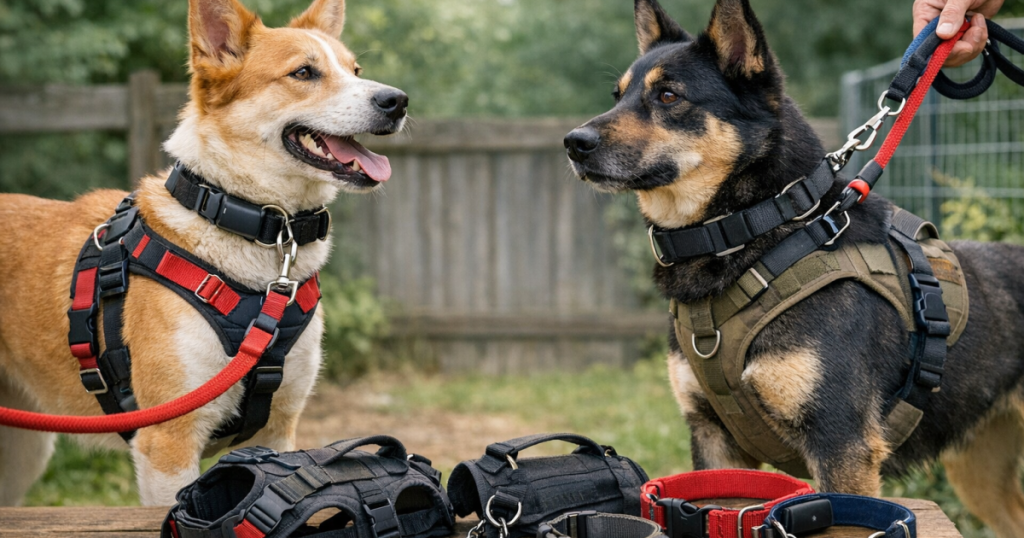
For dogs who reverse, tuck their chin, and suddenly slide free, the best dog collars to prevent escapes are only one part of the answer. A safer setup uses redundancy: a properly fitted collar for ID and backup control, a well-fitted harness for leash pressure, and a short connector so one piece of gear is not carrying the entire job.
The goal is not to make the collar painfully tight or to assume a harness is impossible to slip. The goal is to remove the easy exit path before your dog gets scared, startled, or determined.
The safest answer is a two-point setup
A dog who backs out should not be walked on a single loose flat collar or a single easy-slip harness. The most reliable everyday arrangement is a fitted martingale-style collar, an escape-resistant body harness, and a safety strap connecting the collar to the harness or leash. If the dog reverses out of one point, the second point buys you time to stop, crouch, shorten the leash calmly, and reset.
A martingale collar is useful because it narrows when leash tension appears, then relaxes when tension is gone. It should never be used as a constant choke point. The harness should carry the main leash pressure, especially for dogs who panic, lunge, or twist. The collar remains there for ID, a GPS tracker if appropriate, and backup attachment.
For anxious dogs, shelter dogs, newly adopted dogs, sighthounds, small-headed breeds, thick-coated dogs, and any dog with a history of slipping gear, start with the assumption that one attachment point is not enough. If your dog has already escaped once, treat that as useful information, not a one-off fluke.
Why dogs back out of normal collars and harnesses
Backing out usually happens in a very specific body shape: the dog plants their feet, lowers the head, reverses hard, and pulls against the direction of the leash. A flat collar can slide over the ears if it is loose, if the dog has a narrow skull, or if thick coat makes the fit feel snug while the actual strap sits too far from the neck. A simple harness can also fail if the chest strap rides forward or the belly strap sits where the dog can fold backward through it.
The trigger is often ordinary: a garbage truck, a loose dog, a crowded sidewalk, a veterinarian parking lot, a trailhead full of excited dogs, or a houseguest opening a car door too quickly. The setup that feels fine in the living room is not fully tested until your dog twists, freezes, reverses, and tries to create distance.
This is why escape prevention is more than shopping for stronger gear. Fit, attachment points, leash handling, and your dog’s stress pattern all matter. A nervous dog in a poor setup can slip expensive equipment. A calm dog in a basic setup may never test it. Build for the moment your dog is least predictable.
Three collar-and-harness setups that make sense
1. Everyday walker who occasionally reverses
Use a fitted martingale collar, a comfortable walking harness, and a short safety connector between the harness and collar. Clip the leash to the harness as the main point. The connector should be short enough to prevent full separation, but not so tight that it pulls the collar every time your dog walks normally.
This setup is practical for neighborhood walks, parking lots, and dogs who have backed out once or twice but are not chronic escape artists. A harness such as the 2 Hounds Design Freedom No-Pull Harness can be considered as part of this category, but the exact brand matters less than the fit: the straps must sit securely without rubbing, gaping, or sliding toward the armpits.
2. Nervous dog or known gear slipper
For dogs who have repeatedly backed out, choose a more body-secure harness shape with an additional strap or longer body coverage, then pair it with a martingale collar and safety connector. The Ruffwear Web Master Harness is a recognizable example of a harness style many owners consider when a dog slips simpler walking harnesses, though no harness should be treated as escape-proof.
This setup is useful for newly adopted dogs, fearful dogs, travel days, motel stops, rescue transports, and dogs who panic around traffic. Keep leash pressure low and steady. If the dog starts reversing, do not pull harder in a straight line; that often helps them brace and slip. Instead, move closer, lower your body posture, reduce the backward angle, and calmly regain control.
3. Trailhead, road trip, or high-distraction setup
For hiking starts, roadside potty breaks, campground arrivals, and other messy transitions, use a secure harness, collar with current ID, and a backup tracking plan. Clip the primary leash to the harness, keep a second connection to the collar, and avoid opening car doors until the leash is already attached.
Dogs often bolt during transitions rather than during the walk itself. If trailheads are a problem, the handling routine matters as much as the gear. The same collar-and-harness setup works better when paired with calm unloading habits, distance from other dogs, and a plan for keeping your dog from bolting at busy trailheads.
Step-by-step fit checks before you trust the setup
Check the collar first
Fit the collar high enough that it cannot easily slide forward over the ears, but not so tight that it restricts normal breathing, swallowing, or relaxed movement. For a martingale collar, adjust it so the two control loops do not fully meet when tension is applied. If they touch, the collar can no longer narrow effectively.
Attach ID tags even if your dog wears a tracker. A phone number on a visible tag still helps a neighbor act fast without needing to scan a chip, download an app, or understand your tracker. A GPS collar can support recovery, but it does not physically prevent a dog from slipping away.
Check the harness with movement, not just standing fit
A harness can look correct while your dog is standing still and still fail when the dog twists. After fitting, walk your dog in a quiet area and watch what the straps do when they turn, sit, sniff, reverse, and shake off. The harness should not slide over the shoulders, gape behind the elbows, or rotate heavily to one side.
If your dog has long or dense coat, press through the fur to feel where the strap actually sits. Coat can hide looseness, especially around the neck and chest. For tracker collars and thick fur, the same principle applies: fit against the dog, not against the top layer of hair. For more detail, see this guide to fitting a GPS collar on a thick-coated dog.
Add a safety connector
A safety connector is a short strap or coupler that links the harness to the collar or links both points to the leash. It should not dangle near the front legs or create a tripping loop. Test it indoors first, then in the yard, then on a calm walk.
The connector is not meant to create constant collar pressure. If it is pulling on the collar the whole time, shorten or adjust the leash arrangement so the harness carries the normal walking load. The collar should engage only if the harness shifts, fails, or is slipped.
Practice the reverse test gently
Do not scare your dog to test gear. Instead, in a quiet fenced area or indoors, let your dog move backward while you hold light leash tension. Watch whether the collar approaches the ears or the harness moves toward the shoulders. If anything starts sliding off, stop and adjust. Repeat after your dog has worn the setup for a few minutes, because straps can settle into coat and body shape.
What to avoid with a dog who backs out
- Do not rely on a loose flat collar as the only attachment point for a known reverser.
- Do not tighten a collar to the point of discomfort to compensate for poor gear choice.
- Do not assume a front-clip or back-clip harness is secure just because it helps with pulling.
- Do not use a retractable leash in high-risk areas where you need close control.
- Do not let a GPS tracker replace physical restraint, visible ID, and safe handling habits.
- Do not test new gear for the first time at a crowded park, trailhead, rest stop, or event.
If your dog is anxious on leash, a secure harness is part of a wider routine that may include distance from triggers, slower exposure, and calmer route choices. For more harness-specific examples, this resource on secure harnesses for anxious leash training is a useful next step.
Where GPS collars fit into the plan
A tracker is a recovery tool, not a leash system. It can help you respond faster if your dog gets away, but it cannot stop the first escape. Cellular coverage, battery status, fit, attachment security, and the environment all affect how useful a tracker is in a real scare.
For dogs who back out, the tracker should be attached to gear that stays on the dog without becoming uncomfortable. Some owners place the tracker on the collar because the harness may come off indoors or during rest. Others use a collar for ID and tracking while the harness manages leash pressure outdoors. If you are choosing a collar mainly to hold a tracker securely, start with this guide to dog collars for secure GPS tracker attachment.
Visibility gear can also help during dusk walks, campground evenings, and neighborhood searches. A lighted accessory such as the Nite Ize NiteHowl Rechargeable LED Safety Necklace is not a restraint device, but it can make a leashed dog easier to see around driveways, sidewalks, and dark yards.
Questions people ask
Are martingale collars safe for dogs who back out?
Martingale collars can be appropriate when they are fitted correctly and used for walking control or backup attachment, not constant pressure. They are especially useful for dogs with narrow heads, but they still need a harness partner for dogs who panic or reverse hard.
Can a harness alone stop backing out?
Sometimes, but it depends on the dog and the harness shape. A determined dog may still slip a poorly fitted harness. For a known escape risk, a harness alone is weaker than a harness, collar, and safety connector working together.
What are the best dog collars to prevent escapes when a dog also wears a harness?
The strongest collar choice is usually a properly fitted martingale-style collar with current ID, used as a backup to a secure harness rather than as the only leash point. For dogs wearing GPS trackers, the collar also needs to hold the device firmly without sliding, twisting, or rubbing.
The big picture
The best setup for a dog who backs out is not the tightest collar or the most complicated harness. It is a calm, redundant system: secure collar, secure harness, short backup connector, visible ID, and handling habits that reduce panic moments before they start.
Start with low-distraction fit testing, adjust after movement, and upgrade the setup when your dog’s behavior tells you the current one is not enough. A dog who has slipped gear is giving you an early warning. Listen to it before the next parking lot, trailhead, or open front door turns into a lost-dog emergency.