Busy trailheads are where otherwise reliable dogs make sudden choices: a slammed truck door, a barking dog, a squirrel crossing the lot, or a group of hikers stopping too close. For dog safety during hiking trips, treat the trailhead as the highest-risk part of the outing, not just the place where the fun begins.
A good trailhead routine slows everything down. Your goal is to keep your dog physically connected, mentally settled, and easy to recover if something unexpected happens.
Behavior training for severe fear, leash reactivity, or repeated escape attempts at crowded trail areas should be carried out with a qualified force-free trainer or veterinary behavior professional and should follow local leash rules, park regulations, and public safety requirements.
Main points
- Keep your dog secured before any car door, hatch, or crate door opens.
- Use a calm release routine instead of letting your dog launch straight into the parking lot.
- Move away from traffic, other dogs, and crowd pinch points before adjusting gear.
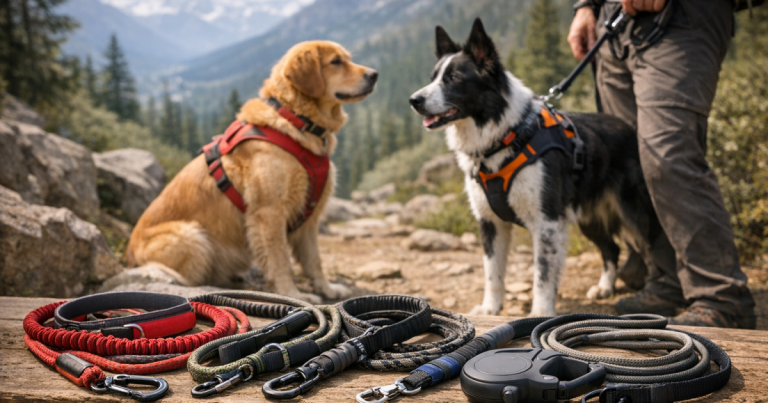
- Use a leash setup that prevents backing out, twisting free, or slipping a collar.
- Make sure ID and tracking backups are working before you reach the trailhead.
- If your dog is already over threshold, skip the hike, reset in the car, or choose a quieter route.
Why busy trailheads make dogs bolt
Trailheads compress a lot of triggers into a small area. Cars are arriving and leaving. Dogs are pulling toward each other. People are opening tailgates, unloading trekking poles, shaking out packs, and calling to friends. A dog that walks calmly on a quiet path may panic or surge when all of that happens at once.
Bolting is not always disobedience. Some dogs bolt toward excitement, some bolt away from pressure, and some do both within the same minute. A young dog may lunge toward another dog and then panic when the leash tightens. A rescue dog may freeze at the first loud noise, then reverse out of a loose harness. A scent-driven dog may drop its head, hit the end of the leash, and be gone before the handler has both feet on the ground.
The safest plan assumes the first five minutes are unstable. Do not use the trailhead to test recall, loosen leash rules, or make last-second gear changes next to moving vehicles. Build the habit that parking lots and entry points are controlled zones.
Start before the car door opens
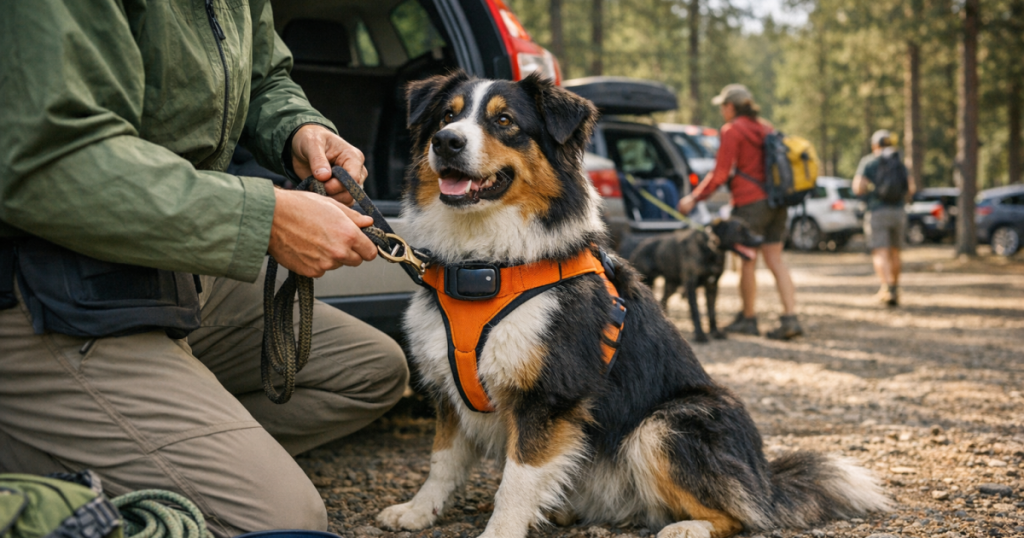
The most important anti-bolt step happens while your dog is still inside the vehicle. Clip the leash to your dog before opening the door wide enough for an exit. If your dog rides in a crate, attach the leash through the crate opening before releasing them. If your dog rides with a seat belt tether, keep one hand on the leash before detaching the tether.
Use a simple sequence every time:
- Park, turn off the vehicle, and pause for a few seconds.
- Put on your own pack first so you are not juggling gear with a dog halfway out of the car.
- Clip the leash while your dog is still contained.
- Ask for a brief pause, sit, or eye contact if your dog knows it reliably.
- Open the door only when you have leash control and a clear landing spot.
This is not about making the dog perform a perfect obedience routine. It is about preventing the common moment when the hatch lifts, the dog sees open space, and the handler is still reaching for the leash.
Use a two-stage leash routine
At crowded trailheads, one leash connection may not be enough for dogs with a history of slipping gear or lunging backward. A two-stage routine means your dog remains connected while you transition from vehicle to trail.
For example, you might use a primary leash on a well-fitted harness and a backup connection to a flat collar for the walk across the lot. The backup is not for yanking or steering; it is there to reduce the chance of a complete escape if the dog twists out of one point of attachment.
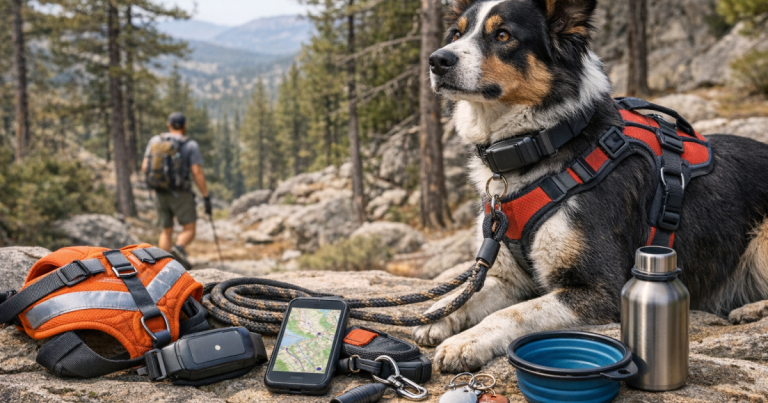
Fit matters more than how rugged the gear looks. A harness that is too loose around the neck or chest can create an escape route when a dog plants its feet and pulls backward. If your dog has a narrow chest, deep rib cage, thick coat, or nervous backward-pull habit, review secure harness fit rather than assuming a standard walking harness is enough. The site’s guide to secure harnesses for anxious leash training is a useful next step for dogs that have already learned to reverse out of gear.
Move away from the pressure zone
Do not stop to adjust everything beside the car if the parking lot is active. Once your dog is leashed and out, move with purpose to a quieter edge: a wide shoulder, a picnic-area boundary, a patch of grass away from the entry lane, or the start of a less congested spur.
Keep the leash short enough that your dog cannot reach another dog, jump into an open vehicle, or swing behind you into traffic. Short does not mean tight. A tight leash can add pressure and make a worried dog fight harder to get away. Aim for controlled slack: close enough for safety, loose enough that the dog can breathe and orient.
Watch your dog’s body before moving toward the trail sign or restroom area. Hard staring, frantic sniffing, tucked tail, spinning, whining, or repeated jumping into the leash can all mean your dog is not ready to proceed. Wait, create distance, or walk a small calm loop away from the crowd before joining the main path.
Give your dog a job at the trailhead
Dogs bolt less when they understand what happens next. Pick one repeatable job for the first minute outside the car. It can be simple:
- Stand on a mat or beside the rear tire while you close the hatch.
- Walk in a small loop around the parking spot before heading to the trail.
- Touch your hand before crossing the lot.
- Check in at each change of surface, such as pavement to dirt.
- Wait behind an imaginary line before stepping onto the trail.
Keep the job realistic. A highly excited dog may not hold a long stay while hikers pass with dogs. A dog that is nervous around trekking poles may not want to sit in the middle of a crowd. The goal is not stillness for its own sake; it is a predictable pattern that keeps the dog’s brain engaged while the environment is loud.
Do not switch to a long line too early
A long line can be helpful once you are away from cars, trailhead congestion, and leash-required entry areas, but it is risky in the first few minutes. Long lines tangle around bumpers, wrap around strangers, and give a powerful dog room to accelerate before hitting the end of the line.
Wait until you are on the trail, away from the parking area, and clear of other dogs before giving more distance. Even then, many US parks, forests, and local trail systems have leash length rules or areas where dogs must stay close. Follow posted signs, and do not treat quiet moments as permission to ignore local requirements.
Make GPS and ID part of the routine, not the rescue plan
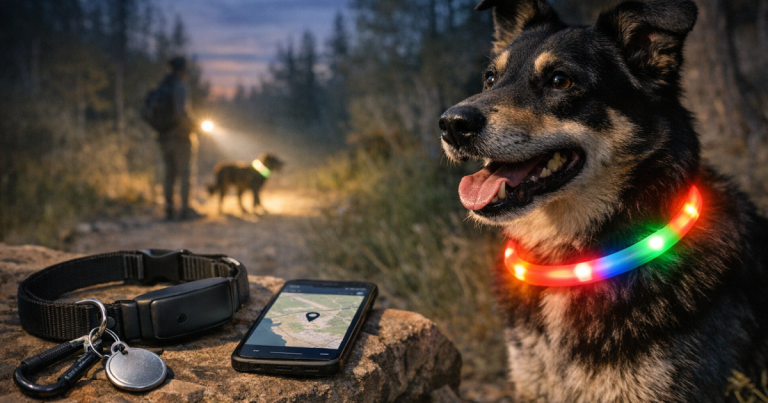
A tracker can help if your dog gets away, but it does not replace leash control. Cellular GPS trackers depend on network coverage and charged batteries. Bluetooth tags depend on nearby compatible devices. No tracker can guarantee an instant location in every canyon, forest, rural road, or crowded trail system.
Before leaving home, check that your dog’s ID tag is readable, the collar is snug enough to stay on, and any tracker is attached securely. If you rely on GPS, run a quick location check while you are still in a known area, then again when you arrive. For a fuller pre-hike process, use these steps to test your dog tracker’s accuracy before off-leash time so you know how it behaves before stress is involved.
At the trailhead, glance at the attachment point. A dangling tracker, loose collar ring, or twisted mount is easier to fix while your dog is calm than after they lunge at the end of the leash.
Practice the trailhead routine somewhere boring
The best place to train trailhead manners is not a packed Saturday morning access point. Practice in a driveway, empty school parking lot after hours where dogs are allowed, quiet park lot, or low-traffic trail entrance.
Rehearse the exact sequence: leash clipped before door opens, pause, calm exit, short walk, check-in, gear check, then forward movement. Keep sessions short. If your dog can repeat the pattern in boring places, you have a stronger foundation when the real trailhead adds noise and movement.
Gradually add difficulty. Park farther from the trail. Practice while a friend walks past at a distance. Visit at quieter times before attempting peak weekend traffic. The more your dog sees the routine as normal, the less the environment controls the first few minutes.
If your dog is already too amped up
Sometimes the safest decision is to not start the hike yet. If your dog is screaming, spinning, lunging at every dog, or trying to climb out before you can clip the leash, take the pressure down.
- Stay in the vehicle with doors closed until your dog’s breathing and movement settle.
- Drive to a quieter overflow lot or alternate trailhead if one is available and allowed.
- Walk a short calm loop away from the main crowd instead of heading straight up the trail.
- Skip greetings with unfamiliar dogs, even if the other owner says their dog is friendly.
- End the outing early if your dog remains over threshold and cannot safely move through the area.
Leaving is not failure. It is a safety choice that prevents your dog from rehearsing the exact launch-and-panic pattern you are trying to reduce.
If your dog bolts anyway
If the leash slips or gear fails, resist the urge to sprint directly after your dog unless they are heading into immediate danger and you can safely intervene. Chasing can make some dogs run harder. Instead, use a calm voice, turn your body sideways, crouch if it is safe, and encourage your dog back toward a familiar person, vehicle, or open space.
Ask nearby hikers to stop reaching, calling, or chasing unless you need help blocking a road or closing a gate. If your dog has a tracker, check location updates while someone remains near the escape point. Many dogs circle back toward the car, the trail entrance, or the last place they saw their person.
After recovery, do not punish the return. Clip the leash, move to a secure place, and end the trailhead activity. Later, review what failed: door timing, leash grip, harness fit, crowd distance, or tracker setup.
Questions people ask
Should I carry my small dog through a crowded trailhead?
Carrying can help if your dog is calm in your arms and the area is crowded with larger dogs or moving vehicles. Use a leash attachment anyway, because a startled small dog can twist or jump suddenly.
Is a harness safer than a collar at trailheads?
A well-fitted harness usually gives better body control than a collar alone, especially for dogs that lunge or pull backward. Many escape-prone dogs still need a backup collar connection during transitions.
When is it safe to let my dog have more leash length?
Wait until you are away from cars, crowds, blind corners, and other dogs. Also check posted leash rules; many trails require dogs to remain on leash even after the trailhead clears.
Can a GPS tracker stop my dog from bolting?
No. A tracker is a recovery tool, not a restraint. It can help you locate a loose dog, but it depends on attachment security, battery status, coverage, and how quickly you notice the escape.
What time should I hike with a dog that bolts at crowds?
Choose quieter windows when possible, such as weekday mornings or less popular trailheads. Avoid peak arrival times until your dog can exit the car and walk through distractions calmly.
Practical takeaway
The safest trailhead plan is simple: connect before opening, exit slowly, move away from pressure, verify gear, and do not give extra freedom until your dog is settled. Busy access points are not the place to gamble on recall, loose gear, or good luck.
For dogs with a known escape history, build your hiking setup around prevention first and recovery second. A secure leash system, readable ID, and tested tracker work together, but none of them is foolproof on its own. If you are refining your full setup for tougher routes, the checklist of dog hiking safety gear for escape-prone dogs can help you think through the layers before your next trail day.