A dog backing out of a collar does not look dramatic until the leash suddenly goes slack. The safest fix is usually not a tougher pull on the leash; it is a second point of connection that stays useful when the collar fails. For dogs who slip out, backup leash attachments work best when they connect a secure harness, a properly fitted collar, and hardware that cannot pop open during a twist or panic.
What to know first
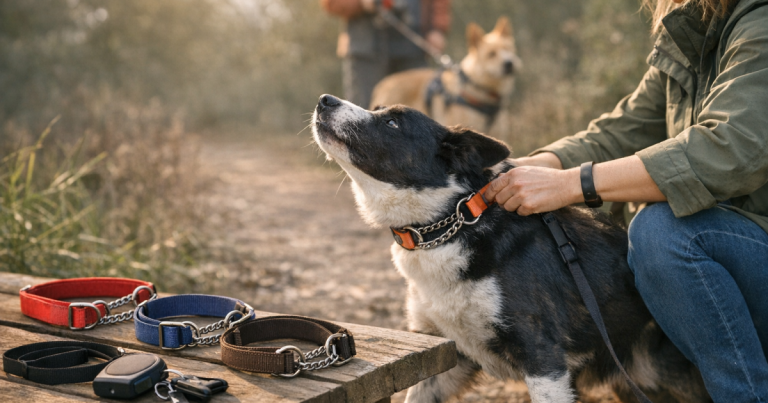
The best backup leash setup for an escape-prone dog is a redundant connection, not a single “escape-proof” collar. Use a well-fitted harness as the main leash point, keep a collar on for ID, and add either a short safety strap, a double-ended leash, or a locking connector between the two. A martingale collar can help reduce collar slipping during leash tension, but it should not be the only protection for a dog that freezes, reverses, or thrashes when startled.
What are the best training collars for dogs that slip out? A limited-slip martingale collar is usually the collar style to consider first because it is designed to tighten only within a set range when tension comes on the leash. It still needs careful fitting and supervision. The safer walking system is a martingale or flat collar for identification, a harness as the primary anchor, and a backup attachment that keeps you connected if one point fails.
Step 1: Choose the main anchor before adding backups
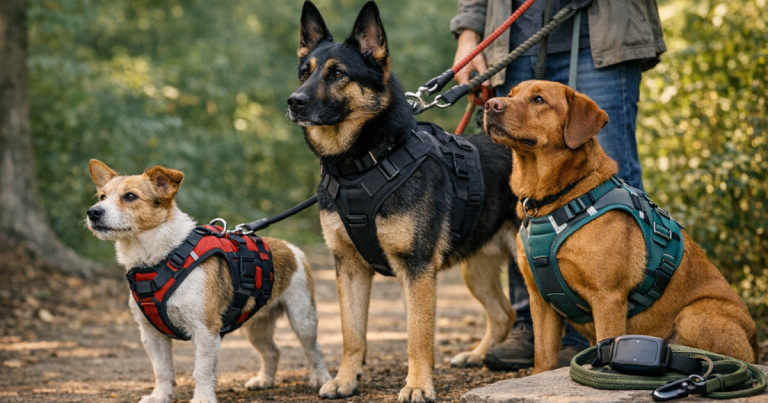
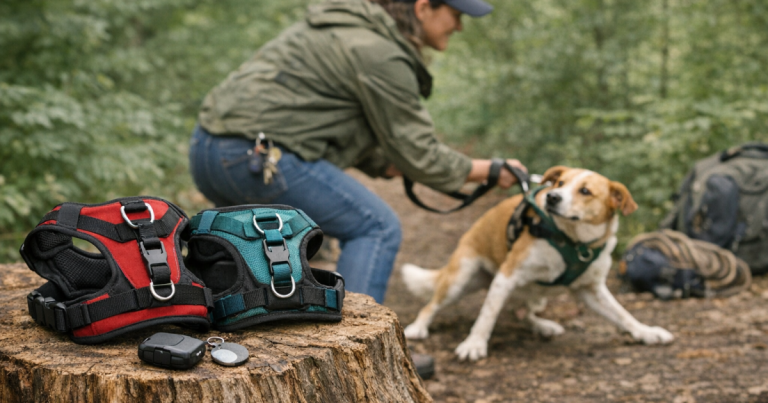
Start with the harness, not the clip. If the harness is loose enough for the dog’s elbows to escape, the neatest backup strap in the world is just decoration with ambition. A good walking harness should sit securely without rubbing, leave normal shoulder movement, and stay in position when the dog reverses.
For narrow-bodied, skittish, recently adopted, or high-alert dogs, a simple step-in or front-clip harness may not provide enough body coverage. A more secure harness design can reduce the chance of the dog backing out when startled by traffic, lawn equipment, fireworks, or an off-leash dog. If that sounds familiar, the guide to escape-resistant harnesses for skittish dogs is the better next stop before changing leash hardware.
Step 2: Match the backup attachment to the escape pattern
For sudden reverse-and-slip moves: short safety strap
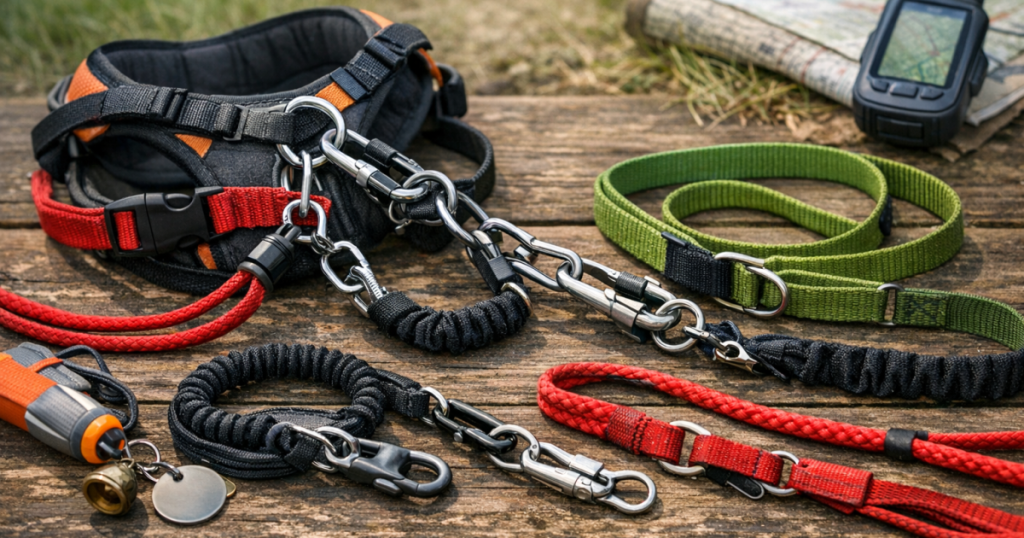
A short safety strap connects the leash, collar, or harness to a second point so the dog remains attached if one clip or fitting fails. This is the simplest everyday choice for dogs that back out of collars at doorways, parking lots, vet offices, or noisy sidewalks.
- Best use: harness as the main leash point, collar as the backup ID point.
- Watch for: straps that hang too low, twist around legs, or pull the collar sideways.
- Training check: practice slow turns and gentle stops in a quiet area before using it near traffic.
For more handling control: double-ended leash
A double-ended leash clips to two places at once, usually the harness and collar or two harness points. It gives you more control than a loose backup strap, but it also asks more from your hands. If you already juggle treats, a poop bag, and a phone, this setup can feel like walking a small sailing rig.
- Best use: urban walks, vet visits, training sessions, and dogs learning not to reverse out of pressure.
- Watch for: uneven tension that drags the collar or turns the harness.
- Training check: keep the leash slack enough that the backup is protection, not constant pressure.
For weak leash clips: locking connector
A locking carabiner can be useful when the leash clip is small, worn, or easy to bump open. It should be part of a clean connection, not a dangling chain of metal pieces. Extra hardware can create awkward angles, rub the dog’s chest, or make the connection weaker if it loads sideways. If you use one, read the detailed guide on how to use a locking carabiner without creating a weak point.
- Best use: replacing a questionable snap or adding a more deliberate closure point.
- Watch for: carabiners that are too heavy for small dogs or too bulky for the leash ring.
- Training check: close and check the lock every time, especially after clipping in a hurry.
Examples that show the main formats
These are not magic fixes, and no single item fits every dog. They are recognizable examples that help clarify the different approaches.
- Halti Training Lead: an example of a double-ended training leash for connecting two points during supervised walks.
- Black Diamond RockLock Screwgate Carabiner: an example of a locking carabiner style some owners use to make a leash connection more deliberate.
- Ruffwear Web Master Harness: an example of a more body-covering harness style to compare when a basic harness is not secure enough.
Before relying on any of them, check size, weight, comfort, leash compatibility, and whether the attachment points line up without twisting. Product convenience is not the same as recovery reliability; the point is to reduce the most likely failure, not pretend escapes are impossible.
Step 3: Set up the leash so the backup actually helps
Use this order on the first few walks:
- Fit the collar so ID tags are present and the collar cannot slide over the head during normal leash tension.
- Fit the harness separately; do not tighten it just to compensate for the collar.
- Clip the main leash to the harness unless your trainer has given you a different plan.
- Add the backup strap or second leash clip to the collar.
- Walk a few circles in the driveway or hallway and watch for twisting, rubbing, or leg tangles.
- Practice gentle stops, direction changes, and a calm “let’s go” cue before walking near roads.
The backup should remain slightly slack most of the time. If it is always tight, it is no longer a backup; it is a second steering line. That can frustrate sensitive dogs and can make panicked reversing worse.
Step 4: Build the training routine around the gear
Hardware buys you time. Training teaches the dog what to do with that time. For a dog that backs up when afraid, reward forward movement, check-ins, and turning toward you. Avoid dragging the dog forward through scary moments. A dog that learns “pressure means panic” will often reverse harder the next time.
Try short sessions in low-stress places: the front path, an empty parking lot, a quiet trailhead before the crowd arrives. Keep treats easy to reach. Rehearse getting out of the car, clipping the backup, walking ten calm steps, and returning to the car. Boring practice is underrated; it is also where most safer habits are built.
Step 5: Plan for the walk that goes wrong
A backup leash attachment reduces risk, but it does not replace ID, recall practice, or a recovery plan. If your dog has a history of bolting, pair the walking setup with visible ID and a tracker suited to your environment. Cellular GPS trackers can be useful for everyday neighborhoods, while rural and field use may call for a different tracking approach. The leash keeps the scare from starting; the recovery plan helps if it does.
For travel days, trailheads, and hotel parking lots, pack as if the dog might slip away at the worst possible moment. A spare leash, printed photos, current ID information, treats, and a flashlight are simple items that can save time. The road-trip checklist for a lost-dog emergency kit is a useful companion to your walking setup.
Questions people ask
Is a martingale collar enough for a dog that backs out?
Sometimes it helps, but it is not enough for every dog. A martingale can reduce collar slip when fitted correctly, but a harness plus backup attachment gives you a second connection if the dog twists, panics, or the collar is not seated well.
Should the leash attach to the collar or the harness?
For most escape-prone dogs, attach the main leash to the harness and use the collar as the backup point for ID and redundancy. If you are following a trainer’s plan for leash skills, keep the backup connection in place while you work on handling.
Can I use two separate leashes?
Yes, but it can be clumsy. Two leashes give true redundancy, yet they tangle more easily and require better handling. A double-ended leash or short safety strap is often cleaner for daily walks.
Why it matters
The best backup leash attachment is the one that matches your dog’s escape habit and that you will use every single walk. For collar-slippers, start with harness security, add a slack backup to the collar, check the hardware before leaving the house, and practice calm movement before you need it in a loud, crowded place. A simple second connection can turn a heart-stopping moment into a quick reset.