An AirTag dog tracker can feel like a simple safety upgrade when your dog wears one every day. The problem is that rural lost-dog recovery is not the same as finding keys in a coffee shop. Out on acreage, wooded trails, farms, or low-traffic roads, the tracker category you choose can determine whether you get a timely lead or only a last-known clue.
What to know first
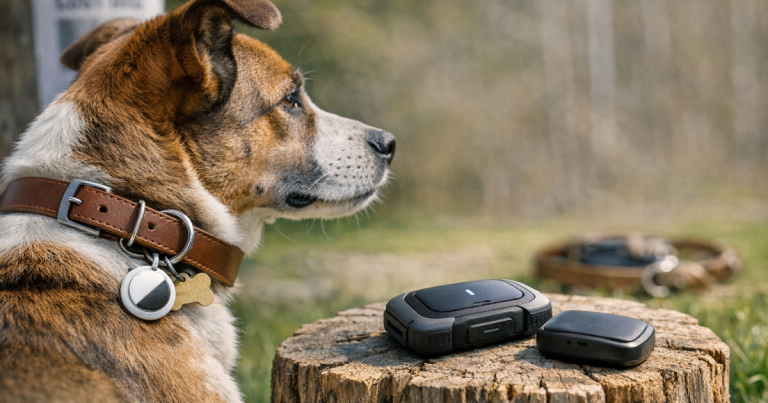
Apple AirTag (2nd generation) is a Bluetooth item tracker, not a GPS dog tracker. It can be useful as a backup identifier or a low-bulk tag in some everyday situations, but it does not independently calculate and transmit your dog’s live location through GPS and cellular service.
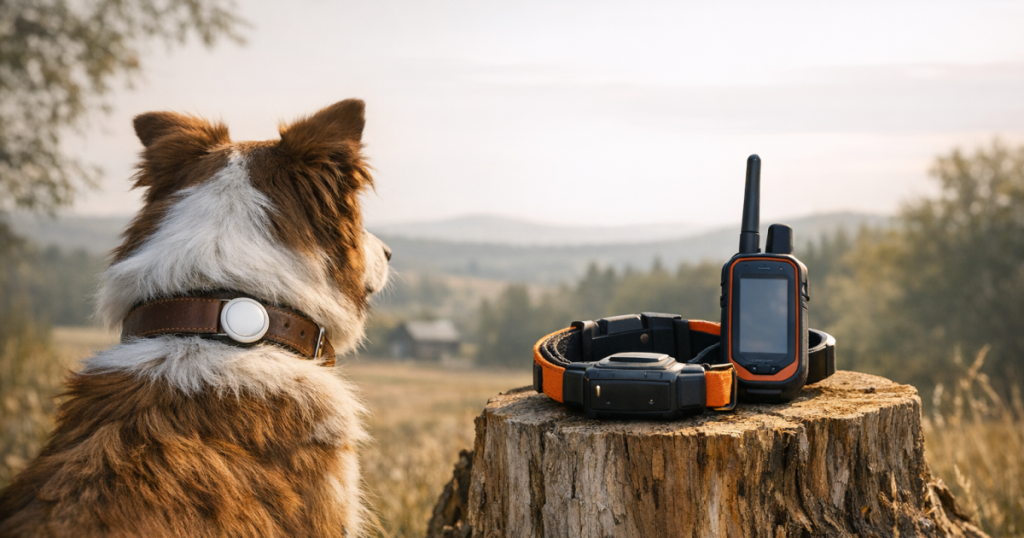
A purpose-built LTE/GPS dog tracker, such as Garmin Alpha LTE, belongs to a different safety category. It is designed around tracking a moving dog outdoors, using GPS for location and LTE service to send that location back when coverage is available. That still does not make it foolproof, but it is a more appropriate category when your dog may run beyond nearby people, homes, parking lots, or phone-heavy areas.
If you are deciding whether to attach an item tracker to a collar, it helps to understand the limits before an emergency. The more detailed lost-pet recovery breakdown on using an AirTag on a dog collar is worth reading before you rely on one as your main plan.
Step 1: Separate Bluetooth finding from GPS tracking
The key difference is not brand preference. It is how the location is created.
- Bluetooth item trackers: These are designed to be detected when they are near compatible devices in a wider finding network. They are best at helping locate objects in populated environments or at close range.
- GPS dog trackers with LTE: These are designed to determine a dog’s outdoor position using GPS and report it through a cellular data connection when the device has service.
- Training collars: These may support training or communication, but they are not automatically location trackers. Do not assume a remote collar helps you recover a lost dog unless it includes real tracking capability.
For rural dog tracking, that distinction matters because your dog may not pass near enough compatible phones to update an item tracker. A dog crossing a pasture, drainage ditch, timber line, or private road can stay invisible to Bluetooth-based networks for long stretches.
Step 2: Picture the actual escape, not the calm version of your dog
Many owners choose tracking gear while imagining their dog trotting politely around the yard. Lost-dog situations are usually messier. A door dasher may sprint straight toward a road. A scent-driven hound may move through brush and ignore recall. A ranch dog may disappear behind terrain before anyone realizes the gate was open.
Ask yourself where your dog would likely go in the first ten minutes:
- Across open acreage with few people nearby
- Into woods, tall grass, gullies, or creek beds
- Down a rural road where cars pass quickly but phones are sparse
- Toward livestock, wildlife, neighboring properties, or trailheads
- Beyond your line of sight before you can grab a leash
If those scenarios sound realistic, you are not just trying to find a misplaced collar tag. You are trying to follow a moving animal in a low-density environment. That is where the LTE/GPS category starts to make more sense than a Bluetooth item tracker alone.
Step 3: Know where AirTag-style tracking can still help
Bluetooth item trackers are not useless for dog owners. They can be helpful as a secondary layer in the right setting. For example, they may provide a clue if a dog is found by someone with a compatible phone nearby, if the dog wanders through a neighborhood, or if the collar is somewhere close and you are searching around the house, vehicle, campsite, or yard.
They can also serve as one part of a layered ID setup: engraved tag, microchip, recent photos, secure collar fit, and a recovery routine everyone in the household understands. The mistake is treating a Bluetooth item tracker as if it will behave like a live GPS dog tracker in open country. It will not.
Step 4: When LTE/GPS becomes the safer rural category
A purpose-built LTE/GPS tracker is the safer category when the recovery problem is distance, movement, and low population density. The tracker still depends on coverage, battery, fit, and correct setup, but it is built for a more demanding job than waiting to be detected by nearby phones.
Consider moving up to LTE/GPS tracking when:
- Your dog has a known escape pattern. Fence jumpers, gate pushers, and door dashers benefit from faster location clues than a passive tag can provide.
- You hike or camp away from busy areas. Trailheads may have people and phones; the ridge, drainage, or back road may not.
- You live on acreage or near farmland. Rural dogs can cover ground quickly before a neighbor ever sees them.
- Your dog follows scent or wildlife. Hounds, sporting dogs, and high-prey-drive dogs may not stay within the tidy search circle owners expect.
- You need repeat location updates. A moving dog requires more than one old location clue.
Garmin Alpha LTE is one example of a purpose-built LTE tracking setup to compare for this kind of risk. It should still be evaluated against your local carrier coverage, your dog’s size and collar comfort, and your normal terrain. For a broader look at where it fits, the site’s guide to Garmin Alpha LTE and other dog trackers by escape risk breaks down the use-case differences.
Step 5: Test the tracker before you trust it
No tracker should get its first real test during a lost-dog panic. Whether you use LTE/GPS, satellite-capable equipment, or a Bluetooth backup, run a calm test while your dog is safely leashed or inside a fenced area.
- Check coverage at home. Walk the property edges, driveway, barn area, back fence, and usual escape points.
- Test your trail routine. Confirm what happens at the parking area, a half-mile in, and where reception typically fades.
- Verify collar fit. A tracker that rotates, catches, rubs, or weighs down a small dog may not stay useful in an emergency.
- Practice notifications and sharing. Make sure the person who would actually search knows how to read the app or tracking display.
- Charge on a schedule. Battery claims vary by device and settings, so build your routine around your real use, not ideal conditions.
For very remote areas where LTE coverage is unreliable, compare the category carefully rather than assuming any one device solves every problem. Some owners look at hybrid or remote-area options such as the Fi Ultra Dog Tracker, but the same rule applies: coverage dependency, battery behavior, fit, and realistic escape routes matter more than marketing language.
Examples that make the choice clearer
The suburban wanderer
A small dog slips out of a front door in a busy neighborhood, passes porches, parked cars, dog walkers, and apartment buildings. A Bluetooth item tracker may have more chances to be detected nearby. It is still not a GPS tracker, but the environment gives it more opportunities to help.
The farm-road runner
A young shepherd mix bolts through an open gate and runs along a rural shoulder bordered by fields. There may be few compatible phones nearby and no steady stream of pedestrians. In that case, relying on a Bluetooth network can leave the owner waiting for a lucky detection. An LTE/GPS tracker is the better category if local service supports it.
The weekend trail dog
A confident off-leash dog follows a deer trail beyond sight. The owner needs direction of travel, not just a possible ping if the dog later approaches another hiker. LTE/GPS tracking is more appropriate, but the owner should test the trail area in advance because valleys, tree cover, and carrier gaps can still interfere.
Practical takeaway
An AirTag dog tracker can be a helpful backup in populated places, but it should not be your main rural recovery plan. It is an item-finding device, not a live GPS dog tracker. For dogs that range across acreage, trails, farmland, or low-traffic roads, a purpose-built LTE/GPS dog tracker is usually the safer category because it is designed to locate and report a moving dog outdoors when coverage allows.
The best setup is layered: secure collar or harness fit, visible ID, microchip registration, current photos, trained recall, charged tracking equipment, and a household plan for who searches, who drives, and who contacts neighbors. Technology improves your odds only when it matches the environment your dog can actually reach.
Things readers ask
Can I use AirTag and a GPS dog tracker together?
Yes. Some owners use a Bluetooth item tracker as a secondary backup alongside a real GPS tracker and standard ID. The Bluetooth tag should not replace the GPS tracker for rural escape risk.
Is LTE/GPS tracking guaranteed to work in the country?
No. LTE/GPS trackers still depend on device power, satellite visibility, cellular coverage, setup, and fit. They are the more suitable category for rural movement tracking, but every owner should test coverage in the places their dog actually goes.
What should I check before buying for a small dog?
Look closely at weight, attachment style, collar width, rubbing points, and whether the tracker stays positioned during normal movement. A tracker that is too bulky or unstable can become uncomfortable or less reliable during an escape.