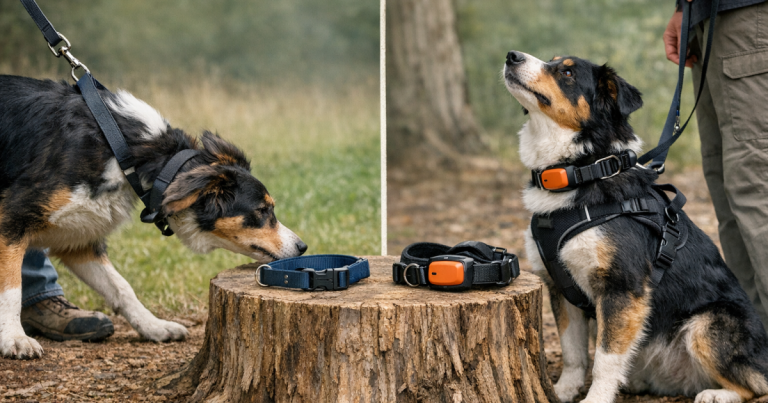
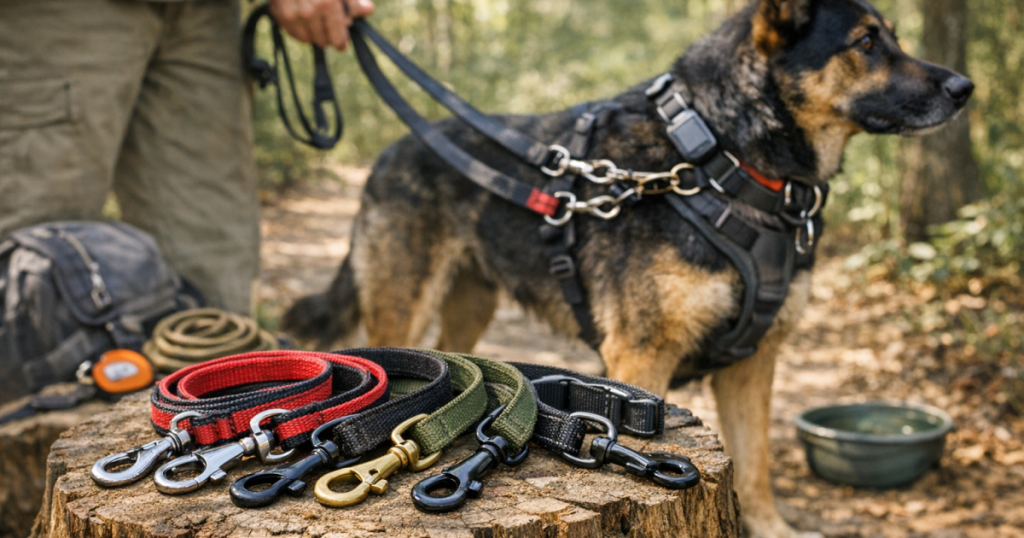
For a dog who can reverse out of a collar, double-ended training leads solve one specific problem: they let you connect two secure points, usually a harness and collar, so one failure does not instantly become a loose-dog emergency. They are not magic. They are a handling tool, and they work best when the fit of every other piece of gear has already been checked.
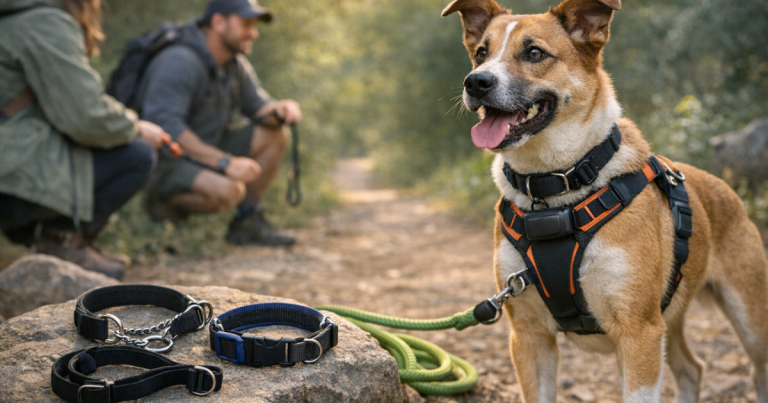
The best setup for most collar-slipping dogs is a double-ended lead clipped to a well-fitted harness and a properly sized martingale or buckle collar. The lead gives you redundancy; the collar or harness gives you retention. If either one fits poorly, the lead is just a very organized way to discover that at the worst possible moment.
The short answer for collar-slipping dogs
If your dog backs up, twists, plants their feet, or panics at thresholds, choose a double-ended lead that is comfortable in your hand, has secure clips, and is easy to shorten without fumbling. Use one clip on the harness and the other on the collar. Keep gentle contact on both points, not a constant pull on the neck.
For dogs that have already slipped a flat collar, do not rely on a standard collar alone. A limited-slip collar, a buckle martingale, or another escape-aware design may be a better backup point. The lead should support that setup, not replace it. For more detail on collar behavior and escape mechanics, read our guide to training collar features that help dogs who back out.
Best double-ended lead picks for different walking scenarios
These are not ranked by hype or hardware bravado. The right choice depends on how your dog tries to escape, where you walk, and how much handling complexity you can manage calmly when a squirrel appears and your dog suddenly becomes a sled team of one.
HALTI Training Lead: best everyday starting point
The HALTI Training Lead is a familiar option for owners who want a two-clip lead for daily neighborhood walks, training classes, and controlled practice. Its appeal is the straightforward multi-use format: one clip can attach to the harness and the other to the collar, or it can be adjusted for closer control when you are working near roads, parking lots, or busy sidewalks.
It is a sensible first choice if your dog is not a severe puller but has a history of reversing out of collars. The handling is simple enough for most owners to learn quickly, which matters. A complicated lead that stays in the drawer prevents exactly zero escapes.
EzyDog Vario 6 Multi-Function Leash: best for owners who want flexible handling
The EzyDog Vario 6 Multi-Function Leash is a good fit for owners who want one lead that can adapt between ordinary walks, closer traffic control, and two-point attachment. It is especially useful when your route changes: a quiet street, then a school pickup zone, then a park path where your dog suddenly notices rabbits.
Choose this style if you are willing to practice the adjustment points before the walk. The main benefit is flexibility; the trade-off is that flexible gear asks more of the handler. If another family member also walks the dog, make sure they know which clip goes where and how much slack to leave.
Blue-9 Multi-Function Leash: best for structured training sessions
The Blue-9 Multi-Function Leash fits owners who are working on calm leash skills, body awareness, and better responses around triggers. It makes sense when the dog’s collar slipping is part of a larger pattern: balking, spinning, pulling backward, or trying to escape pressure instead of moving with the handler.
This is the style to consider if you already use a training harness with front and back attachment points, or if your trainer has recommended two-point handling. It can help divide pressure across the dog’s body, but only when used calmly. Jerking both ends of a two-point lead is not better training; it is just twice the confusion.
Mekuti Balance Lead: best for gentle two-point control
The Mekuti Balance Lead is often discussed by owners who want a quieter, more cooperative feel from a two-point lead. It is best viewed as a handling aid for dogs who need guidance rather than force. For a dog who slips collars because they panic, that distinction matters.
It is a strong candidate for owners who are pairing lead handling with desensitization, confidence work, or professional training advice. Before buying, verify the clip size against your dog’s collar rings and harness rings, especially for toy breeds and narrow-headed dogs where hardware weight can become annoying fast.
How to set up a two-point lead before the first walk
Start indoors or in a fenced area. Clip one end to the harness and the other to the collar. Stand beside your dog, not directly behind them, and let the lead form a soft V shape. You should be able to guide the shoulders through the harness connection while keeping the collar clip as a backup, not as the main steering wheel.
- Check the harness first. A dog that can back out of a loose harness can still escape from a two-point lead. Use the pre-walk process in our guide to checking a dog harness for escape gaps before relying on it outside.
- Check collar fit second. The collar should not slide over the ears when your dog lowers their head and backs up. For narrow-headed breeds, collar shape matters as much as tightness.
- Assign the main connection. For most dogs, the harness should carry normal walking tension. The collar side should stay lightly managed as a safety backup.
- Practice shortening the lead. You should be able to gather the lead smoothly at curbs, trailheads, vet entrances, and car doors.
- Watch the clips. Rotate the lead in your hand if the hardware twists. Twisted clips can pull awkwardly and may encourage the dog to fight the pressure.
When a double-ended lead is not enough
A two-point lead is useful, but it does not fix fear, poor fit, or unsafe environments by itself. If your dog has slipped gear more than once, treat that as a systems problem. Look at the collar, harness, lead, ID tag, route choice, and your recovery plan together.
For Greyhounds, Whippets, Salukis, and other narrow-headed dogs, a standard flat collar may be the wrong backup point even with a double-ended lead. A no-slip collar can reduce the chance of the collar passing over the head when the dog reverses. Our guide to no-slip dog collars for narrow-headed dogs explains the fit differences that matter before you add the lead.
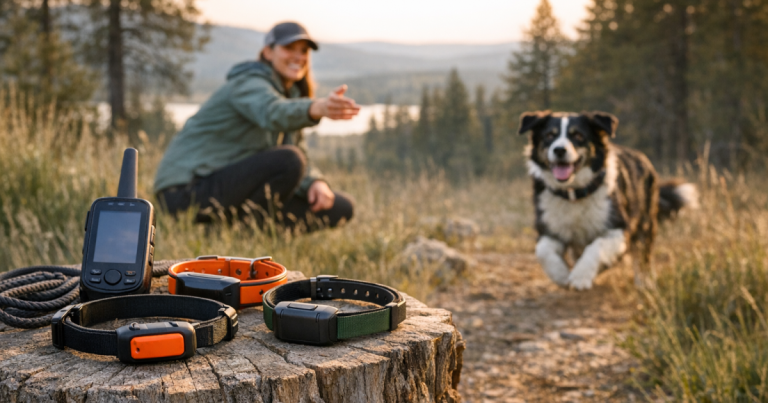
For dogs who bolt from cars, campsites, trailheads, or front doors, add layers. A visible ID tag, a charged GPS tracker, and a recent photo are not training tools, but they improve your odds if training gear fails. No tracker makes a dog escape-proof; it simply gives you more information when seconds feel very expensive.
Handling checks that prevent most lead mistakes
Use these checks on the first few walks, then repeat them whenever you change collar, harness, coat length, or leash setup.
- The backward test: With your dog calm, step slightly behind and encourage them to move backward a step. The collar should not approach the ears, and the harness should not slide over the shoulders.
- The door test: Before opening the front door or car door, shorten both sides of the lead and keep your dog beside you. Doorway escapes happen quickly because handlers are doing three jobs at once.
- The trigger test: If your dog sees a squirrel, another dog, or a delivery truck, you should be able to steady the harness without choking up hard on the collar end.
- The hand comfort test: If the lead burns, bunches, or becomes hard to manage after 10 minutes, it is the wrong daily setup for you, even if it looks clever online.
- The backup ID test: Check that tags, tracker mounts, and collar rings do not crowd the lead clip. Overloaded hardware is noisy, bulky, and easier to mishandle.
What to remember
The best lead for a collar-slipping dog is the one that gives you calm backup control without turning every walk into a rigging project. For most owners, the sweet spot is a simple double-ended lead attached to a secure harness and a collar designed for the dog’s head shape and escape habits.
Choose HALTI for a straightforward everyday start, EzyDog for flexible walking setups, Blue-9 for more structured training, and Mekuti when gentle two-point handling is the priority. Then practice before you need it. The time to learn which clip goes where is not when your dog has just spotted a deer, a skateboard, or the neighbor’s suspiciously confident cat.