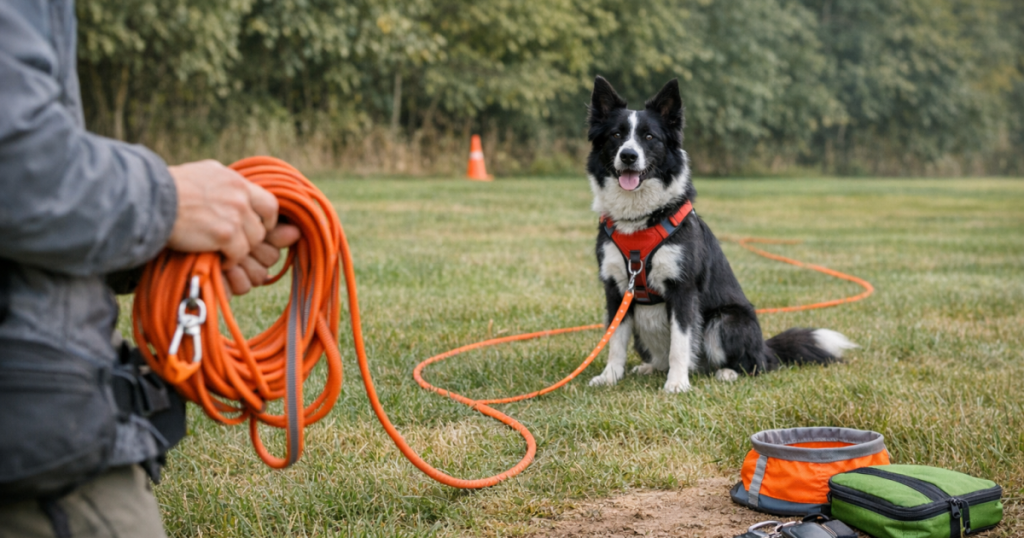
A long line gives your dog room to sniff, turn, and choose to come back without giving up control completely. The goal is to use a long line safely so recall practice feels calm, repeatable, and fair instead of turning into a high-speed tangle at the end of a leash.
Think of the line as a bridge between a regular leash and off-leash freedom. It is not a guarantee against escapes, but it gives you a controlled way to rehearse the exact moment your dog hears their name, disengages from the world, and returns to you.
Training a dog with a bite history, severe reactivity, or a serious public-control risk should be planned with a qualified dog trainer or veterinary behavior professional and follow local leash laws, park rules, and safety requirements.
At a glance
- Start with a 15- to 30-foot flat long line in a quiet, open area.
- Attach the line to a well-fitted harness for most recall practice, not to a slip collar or correction collar.
- Never wrap the line around your hand, wrist, waist, or leg.
- Keep light slack in the line, but stay ready to gather it before your dog reaches full speed.
- Practice recalls before your dog is overstimulated, not only after they are already chasing something.
- Treat GPS trackers, ID tags, and collars as backup layers, not as substitutes for handling and training.
Choose the right place before you clip on
The safest long-line session usually starts in a boring place. A fenced ball field when permitted, a quiet open lawn, an empty training field, or a wide backyard gives your dog space without forcing you to handle the line around cars, bikes, playgrounds, picnic tables, or other dogs.
Avoid crowded dog parks for recall practice on a long line. Lines can wrap around legs, clip other dogs, or create tension during greetings. Also avoid wooded trails until you and your dog have cleaner mechanics; trees and brush can turn a 30-foot line into a knot machine.
Before you begin, scan for the likely trigger. For some dogs it is squirrels. For others it is a jogger, a child with a ball, a loose dog, or the open edge of a parking lot. If you already know your dog may bolt toward one side of the field, stand so you are not between your dog and the hazard, and keep the line shorter in that direction.
Set up the gear so it helps rather than surprises your dog
A flat long line is easier to handle than a round cord for most owners. Many dogs do well starting at 15 or 20 feet; 30 feet gives more freedom but also more speed, more line on the ground, and more timing required from the handler. Longer is not automatically better.
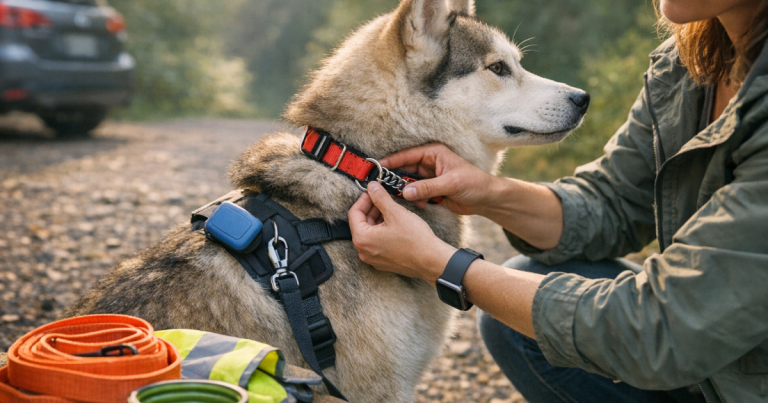
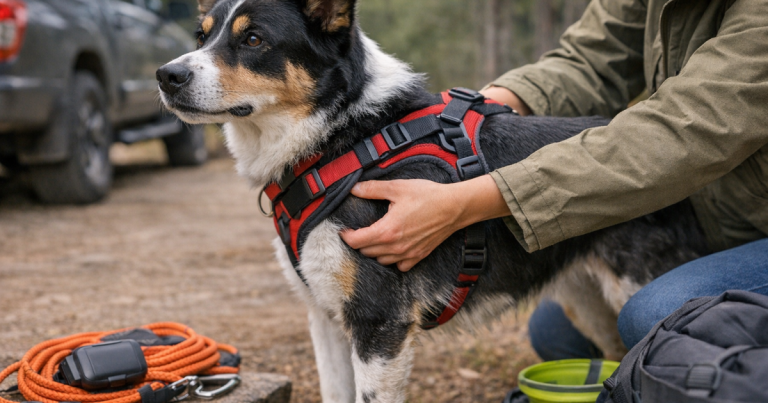
For recall practice, a harness is often the kinder attachment point because a dog can hit the end of the line suddenly. A back-clip or multi-clip harness spreads pressure better than a neck-only setup if the dog surges forward. If you also use a collar for ID or everyday walks, make sure it fits securely; escape-prone dogs may need a different collar style, and it is worth reviewing how to fit a martingale collar for escape-prone dogs before relying on one near distractions.
Do a quick equipment check before every session:
- Clip closes fully and swivels freely.
- Harness is snug enough that your dog cannot back out.
- Line has no frays, knots, or weak spots.
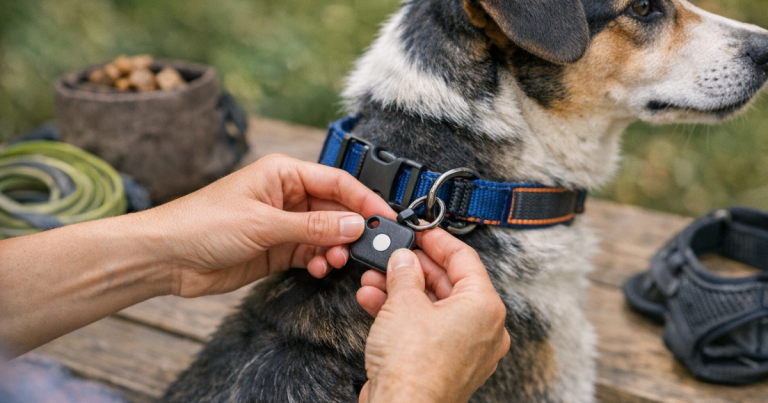
- ID tag is attached and readable.
- GPS tracker, if used, is secure and not bouncing under the chest or throat.
Hold the long line without creating a trap
The safest grip is simple: hold the handle or a folded section in one hand, and use your other hand to feed or gather slack as your dog moves. Keep the spare line in loose, open loops rather than tight coils around your fingers. If your dog takes off, you want the line to slide and slow, not cinch around skin.
Do not wrap the line around your hand, wrist, waist, or belt. A medium or large dog can build speed quickly over 20 feet, and a sudden stop can pull you off balance. Gloves can help protect your hands, but they do not make it safe to anchor yourself to the line.
Watch the line as much as the dog. If it starts to drift behind your knees, around your ankle, under your dog’s belly, or across another person’s path, pause the session and reset. Long-line handling is less glamorous than the perfect recall, but it is the part that keeps everyone upright.
Build the recall in small, successful repetitions
Start when your dog is only mildly distracted. Let them sniff, say their recall cue once, then move backward as you encourage them toward you. When they arrive, reward close to your body so they learn that coming all the way in is worthwhile. Then release them back to sniff again if the area is safe.
That release is important. If every recall ends the fun, many dogs begin to slow down, hover just out of reach, or scan for a better offer. A good session includes easy wins: call, reward, release, repeat. The dog learns that returning to you does not always mean the adventure is over.
Use the line as a boundary, not as the main instruction. If your dog ignores the cue, gently gather the line and move away from the distraction instead of yanking. The message should be, “Come with me,” not, “You are being dragged.” If the dog cannot respond at all, you are too close to the distraction or the environment is too difficult for that stage of training.
Manage speed before your dog reaches the end
The hardest moment with a long line is not when the dog is standing still. It is when they launch. A dog who has 25 feet of runway can hit the end hard enough to startle themselves and strain your shoulder.
Prevent that by keeping a soft bend in the line instead of letting all 30 feet trail loose while your dog stares at a trigger. Gather a few feet as soon as their body gets tall, their ears lock forward, or their weight shifts into a chase posture. Step sideways, lower your center of gravity, and call before the sprint begins.
If your dog repeatedly hits the end, shorten the working length. There is no training prize for using every foot you own. A 10-foot working radius with calm returns is better than a 30-foot radius full of jolts and frustration.
Practice real-life scenarios, not just empty-field obedience
Once your dog is responding well in a quiet space, add realistic but manageable distractions. Ask for a recall near a low-interest smell. Then near a person at a distance. Later, near a dog behind a fence or a squirrel far across the field. Increase only one challenge at a time: distance, distraction, or excitement level.
For backyard escape artists, recall practice should pair with gate routines. Practice calling your dog away from the gate, rewarding them for turning back, and clipping the line before opening the latch. If your dog has already slipped out once, keep a plan for how to track a dog after a backyard gate escape so the household knows what to do before panic takes over.
For hiking dogs, rehearse trail-specific cues before you need them. Call your dog off a scent trail, away from water, and back to your side when people appear ahead. In rural areas, a long line can help with training, but it will not remove the risks of wildlife, livestock, roads, or poor cellular coverage for trackers.
Use safety backups without trusting them too much
A visible ID tag and a properly fitted collar are still useful during long-line sessions, even if your dog is wearing a harness. If the harness clip fails or your dog backs out, the collar gives you another identification layer. A GPS tracker can add recovery support, but it depends on fit, power, coverage, and the type of tracking system being used.
If you move a tracker from a collar to a harness, or change collars during training, run a short mounting check before giving your dog room to run. A device that hangs sideways, rotates under the throat, or catches on the long line may be less useful when you need it most. The same thinking applies after coat changes, bath days, and seasonal shedding.
Households with a genuine flight-risk dog should also keep printed photos, leash backups, and contact numbers in one place. A simple lost dog recovery kit can save time when everyone is anxious and trying to remember what comes next.
Common mistakes to avoid
- Using the long line like a brake at full speed: slow the dog before they accelerate, and shorten the line near triggers.
- Repeating the recall cue over and over: say it once, help the dog succeed, then make the next repetition easier.
- Letting the line drag through crowded spaces: keep it gathered when people, dogs, bikes, or strollers are nearby.
- Attaching to unsafe equipment: avoid using a long line on choke chains, prong collars, head halters, or poorly fitted collars during running practice.
- Moving to hard environments too soon: a dog who recalls in the yard may not be ready for deer, beach birds, or a busy trailhead.
What people usually ask
How long should a long line be for recall training?
For most dogs and handlers, 15 to 30 feet is enough. Start shorter if your dog is powerful, easily startled, very young, or new to recall work. A shorter line gives you better timing and reduces the force if your dog runs to the end.
Should the line drag or stay in my hand?
Keep it in your hand while you are learning. Letting it drag can work in controlled settings with an experienced handler, but it also creates snagging risks and makes it harder to prevent a sudden chase.
Can I use a retractable leash instead?
A retractable leash is not the same as a training long line. It keeps constant tension, can be difficult to grip safely, and may not give you the same smooth ability to gather slack. A flat long line is usually easier to manage for structured recall practice.
A calm way to finish each session
End before your dog is fried. Two or three clean recalls near mild distractions often teach more than 20 sloppy repetitions after your dog has lost focus. Clip back to a regular leash, reward a calm walk out of the area, and note what worked: distance, distraction level, line length, and reward type.
Good recall practice is built in ordinary moments, not dramatic ones. A well-handled long line gives your dog a little freedom while giving you time to guide the choice you want: turn away, come back, and stay connected even when the world smells interesting.