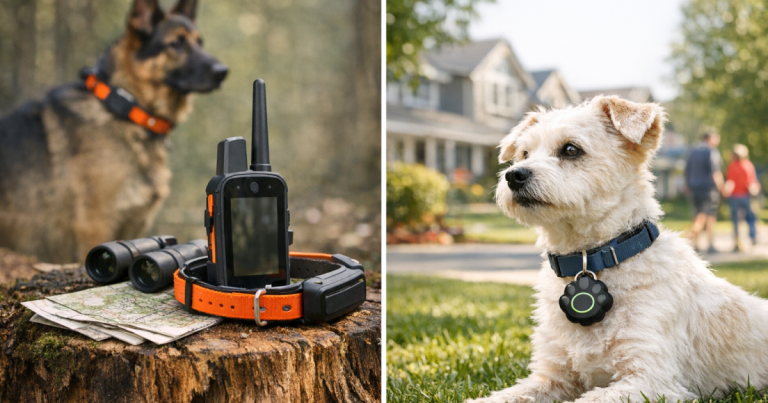

A dog that slips the yard and keeps moving creates a different problem than a dog who usually circles the block. FitBark GPS vs Pawscout is really a choice between a cellular GPS tracker built for wider-area location work and a Bluetooth community tag built for short-range awareness and recovery handoffs.
Quick Buying Links
FitBark GPS 2nd Gen Pet Location + Health Tracker
escape-prone dogs needing GPS/cellular location, safe-place alerts, health monitoring, and broader US traceability
Pawscout Bluetooth Smarter Pet Tag
Better as a low-cost neighborhood backup with Bluetooth range alerts, community lost-pet posts, and rescuer contact flow
The calmer way to choose is to picture the first ten minutes after an escape. Are you trying to see a moving location beyond your street, or are you trying to get a local alert, a scan contact, and a low-cost backup on the collar? Both tools can support recovery, but they do very different jobs.
In brief
- Choose FitBark GPS 2nd Gen if your priority is GPS and cellular tracking, virtual fences, safe-place escape alerts, activity and sleep monitoring, and location history.
- Choose Pawscout Bluetooth Smarter Pet Tag if you want a lower-cost Bluetooth tag with outdoor virtual leash alerts, community lost-pet alerts, lost-pet posts, and a rescuer scan/contact flow.
- Do not treat them as interchangeable. FitBark is a GPS/cellular pet tracker. Pawscout is a Bluetooth and community recovery tag, and Pawscout’s official bundle page says the Bluetooth tag will not show the pet’s exact location.
- For fence-jumpers, travel escapes, rural properties, and off-leash hikes, the verified facts favor FitBark’s GPS/cellular model, subject to cellular signal and battery state.
- For neighborhood backup, collar ID support, and short-range awareness, Pawscout is the simpler, lower-cost option with a free app and optional Pawscout Pro plan.
If your dog is already a known escape artist, a tracker decision should sit inside a larger prevention plan. Our guide to GPS dog trackers with fast escape alerts can help you compare wider escape-alert options once you know whether Bluetooth is enough for your situation.
What each device is built to do
FitBark GPS 2nd Gen
FitBark describes the FitBark GPS 2nd Gen as a pet location and health tracker collar attachment. Its official specification includes on-board GPS, mobile phone GPS, Wi-Fi APIs, cell-tower data, LTE Cat M1 cellular coverage, and Bluetooth Low Energy. FitBark states US cellular network support through Verizon, AT&T, and T-Mobile 4G LTE-M networks.
That mix matters because FitBark’s recovery role is not just “near my phone.” The manufacturer-stated role includes real-time GPS tracking, virtual fences, safe-place escape alerts, and location history. FitBark also lists activity tracking, sleep monitoring, health alerts, wellness alerts, and 5-year location history with subscription.
The editorial takeaway is straightforward: FitBark is the better match when the problem is distance. If your dog bolts past the end of the street, disappears behind houses, or leaves the campground loop, a Bluetooth-only tool is not designed for that job.
Pawscout Bluetooth Tag / Pawscout Smarter Pet Tag
Pawscout positions its tag differently. The official facts describe a Bluetooth-enabled cat and dog tag that communicates with the Pawscout App on the owner’s phone and other Pawscouters’ phones. Pawscout states a 300 ft outdoor Bluetooth range, plus outdoor virtual leash alerts when a pet goes in or out of range of the phone or guardians.
Pawscout’s recovery features focus on neighborhood and community help: lost pet alerts to nearby Pawscouters, rescuer tag scan flow, two-way notifications, and lost-pet posts. It also offers walk tracking and pet records through the app experience, but it should not be described as a GPS tracker.
The editorial takeaway is that Pawscout is best understood as a smart identification and community-alert layer. It is useful when a nearby person, nearby phone, or rescuer interaction is part of the recovery path. It is not the tool you pick when you need a precise moving location beyond Bluetooth range.
Side-by-side: the differences that change the decision
- Lost-pet recovery role: FitBark provides real-time GPS tracking, virtual fences, safe-place escape alerts, and location history. Pawscout provides Bluetooth range awareness, an outdoor virtual leash, community lost-pet alerts, and rescuer scan/contact flow.
- Location technology: FitBark uses GPS, LTE Cat M1 cellular, Wi-Fi, and Bluetooth Low Energy. Pawscout uses a Bluetooth tag with the Pawscout app and community phones.
- Range or coverage: FitBark’s official materials describe nationwide embedded cellular coverage and traceability in the United States where cellular signal is available. Pawscout’s official range claim is 300 ft outdoors to the phone or another Pawscouter.
- Subscription model: FitBark requires an in-app subscription for its built-in SIM and service plans. Pawscout has a free app, with Pawscout Pro optional at $0.99 monthly or $9.99 yearly.
- Device price shown: FitBark’s official product page shows a $34.95 sale price and $69.95 regular price. Pawscout lists buying starting at $19.95.
- Water resistance: FitBark is IP67, with submersion up to about 3.3 ft for up to 30 minutes. Pawscout is IPX7 water resistant.
- Pet compatibility: FitBark is for dogs and cats, fits pets from 5 lb, and fits flat collars not wider than 1.5 in. Pawscout is a Bluetooth-enabled cat and dog tag.
- Battery approach: FitBark uses a rechargeable lithium-ion polymer battery. Pawscout uses a replaceable CR2032 battery sold through Pawscout.
Where FitBark has the stronger recovery case
FitBark’s advantage is the combination of GPS and cellular service. For a dog who runs beyond the yard, crosses into another subdivision, or vanishes from sight during a hike, the official coverage model gives it a recovery role Pawscout is not built to match.
This does not make FitBark foolproof. Cellular trackers depend on signal, device power, collar attachment, and the tracker being on the dog when the escape happens. FitBark’s own official materials list live tracking battery life as up to 6 hours, which is much shorter than normal mixed-use expectations. In a real recovery plan, that means live tracking is a tool to use deliberately, not something to burn through casually while everyone argues in the driveway.
FitBark is also the only option in this comparison with official activity, sleep, health alerts, wellness alerts, and long location history claims. That does not replace veterinary care or hands-on observation, but it does mean FitBark has a broader everyday monitoring role than Pawscout.
The most sensible FitBark buyer is the owner who needs both escape alerts and a moving-location tool. That might be the person with a gate-dasher, a dog who has slipped a harness at a trailhead, or a small dog from 5 lb who still needs a lightweight collar attachment rather than a bulky field collar.
Where Pawscout makes more sense
Pawscout’s strength is not wide-area tracking. Its strength is lower-cost collar intelligence close to home: Bluetooth range awareness, a virtual leash alert, lost-pet posts, rescuer scan/contact flow, and nearby Pawscouter alerts.
That can be valuable for dogs whose escapes are usually hyperlocal. Think of the dog who squeezes through a porch gap, visits the same neighbor, or wanders around the apartment complex courtyard. In those situations, a 300 ft outdoor Bluetooth range and a community recovery workflow can be useful. A Bluetooth tag also makes sense as a backup layer alongside a plain engraved ID tag, because recovery often depends on the first person who can safely read or scan something on the collar.
Pawscout also has the lower official starting price and a lighter ongoing commitment. The app is free, while Pawscout Pro is optional at $0.99 monthly or $9.99 yearly. That makes it easier to justify as a secondary safety tag for a dog who already wears traditional identification.
The boundary is important: Pawscout’s official bundle page says the Bluetooth tag will not show the pet’s exact location. If that exact-location expectation is the reason you are shopping, Pawscout is the wrong primary tool.
Price and subscription trade-offs
FitBark costs more to operate because GPS service is subscription-based. The official FitBark product page lists an in-app subscription requirement, with plans shown from $4.00 to $10.00 per month depending on term. That recurring cost is tied to the broader tracking role: GPS service, cellular connectivity, and the location/monitoring features FitBark lists.
Pawscout is cheaper at the device level, starting at $19.95, and its app is free. Pawscout Pro is optional, with official pricing at $0.99 monthly or $9.99 yearly. For a dog owner who wants a smart tag rather than a GPS tracker, that difference matters.
The fair comparison is not simply “which costs less?” It is “what are you paying to solve?” FitBark asks you to pay more because it is built around GPS/cellular tracking and monitoring. Pawscout costs less because it is built around Bluetooth range, community visibility, and scan/contact recovery, not exact GPS location.
Fit, collar setup, and daily wear
FitBark’s official specs make its fit case unusually clear: it weighs 0.56 oz, fits pets from 5 lb, and works with flat collars not wider than 1.5 in. That makes it relevant for many small dogs, but the collar format still matters. A tracker that twists under the neck, sits against a buckle, or gets buried under thick fur can become annoying or less practical in daily use.
Pawscout is described as a Bluetooth-enabled cat and dog tag. The supplied evidence does not list a weight or collar-width requirement for Pawscout, so the responsible comparison is limited to its role as a tag rather than a collar attachment with stated size thresholds.
For either device, the tracker or tag should not be the only thing carrying your phone number. A simple engraved ID tag remains one of the fastest recovery tools when a neighbor, camper, or animal control officer is close enough to help. If your dog’s collar setup is overdue for a refresh, use our guide to choosing dog ID tags for faster lost-pet recovery before relying on electronics alone.
How the recovery workflow feels in real life
Fence escape in a suburban neighborhood
With FitBark, the useful moment is the escape alert and the ability to follow GPS/cellular location information while service and battery support it. The goal is to reduce the blind search radius quickly: which street, which direction, which safe place, which last known area?
With Pawscout, the useful moment is different. You are working within Bluetooth range, community alerts, lost-pet posts, and a rescuer scan/contact flow. That can be enough when the dog is still nearby or when another Pawscout user or rescuer becomes part of the chain.
Campground or trailhead scare
For off-leash hiking, rural areas, or wider escape scenarios, the evidence favors FitBark’s GPS/cellular model, with the practical limits already noted: cellular coverage and battery state. Pawscout’s 300 ft outdoor Bluetooth range is not a backcountry tracking plan. It can still act as a collar tag, but it should not be asked to do a GPS tracker’s work.
Scared dog sighting
Technology helps most when the human response stays calm. If a frightened dog has been spotted, the wrong move can push them farther away. Whether a location came from FitBark, Pawscout, a neighbor, or a tag scan, pair the information with low-pressure recovery tactics. Our lost-dog recovery guide explains how to catch a scared lost dog without chasing.
Helpful questions
Is Pawscout a GPS tracker?
No. Pawscout is a Bluetooth-enabled pet tag that works with the Pawscout app and other Pawscouters’ phones. Its official outdoor Bluetooth range is 300 ft, and Pawscout’s official bundle page says the Bluetooth tag will not show the pet’s exact location.
Does FitBark require a subscription?
Yes. FitBark’s official product page states that an in-app subscription is required. The listed plans run from $4.00 to $10.00 per month depending on term.
Which is better for a dog who slips out of the yard?
FitBark is the stronger primary option when the dog may travel beyond nearby Bluetooth range, because it uses GPS and cellular service where signal is available. Pawscout is better framed as a lower-cost neighborhood and community recovery layer.
Can either device guarantee recovery?
No tracker or tag can guarantee recovery. FitBark depends on coverage, battery state, and proper attachment. Pawscout depends on Bluetooth range, the owner’s phone or another Pawscout app user, and rescuer or community interaction.
Which one should you choose?
Choose FitBark GPS 2nd Gen if your main fear is not knowing where your dog went. Its verified GPS/cellular model, safe-place escape alerts, virtual fences, location history, and monitoring features make it the more capable primary tracker for dogs who run farther than a few houses away. It is also the better fit for travel, off-leash hiking, rural properties with cellular signal, and dogs whose escape pattern is unpredictable.
Choose Pawscout Bluetooth Smarter Pet Tag if you want an affordable smart tag for short-range awareness and community-assisted recovery. Its verified strengths are the 300 ft outdoor Bluetooth range, virtual leash alerts, lost-pet alerts to nearby Pawscouters, lost-pet posts, two-way notifications, and rescuer scan/contact flow. It is a sensible backup for neighborhood dogs and a useful companion to traditional ID, but it should not be treated as exact-location tracking.
The cleanest decision is this: use FitBark when GPS/cellular location is the job, and use Pawscout when Bluetooth range, scan contact, and community alerts are enough for the risk you are managing. For many devoted dog owners, Pawscout is the collar backup; FitBark is the recovery tool you want when the map needs to move with the dog.
Quick Buying Links
FitBark GPS 2nd Gen Pet Location + Health Tracker
escape-prone dogs needing GPS/cellular location, safe-place alerts, health monitoring, and broader US traceability
Pawscout Bluetooth Smarter Pet Tag
Better as a low-cost neighborhood backup with Bluetooth range alerts, community lost-pet posts, and rescuer contact flow