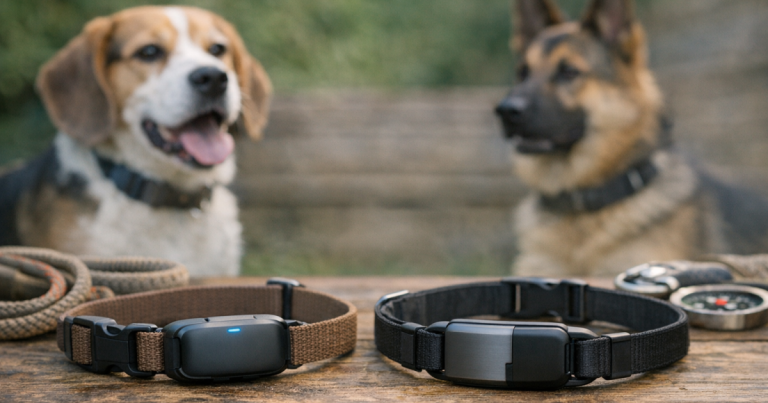
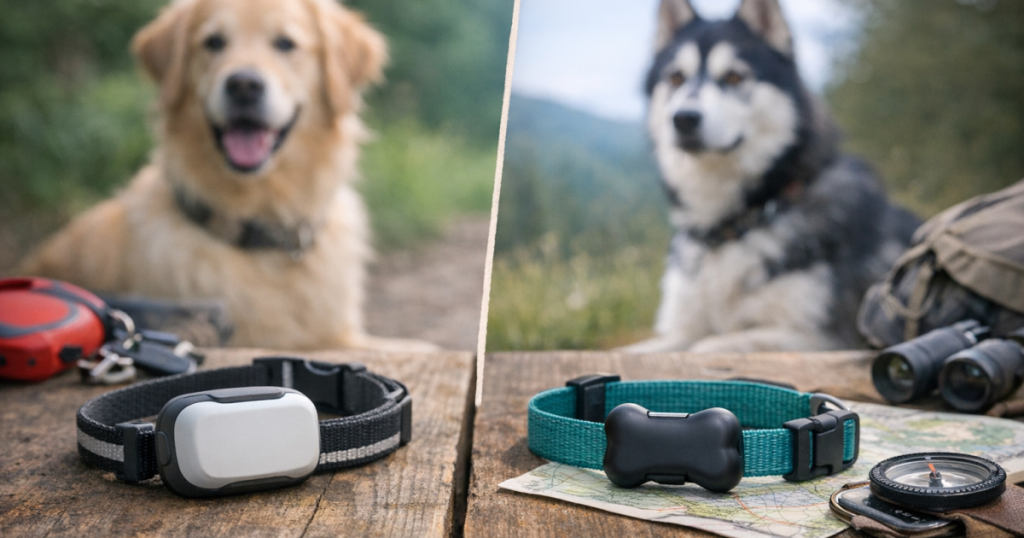
A loose latch, a distracted houseguest, a rabbit at the edge of the yard: most lost-dog scares start small. The Whistle GO Explore vs FitBark GPS decision is less about finding a perfect tracker and more about choosing the device whose coverage, comfort, alerts, and wellness features match the way your dog actually gets into trouble.
Quick Buying Links
Whistle GO Explore
owners who want escape alerts, location tracking, and wellness monitoring in a straightforward daily safety routine
FitBark GPS
Better for data-minded households that value activity trends and health-style insights alongside cellular GPS location tracking
Both trackers sit in the same broad lane: collar-worn GPS devices for everyday dogs, with companion apps and subscription-based cellular tracking. Neither one is a magic recovery guarantee. Cellular coverage, battery habits, fit, notification timing, and how quickly you respond all matter. The useful question is not “which one is perfect?” It is “which one gives my household the clearest, most practical warning before a scary situation gets worse?”
The short version
Choose Whistle GO Explore if your priority is a fuller lost-pet safety routine with geofence alerts, location tracking, and wellness-style monitoring in one familiar consumer tracker. It is the easier fit for many dog owners who want one device to cover daily escape alerts, walks, and general health trends without overcomplicating the setup.
Choose FitBark GPS if you are especially interested in activity and health-style insights alongside GPS location, and you want a compact tracker that fits into a more data-driven view of your dog’s routine. It makes sense for owners who already pay close attention to sleep, movement, weight management, or recovery after a change in activity.
For lost-dog prevention, both should be judged by the same practical filters: cellular coverage where your dog actually roams, how reliably alerts reach your phone, whether the tracker sits comfortably on your dog’s collar, and whether your household will keep it charged and worn every day.
Where the two trackers overlap
Both devices are designed for owners who want more than a basic ID tag but do not need a hunting-grade handheld system. They are best understood as everyday cellular GPS trackers: useful around neighborhoods, suburbs, dog parks, travel stops, and many routine walking routes, provided the device can connect through its supported network.
- Both are worn on or attached to a dog’s collar.
- Both pair with a mobile app for location and activity-related features.
- Both rely on a subscription plan for core tracking service, so check current plan terms before buying.
- Both can help you notice a dog leaving a defined safe area, depending on settings, signal, and phone notifications.
- Both should be backed up with visible ID, updated microchip information, and a practiced lost-dog response plan.
For a Whistle GO Explore vs FitBark GPS comparison, the overlap matters because neither product should be treated like a rugged field system or a no-service satellite beacon. If your dog disappears into a canyon, deep timber, or a dead zone with poor cellular service, either tracker may have limits. That does not make them useless; it just means the best choice depends heavily on your normal environment.
Side-by-side decision points
Tracking approach and coverage dependence
Whistle GO Explore and FitBark GPS both use GPS location combined with cellular connectivity to send location data to your phone. That means the map experience depends on more than the tracker’s hardware. Your local cell coverage, surrounding buildings, tree cover, terrain, and the device’s current connection can all affect how quickly and consistently you see updates.
Before committing to either tracker, check the brand’s current US coverage guidance and look closely at your real use areas: your yard, your usual walking loop, the dog sitter’s house, your favorite trailhead, and the highway rest stops you use when traveling. A tracker that works beautifully around your home may behave differently at a rural cabin or campground.
Escape alerts and geofencing
The strongest everyday value of either tracker is often the early warning. If your dog slips out before you notice, an alert can change the whole recovery timeline. Instead of discovering an empty yard 20 minutes later, you may know while your dog is still close enough to intercept calmly.
Whistle GO Explore is a strong candidate for households that want a straightforward safe-zone routine: home boundary, phone alert, then location follow-up. FitBark GPS also supports location-based safety use, but many owners will be drawn to it because the tracking sits alongside a broader activity profile.
With either device, geofence alerts are not instant physical barriers. They depend on location checks, signal conditions, app settings, notification permissions, and battery state. Test alerts during calm daylight hours rather than waiting for a real escape. Walk the tracker outside your safe area, time how the alert behaves, and make sure every responsible adult in the household knows what the notification means.
Health and activity insights
This is where FitBark GPS often feels most distinctive. FitBark has long appealed to owners who like monitoring activity patterns and health-style trends, especially when a dog’s routine changes. If your dog is recovering from a period of reduced exercise, gaining weight, aging into a gentler schedule, or needing more consistent movement, those insights may be genuinely useful.
Whistle GO Explore also includes wellness and activity-style features, so it is not simply a dot-on-a-map tracker. The difference is more about emphasis. Whistle tends to feel like a safety tracker with wellness layered in, while FitBark GPS may appeal more to owners who want GPS plus a stronger activity-tracking mindset.
Do not treat consumer tracker insights as veterinary diagnosis. They are best used as pattern-spotting tools: noticing less movement, unusual rest, or changes that prompt you to observe your dog more closely. For illness, pain, limping, sudden lethargy, or behavior changes, your veterinarian is the right next step.
Fit, comfort, and collar setup
Small details decide whether a tracker becomes part of daily life or ends up in a drawer. A device can have excellent features and still be wrong for a particular dog if it bumps the water bowl, rotates under the neck, catches on harness straps, or feels bulky on a smaller frame.
Whistle GO Explore is best evaluated on the collar your dog already wears most often. Check how the tracker attaches, whether it stays stable during sniff-heavy walks, and whether it sits comfortably when your dog lies down. For dogs with narrow necks, long coats, or sensitive skin, attachment style matters as much as the app.
FitBark GPS is also worth checking carefully on toy breeds, lean dogs, and dogs that roughhouse hard at daycare. A compact tracker still needs to sit securely and avoid rubbing. Whatever you choose, test it at home for a full day before relying on it during travel or off-property walks.
Battery habits and charging reality
Published battery claims can be helpful, but they rarely tell the whole story. Real battery life changes with signal strength, update frequency, active tracking modes, app behavior, temperature, and how often your dog leaves safe zones. A tracker working hard in weak coverage may drain faster than one sitting quietly at home.
For many owners, the better question is not “which tracker lasts longest on paper?” but “which tracker fits my charging routine?” If you already charge a phone, smartwatch, and headphones every night, another device may be easy. If your dog’s collar hangs by the door and you forget until morning, choose the tracker whose app reminders and charging rhythm you are most likely to maintain.
- Set a recurring charging time before the first low-battery warning matters.
- Keep the charging cable somewhere obvious, not buried in a drawer.
- Check battery level before road trips, boarding drop-offs, hikes, and fireworks-heavy holidays.
- Do one “worst normal day” test: a long walk, errands, indoor downtime, and evening yard time.
Which one fits common dog-owner scenarios?
The fence-jumper or door-dasher
For a dog that bolts through doors, squeezes gates, or jumps fences, Whistle GO Explore has the more natural appeal for owners who want a simple escape-alert habit. The practical win is not just seeing a map. It is getting a prompt, understandable warning while the dog may still be close.
FitBark GPS can still work well here, particularly if you also want activity data, but do not let health features distract from the recovery workflow. For a true escape artist, prioritize alert reliability, coverage around your neighborhood, collar security, and fast access to the live location screen.
The wellness-tracked family dog
FitBark GPS is a compelling option for owners who like to watch patterns. Maybe your dog has become less active after a move. Maybe winter weather has shortened walks. Maybe you are trying to keep a middle-aged Lab from slowly turning couch time into a lifestyle. FitBark’s appeal is that location tracking and activity awareness live together.
Whistle GO Explore can also support wellness routines, but if the activity side is your emotional reason for buying, FitBark GPS deserves close attention. Just remember that safety features still depend on coverage and subscriptions, not just a good-looking app dashboard.
The traveler, camper, or weekend hiker
Neither tracker should be chosen for remote wilderness work without checking coverage first. Around hotels, suburbs, rest stops, vacation rentals, and many populated trail towns, cellular GPS tracking can be very helpful. On backcountry trails, rural acreage, or deep wooded areas, signal gaps can reduce usefulness.
If you travel with your dog, test whichever tracker you choose before the trip. Add temporary safe zones when the app supports them, update your dog’s ID tag, save a current photo, and make sure the tracker is seated firmly after every collar adjustment. For night walks at unfamiliar stops, visibility gear can help drivers and pedestrians see your dog sooner; our NiteHowl Rechargeable LED Safety Necklace review covers one add-on that pairs well with a tracker-focused safety plan.
The small dog or sensitive dog
Small dogs need a comfort-first decision. Look beyond the product photo and imagine the tracker on your dog during naps, crate time, fast turns, and leash pressure. A device that feels modest on a 65-pound dog may be annoying on a 12-pound dog.
For either Whistle GO Explore or FitBark GPS, verify the current weight, recommended pet size, and attachment dimensions before buying. If your dog wears a harness more often than a collar, check whether the tracker’s attachment is still practical for daily use. GPS trackers are usually designed around collars, and moving them to a harness can affect stability or convenience.
What to verify before you buy either tracker
The right choice depends partly on features, but the owner checklist matters just as much. Before you buy, compare the current manufacturer details rather than relying on old screenshots, third-party summaries, or assumptions from a previous pet tracker.
- Subscription structure: confirm monthly or annual plan options, cancellation terms, and whether GPS tracking requires an active plan.
- Coverage: check the supported US carrier network and compare it with your home, walking routes, sitter location, and travel areas.
- Battery expectations: read current battery guidance, then assume your results may vary with signal strength and tracking frequency.
- Water resistance: verify the current rating if your dog swims, runs through sprinklers, or plays in heavy rain.
- Collar compatibility: check strap width, attachment method, and how securely the tracker sits on your dog’s normal collar.
- App sharing: confirm whether multiple family members can access the dog’s location and who receives alerts.
- Return window: test fit, notifications, and local coverage while you still have options if the tracker is not right.
If you like comparing setup habits and recovery planning beyond this head-to-head, the GPS dog tracker blog has more practical articles on escape prevention, travel routines, and choosing backup safety gear.
Pros and trade-offs
Whistle GO Explore
- Good fit for owners who want a safety-first tracker with location alerts and wellness features in one device.
- Works best when your main risk is a dog leaving home, a yard, or a familiar safe area.
- Needs careful setup of safe zones, phone notifications, and charging routines to be genuinely useful.
- May not be the right tool for remote areas where cellular coverage is weak or inconsistent.
- Comfort and attachment should be tested on your dog’s actual collar before relying on it outside the house.
FitBark GPS
- Good fit for owners who want activity and health-style pattern tracking alongside location safety.
- Useful for households that already pay attention to movement goals, rest, routine changes, or weight-management habits.
- Still requires the same practical GPS checks: coverage, subscription terms, app alerts, collar fit, and battery behavior.
- May be more tracker than you need if your only concern is a simple escape alert.
- Like any collar-mounted device, it should be tested for rubbing, rotation, and stability during real daily movement.
Questions people ask
Is Whistle GO Explore better than FitBark GPS for lost-dog recovery?
Whistle GO Explore may be the more natural pick if escape alerts are your top priority, but recovery reliability depends on coverage, battery, setup, and response speed. FitBark GPS can still support recovery well when it has service and is worn consistently.
Do both trackers require a subscription?
Both are generally sold as subscription-based cellular GPS trackers. Confirm current plan requirements before buying, because core location features typically depend on active service.
Can either tracker replace an ID tag or microchip?
No. A GPS tracker is an active recovery tool, not a complete identification system. Keep a readable ID tag on your dog and make sure the microchip registry has your current phone number.
Which tracker is better for hiking?
Either can help on hikes with reliable cellular coverage. For remote trails, verify coverage first and carry backup safety gear; a cellular tracker may struggle where phones also lose service.
How soon should I test a new dog tracker?
Test it during the first 48 hours. Check collar comfort, safe-zone alerts, app notifications, battery drain, and location behavior around the places your dog actually goes.
Final thoughts
Pick Whistle GO Explore if your main worry is the sudden escape: the gate left open, the dog who bolts after wildlife, the family member who forgets to latch the door. Its appeal is the practical, everyday safety rhythm of safe zones, alerts, and location follow-up.
Pick FitBark GPS if your dog’s location matters, but you also want a fuller picture of movement and routine. It is the more natural match for owners who will actually use activity data, notice changes, and fold those patterns into everyday care.
The calmest answer is to choose the tracker you will maintain consistently. A perfectly reviewed device with a dead battery or loose collar mount will not help much. Set it up carefully, test it in your real environment, keep your dog’s ID information current, and treat GPS as one layer in a broader lost-dog recovery plan.
Quick Buying Links
Whistle GO Explore
owners who want escape alerts, location tracking, and wellness monitoring in a straightforward daily safety routine
FitBark GPS
Better for data-minded households that value activity trends and health-style insights alongside cellular GPS location tracking
GPSDogTrackers.com may earn from qualifying purchases through product links. You can read how that works in our affiliate disclosure.