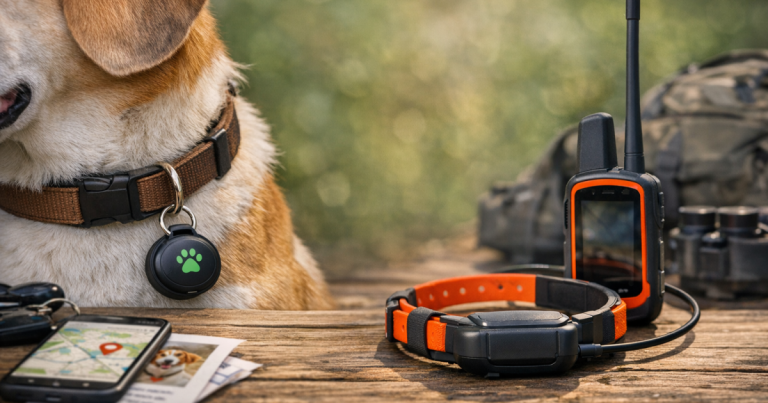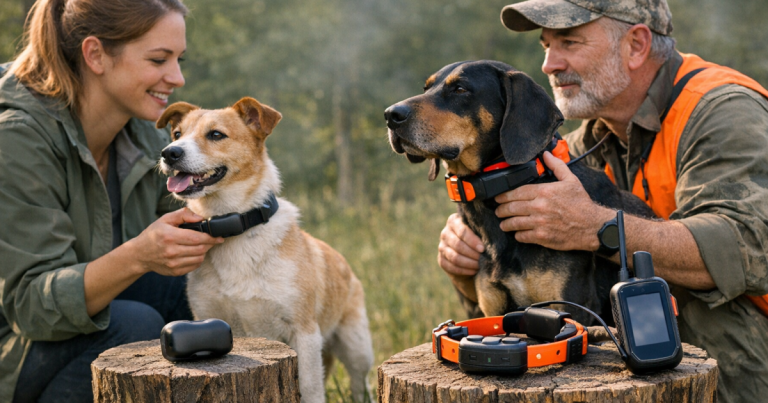
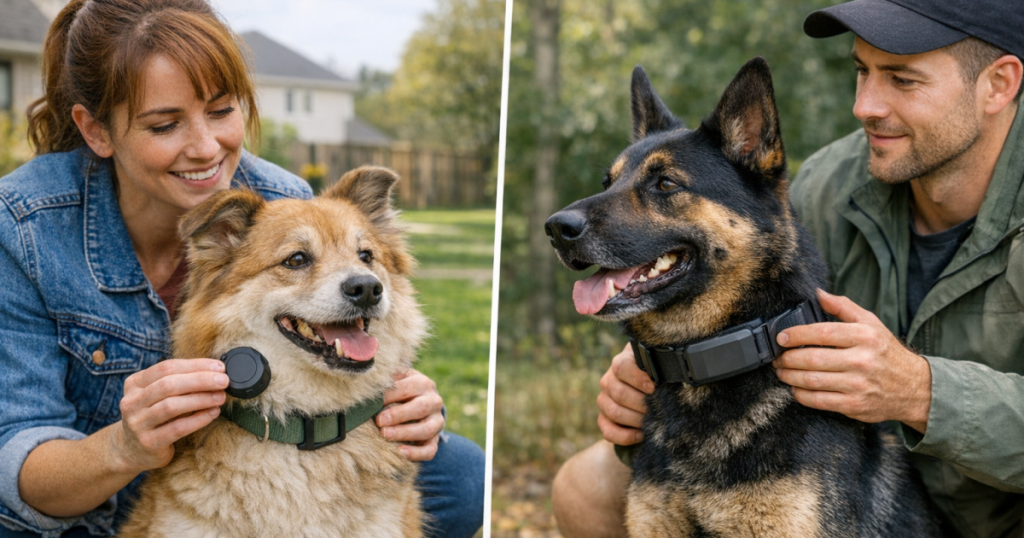
A dog slipping through a half-open gate is not the moment to discover your tracking setup is built for the wrong kind of recovery. Pawscout Smarter Pet Tag vs Fi Ultra is really a choice between a Bluetooth community recovery tag and a live GPS/LTE/satellite dog tracker, not two versions of the same tool.
Quick Buying Links
Pawscout Smarter Pet Tag
low-cost neighborhood recovery support, Bluetooth proximity awareness, and community-assisted lost-pet contact workflows
Fi Ultra
Better for US dog owners needing live GPS recovery features, escape alerts, and paid remote tracking
That distinction matters because both can help in a lost-pet situation, but they help in very different ways. One leans on local range, the Pawscout app, and nearby community participation. The other is built for remote dog tracking in the United States with an active plan or membership.
What to know first
- Pawscout is a Bluetooth smart pet tag and lost-pet recovery app accessory, not a standalone GPS/LTE tracker.
- Fi Ultra is a GPS/LTE/satellite dog tracker designed for use within the United States, with satellite connectivity not extending internationally and no satellite coverage in Alaska.
- Pawscout has a stated 300-foot outdoor local range and can broadcast a lost-pet alert to Pawscouters within a 5-mile radius.
- Fi Ultra provides instant escape alerts and real-time location tracking with an active GPS/LTE plan or membership.
- Pawscout starts at $19.95 on the official source used for this comparison. Fi Ultra is listed at $299 regular price, with $209 shown as a promo price on the official shop result.
- Neither choice is a magic homing beacon. Pawscout depends on Bluetooth, app, and community interactions; Fi notes real-time communication limits where the app cannot communicate with the tracker in areas with no cell service.
The core difference: proximity recovery or live tracking
The Pawscout Smart Pet Tag is best understood as a recovery-support tag. It uses Bluetooth with the Pawscout app and nearby Pawscout community phones. The official Pawscout materials describe the Bluetooth Smarter Pet Tag as having a 300-foot outdoor range, Outdoor Virtual Leash alerts when the pet goes in or out of range of the owner’s phone or guardians, and lost-pet alerts that broadcast within a 5-mile radius.
That makes Pawscout a better fit for owners who want a collar-worn tag that supports neighborhood recovery, ID-style contact, and app-based community help without turning the tag into something it is not. If your dog is usually in familiar places, and your biggest fear is a gate pop, yard escape, or quick breakaway near home, Pawscout’s recovery workflow is the more relevant part of the story.
The Fi Ultra is built around a different job. Fi describes Ultra as live GPS tracking with cellular and T-Satellite with Starlink satellite connectivity, plus instant escape alerts and real-time location tracking with an active GPS/LTE plan or membership. Fi also states Ultra is for dogs in the United States only, with satellite connectivity not extending internationally.
For a dog who hikes off leash, slips out during travel stops, or covers ground fast after escaping, Fi Ultra is the stronger recovery tool on verified tracking capability. It is the option here with live GPS recovery features, but it also brings a required paid service layer and a charging routine.
Side-by-side differences that actually affect recovery
Tracking and recovery method
Pawscout uses Bluetooth, the Pawscout app, and nearby Pawscout community phones. Its recovery model includes lost-pet reports, broadcast alerts, a rescuer scan/contact workflow, and community features. That is useful, but it is not the same as watching a moving dot update through a remote tracking system.
Fi Ultra uses live GPS tracking with cellular and T-Satellite with Starlink satellite connectivity. Its recovery model centers on instant escape alerts, real-time location tracking, and live GPS recovery features when the required plan or membership is active. If the decision is purely about following a loose dog beyond immediate Bluetooth range, Fi Ultra has the more capable verified tracking method.
Range, coverage, and real-world limits
Pawscout states a 300-foot outdoor local range. Its lost-pet alert can be broadcast to Pawscouters within a 5-mile radius, which adds a community layer when people nearby are using the system. That is a meaningful difference from a passive engraved ID tag, but Pawscout still depends on Bluetooth/app/community interactions.
Fi Ultra is designed for use within the United States. Its satellite connectivity does not extend internationally, and Fi states satellite coverage is not available in Alaska. Fi also says Ultra is for off-leash use, not off-grid use; in areas with no cell service, the app may not communicate with the tracker in real time. That caveat is important for owners picturing remote backcountry certainty. Fi Ultra offers far more remote tracking capability than Pawscout, but it should not be treated as a guarantee in every terrain or signal condition.
For remote hiking decisions beyond this head-to-head, our guide to the best dog GPS trackers for remote hikes in 2026 digs further into how coverage and trail conditions change the choice.
Alerts and owner response
Pawscout’s Outdoor Virtual Leash alerts when the pet goes in or out of range of the owner’s phone or guardians. That makes sense for close-range awareness: dog drifts beyond Bluetooth range, owner gets a prompt, owner checks immediately. It is a useful nudge for parks, yards, and familiar outdoor routines.
Fi Ultra’s verified alert story is more recovery-oriented for an escaping dog. The official shop listing describes instant escape alerts and real-time location tracking with an active GPS/LTE plan or membership. Fi Ultra also includes sound and vibration that can be triggered from the Fi app, with adjustable intensity settings. No equivalent official recall or attention feature is confirmed for Pawscout’s Bluetooth Smarter Pet Tag.
Wearable format and attachment
Pawscout is a Bluetooth-enabled pet tag for cats and dogs, with the official shop listing the Pawscout Tag and Tag & Nameplate Bundle. It is the more tag-like option in this comparison, which is part of its appeal for owners who want a simple collar accessory rather than a full GPS tracker.
Fi Ultra uses a universal integrated clip that attaches to harnesses, working dog vests, and thick leather collars. Fi lists the Ultra at about 3.0 inches by 1.6 inches by 1.0 inch, converted from the manufacturer’s stated metric dimensions, and about 2.4 ounces. That format is more substantial than a tag, but it also supports the live tracking system Fi is selling.
Water resistance
Pawscout’s official shop lists the tag as IPX7 water resistant. For everyday dog life, that matters: wet grass, rain, a messy water bowl, and the occasional splash are not rare events.
Fi Ultra is listed with an IP68 waterproof rating and is tested in salt water. If your dog’s escape risks overlap with lakes, beaches, wet trails, or working-dog routines, Fi has the stronger verified water-resistance claim in this comparison.
Battery and charging routine
Pawscout uses a replaceable watch battery for the Bluetooth Smarter Pet Tag. That suits an owner who does not want another device charging beside the phone and leash pile. The trade-off is that Pawscout’s recovery model remains a Bluetooth/community system.
Fi Ultra is rated for 2 to 3 days of battery life and charges by USB-C. Fi also states the Fi Base is not needed or included. That creates a more familiar rechargeable-device routine: more capability, but also more responsibility to keep the tracker ready before hikes, travel days, and high-risk outings.
Paid service layer
Pawscout Pro is optional and is available monthly or yearly. The shared verified evidence notes that Pawscout Pro adds alerts, scan history, boosted posts, and other benefits, while core app and tag functions also exist outside Pro.
Fi is different: all products require a GPS/LTE plan selected at activation, and Fi Membership is required for remote tracking capabilities. For budget planning, that is one of the clearest dividing lines. Pawscout is the lower-cost hardware choice with optional Pro features; Fi Ultra is the higher-cost tracker with a required service layer for the remote-tracking job most buyers are considering it for.
Where Pawscout makes more sense
Pawscout is the more sensible pick if you want a low-cost smart tag that adds recovery structure without committing to a full GPS tracker. It is especially compelling for close-to-home routines: a dog who spends most days around the house, yard, neighborhood sidewalks, dog-friendly patios, or familiar parks.
Its strongest verified advantages are straightforward. The hardware starts at $19.95 on the official source used here. It supports cats and dogs. It offers a 300-foot outdoor Bluetooth range, Outdoor Virtual Leash alerts, a lost-pet broadcast to Pawscouters within a 5-mile radius, and a rescuer scan/contact workflow. For a family that wants a smarter backup than a traditional tag, Pawscout Bluetooth Smarter Pet Tag fills a real gap.
The editorial caution is equally clear: do not buy Pawscout expecting GPS behavior. It is not the tool for watching a fast dog move across town, tracking an off-leash dog on a remote trail, or replacing a dedicated live tracker for a known escape artist.
Where Fi Ultra makes more sense
Fi Ultra is the stronger choice when the problem is distance, speed, or delayed discovery. If your dog has a history of leaving the yard, slipping gear during travel, or ranging farther than you can comfortably scan by sight, Fi’s live GPS tracking, cellular connection, and T-Satellite with Starlink satellite connectivity make it the more serious recovery option here.
Its attachment system also points toward more active dogs. Fi states the universal integrated clip attaches to harnesses, working dog vests, and thick leather collars. That flexibility matters for owners who do not rely on one everyday collar for every outing.
The cost and upkeep are the trade. Fi Ultra Dog Tracker is listed at $299 regular price and $209 with promo on the official shop result used for this comparison, and remote tracking requires an active GPS/LTE plan or membership. Its 2 to 3 day battery rating means charging belongs in the same routine as packing water, checking leash hardware, and confirming ID tags before a trip.
Fi Ultra is not the right recommendation for cats because official support limits compatibility to dog profiles only. It is also not an international satellite tracker. For US dog owners who understand those boundaries, it is the more capable recovery device in this pair.
Trade-offs owners should not gloss over
- Convenience versus recovery reach: Pawscout is easier to justify as a low-cost smart tag. Fi Ultra reaches into live remote tracking, but with a higher device price and required service.
- Community help versus owner-led tracking: Pawscout can broadcast to nearby Pawscouters and support rescuer contact. Fi Ultra is built for the owner to follow location data through the Fi app.
- Battery style: Pawscout uses a replaceable watch battery. Fi Ultra uses USB-C charging and is rated for 2 to 3 days.
- Species fit: Pawscout is positioned for cats and dogs. Fi Ultra is compatible with dog profiles only.
- Travel boundaries: Pawscout’s app is accessible in the USA and Canada. Fi Ultra’s satellite-enabled use case is US-only, with no international satellite coverage and no satellite coverage in Alaska.
- Water exposure: Pawscout is IPX7 water resistant. Fi Ultra is IP68 waterproof rated and tested in salt water.
Recommendation: pick the recovery job, not the shiniest device
Choose Pawscout if your priority is affordable, collar-worn recovery support for a pet who is usually close to home. It is the better match for owners who want Bluetooth range awareness, Pawscout community alerts, and a rescuer contact workflow without paying for remote GPS tracking. It is not a GPS tracker, and that boundary is exactly why it belongs in a different lane.
Choose Fi Ultra if your dog’s risk profile demands live tracking: off-leash outings, fence escapes, travel stops, working-dog gear, or situations where a few blocks can become a few miles quickly. Fi Ultra has the stronger verified recovery feature set for dogs because it combines GPS, cellular, and T-Satellite with Starlink connectivity, instant escape alerts, and real-time tracking with the required plan or membership.
The calmest setup for many owners is not one device doing everything; it is layered preparation. A tracker or smart tag should sit alongside visible ID, good leash-transfer habits, current contact details, and a recovery plan your household already understands. If you are building that full plan, start with a lost dog recovery kit buying guide so the device you choose becomes part of a faster, cleaner response.
For this specific comparison, the editorial preference is simple: Pawscout wins on low-cost smart-tag recovery and close-range community support; Fi Ultra wins for US dog owners who need live remote tracking and are prepared for the required paid plan and charging routine.
Quick Buying Links
Pawscout Smarter Pet Tag
low-cost neighborhood recovery support, Bluetooth proximity awareness, and community-assisted lost-pet contact workflows
Fi Ultra
Better for US dog owners needing live GPS recovery features, escape alerts, and paid remote tracking