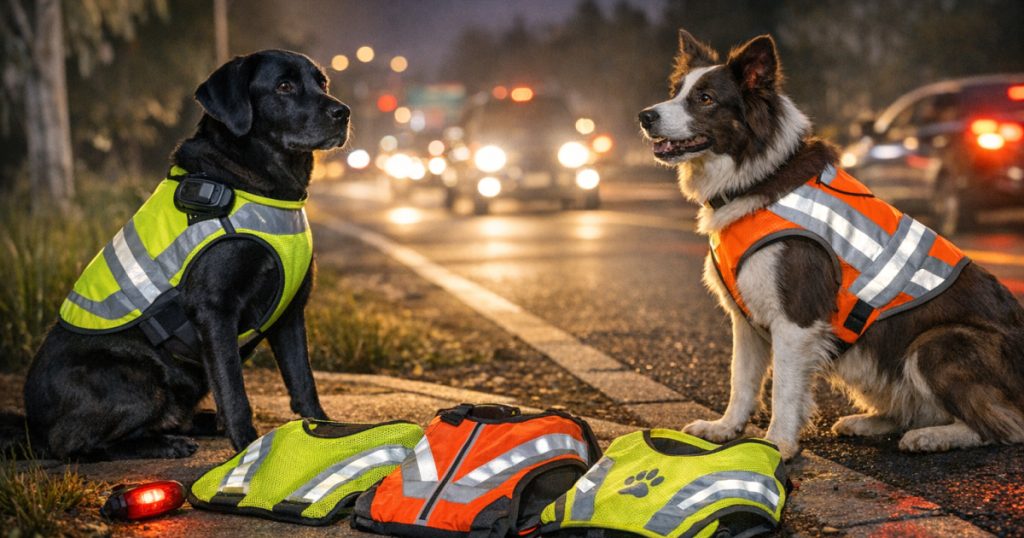
A dark sidewalk, wet pavement, and headlights coming around a bend can make even a large dog hard to see. For night walks close to traffic, the best reflective vests for dogs are the ones that make your dog visible from the side, stay centered while they move, and do not interfere with the leash, harness, ID tag, or GPS collar you already rely on.
The short version
A reflective dog vest should do three jobs well: create a bright outline, reflect light from multiple angles, and stay secure when your dog sniffs, trots, shakes, or pivots. Near traffic, side visibility matters just as much as visibility from behind because drivers often approach from cross streets, driveways, and parking-lot entrances.
- Choose a vest with bright high-visibility fabric plus reflective trim or panels.
- Prioritize shoulder and rib-cage coverage, not just a small reflective patch on the back.
- Check that the vest does not cover the collar, ID tag, leash attachment, or GPS tracker antenna area.
- Use lights as a supplement, not a replacement for a reflective layer.
- Test the fit at home before relying on it along a busy road.
Step 1: Match the vest to the way your dog moves near traffic
The right vest depends less on the product photo and more on your dog’s walking pattern. A calm senior dog on a short neighborhood loop needs a different setup than a young retriever weaving from grass strip to curb, or a small terrier partly hidden by parked cars.
For sidewalk walks beside moving traffic, look for a vest that shows clearly from both sides of the dog’s body. If your dog is low to the ground, a vest that sits high on the back but has little side coverage can disappear behind curbs, leaves, and headlights. For dogs with thick coats, the vest also needs enough contrast to stand out against fur rather than blending into it.
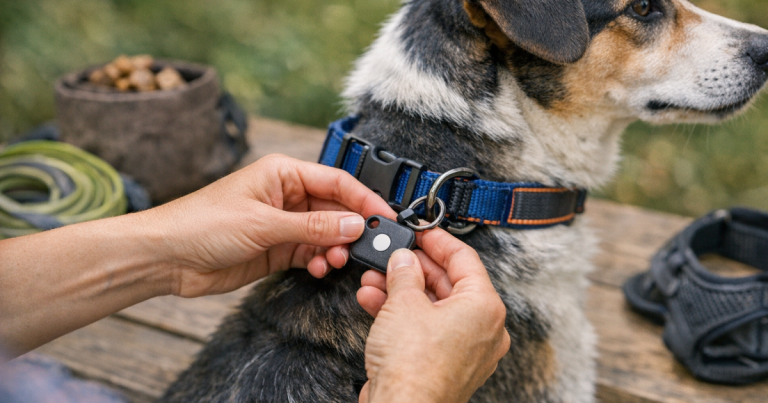
If your dog already wears a GPS collar, do not bury it under extra layers. A visibility vest should work around your recovery gear, not weaken it. If you are unsure whether your current setup is sitting correctly, use this guide to position a dog GPS collar for a better signal before adding a vest over or around it.
Step 2: Use real products as reference points, not magic shields
No reflective vest makes a dog safe by itself. Drivers still need time, distance, and a clear line of sight. But a well-fitted vest can make your dog easier to notice during the exact moments that worry owners most: stepping off a curb, crossing a driveway, walking beside a shoulder, or being seen against dark grass.
These are useful examples to compare by scenario, without treating any one vest as foolproof:
- Ruffwear Track Jacket: a visibility layer from an outdoor dog-gear brand, useful as a reference for owners who want a vest-style garment that can go over a dog during active walks.
- SafetyPUP XD Reflective Dog Vest: a straightforward high-visibility vest style that is easy to understand at a glance and suited to owners who want a simple visual layer for neighborhood walks.
- Vizpet High Visibility Dog Vest: another simple reflective vest example to evaluate if you want broad visual contrast without changing your dog’s normal collar or harness routine.
- Noxgear LightHound: not a reflective vest in the traditional sense, but a lighted harness-style visibility option to consider when your route has very dark stretches or poor street lighting.
When scanning owner reviews, pay more attention to fit comments than star ratings alone. Useful reviews mention whether the vest twists, whether closures stay put after several walks, whether the dog tolerates the material, and whether the vest remains visible from the side. A photo taken in a bright kitchen does not tell you how the vest performs beside wet pavement at dusk.
Step 3: Check side visibility before you trust it on the road
A vest can look bright from above and still be weak where it matters. Before your first roadside walk, put the vest on your dog and view them from the front, back, and both sides. Then repeat the check while they are moving.
- Stand at driveway distance and look at your dog from the side.
- Have another person walk the dog past a parked car so you can see what disappears behind the vehicle line.
- Use a flashlight from different angles to see which reflective areas actually return light.
- Check whether the leash blocks the reflective panel when your dog pulls slightly ahead.
- Watch for twisting after your dog shakes or lowers their head to sniff.
If the vest only flashes from behind, it may be fine for a quiet trail but less useful near intersections. For traffic-adjacent walks, you want visibility that survives real movement: sniffing, turning, stopping, and stepping sideways when a truck passes.
Step 4: Make sure the fit is secure but not annoying
A reflective vest that irritates your dog will not become part of your nightly routine. The fit should be snug enough that the vest does not rotate, but loose enough that your dog can breathe, walk, and lower their head naturally. After fastening it, slide two fingers under the main contact points and watch your dog move for a few minutes indoors.
Pay close attention to the armpit area, chest, belly straps, and the back edge of the vest. Small dogs can be overwhelmed by stiff panels or bulky closures. Deep-chested dogs may need careful strap adjustment so the vest does not ride forward. Long-coated dogs may need a brighter color or larger reflective surface because loose fur can cover narrow strips.
If your dog freezes, scratches at the vest, or walks with a shortened stride, do not push straight into a traffic-heavy route. Let them wear it for a short indoor session, then a calm driveway or yard session, and then a short block walk before making it part of your regular night route.
Step 5: Build the vest into a wider escape-prevention routine
Visibility gear is most valuable when it is part of a system. A vest helps drivers and neighbors see your dog; it does not stop a leash slip, gate dash, or fence jump. Dogs that startle at buses, motorcycles, trash trucks, or loose dogs need a walking setup that accounts for panic as well as darkness.
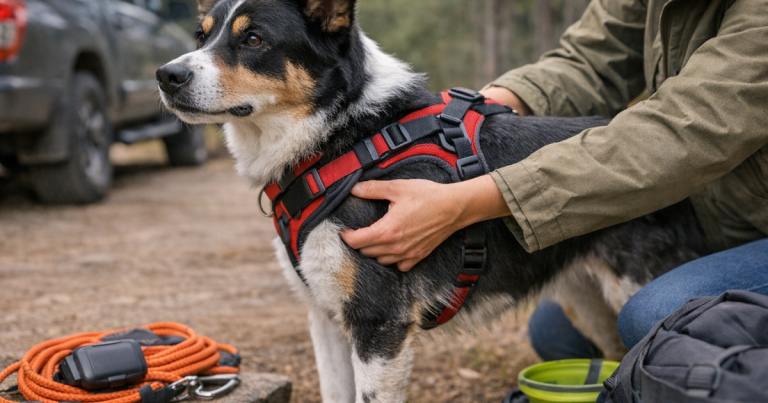
Before heading out, check the leash clip, collar or harness fit, ID tag, tracker placement, and the vest closure. If your dog has a habit of launching over barriers or using yard time as a warm-up for escape attempts, night visibility should pair with home prevention work. The same dog who vanishes over a fence at dusk can end up near traffic before you have time to react, so it is worth reviewing how to stop a dog from jumping the yard fence alongside your walking gear setup.
Step 6: Add light only where it solves a real problem
Reflective material needs light hitting it. On streets with headlights, porch lights, and streetlamps, a reflective vest can do a lot of useful work. On unlit roads, wooded shoulders, or rural lanes, an active light can make your dog easier to spot before a beam catches the reflective panel.
That does not mean every dog needs a glowing setup. Some dogs dislike extra straps or moving lights. Others are already wearing a harness, collar, ID tag, and GPS tracker, and too much gear can create rubbing or leash tangles. If you add a light, keep the arrangement simple and test it with the full walking setup your dog actually uses.
FAQ
What are the best reflective vests for dogs near traffic?
The safest choice is usually a high-visibility vest with side coverage, reflective trim or panels, secure closures, and a fit that does not twist. Specific examples worth using as reference points include Ruffwear Track Jacket, SafetyPUP XD Reflective Dog Vest, and Vizpet High Visibility Dog Vest.
Is a reflective leash enough for night walks?
A reflective leash helps, but it does not show the full shape or position of your dog. Near traffic, a vest gives drivers and cyclists a clearer visual cue, especially when your dog is beside you, slightly ahead, or partly hidden by parked cars.
Should my dog wear a reflective vest over a harness?
Only if the vest does not block the leash attachment, restrict shoulder movement, or cause the harness to shift. Put the full setup on at home and check it while your dog walks, turns, sits, and sniffs.
Can a Bluetooth tag replace a reflective vest or GPS tracker?
No. A Bluetooth tag is a short-range recovery aid, not visibility gear and not the same as live GPS tracking. For more detail, see why the Tile Pro is a useful backup, not a dog GPS tracker.
How often should I replace a reflective dog vest?
Replace it when the reflective areas look dull, the fabric tears, closures loosen, or the vest no longer stays centered. Also reassess fit after weight changes, coat changes, or switching harnesses.
Final thoughts
A good reflective dog vest is not about making night walks feel dramatic or over-geared. It is about giving drivers, cyclists, neighbors, and you a clearer chance to see your dog before the risky moment happens. For walks near traffic, favor broad side visibility, comfortable fit, simple closures, and compatibility with your leash, ID, and tracker setup.
The best routine is boring in the best possible way: vest on, leash checked, tracker clear, ID visible, route chosen, and dog comfortable. That small habit can turn a stressful dark walk into something calmer, safer, and easier to repeat.