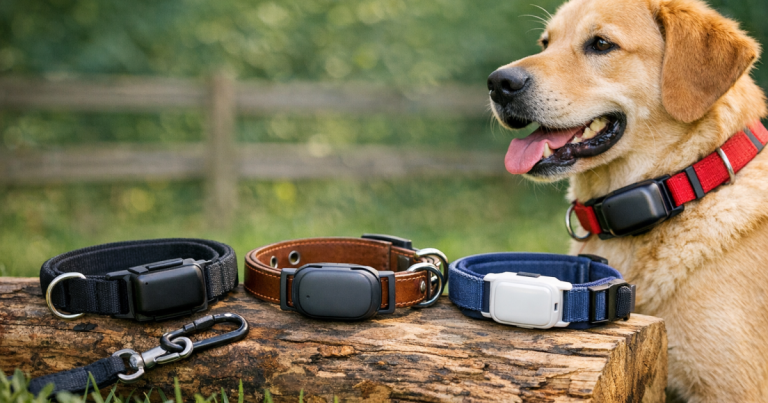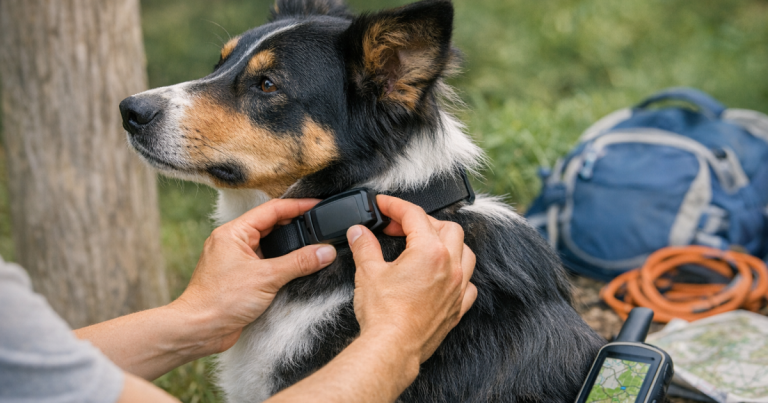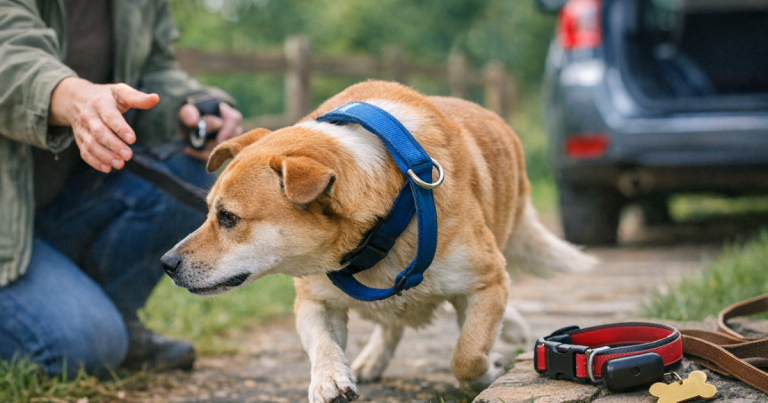
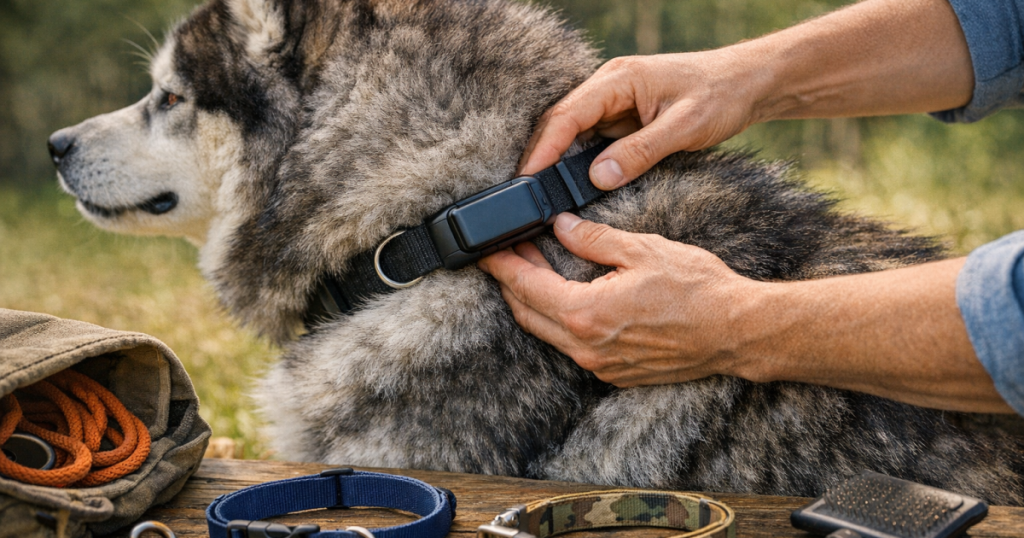
A thick ruff can make a tracker look secure when the contact point is actually floating on fur. The goal when you fit a GPS dog collar is not to flatten the coat, but to create steady strap contact, a stable tracker position, and enough comfort for normal breathing, sniffing, and turning.
This matters most for dogs with dense neck coats, feathering, or seasonal undercoat changes: Huskies, Malamutes, Great Pyrenees, Golden Retrievers, German Shepherds, Collies, Newfoundlands, and many mixed breeds. A collar that seems snug in the kitchen can rotate, slide forward, or disappear into coat once your dog starts trotting, shaking, or pushing through brush.
Main points
- GPS does not need bare skin contact, but the tracking unit does need a stable position and, on many devices, a clear orientation that is not buried under heavy coat or twisted under the jaw.
- Check fit at the base of the coat, not on top of the fluff. Your fingers should reach the strap itself, not just press into fur.
- Use motion checks after fitting: head down, head up, shake, trot, turn, and sniff. Thick coat hides movement until the dog actually moves.
- Recheck after outdoor wear. A double coat compresses, expands, sheds, and mats, so a good fit is not a one-time adjustment.
Start with the right neck position
Place the collar on the middle-to-upper part of the neck unless the tracker maker gives different instructions. Too low on the neck can let the device swing toward the chest or catch in shoulder ruff. Too high, directly behind the ears, may feel restrictive and can be more likely to shift when the dog lowers their head.
For a thick-coated dog, use your fingers to part the coat before buckling. You are looking for the actual neckline, not the outer silhouette of the fur. On a fluffy dog, the difference can be more than an inch visually, which is why a collar can look tight while still sitting loose underneath.
Do not shave a patch just to improve tracking unless a veterinarian or groomer has specifically advised it for another reason. GPS tracking relies on satellites and network communication, not skin contact. The fit problem is usually rotation, looseness, pressure, or poor module position, not fur blocking an electrode.
Step-by-step fitting method
1. Brush out the neck area first
Before adjusting the collar, gently brush or comb the area where the strap will sit. You do not need a show-groom finish. You are simply removing tangles, loose undercoat, burrs, and flattened mats that can create pressure points or make the collar feel tighter after a walk.
Pay attention behind the ears, under the jaw, and along the side of the neck. These are common places for thick-coated dogs to develop hidden mats, especially if they swim, hike, or wear gear frequently.
2. Buckle the collar over the coat, then settle it down
Fasten the collar loosely at first. Then use your fingers to work the strap through the top layer of coat until it rests closer to the dog’s neck. You are not trying to cinch the fur flat; you are helping the collar sit evenly instead of perching on the outer coat.
Rotate the collar gently once around the neck if the dog tolerates it. This helps distribute hair underneath the strap. If the collar drags, snags, or twists the fur, stop and reset rather than forcing it.
3. Use the two-finger check correctly
The familiar two-finger rule still helps, but only when your fingers are under the strap itself. Slide two fingers between the collar and the dog’s neck, pushing through the coat until you feel the strap. Your fingers should fit with light resistance. If they slip in with lots of empty space, the collar is probably too loose. If you have to wedge them in, it is too tight.
For very small dogs or narrow-necked breeds, two adult fingers may be too much space. In that case, use the tracker maker’s size guidance and focus on whether the device stays stable without compressing the throat, rubbing the skin, or restricting jaw and shoulder movement.
4. Position the tracker so it cannot roll under the chin
Most collar-mounted trackers work best when the device stays on the upper side or side of the neck rather than hanging below the throat. A unit that rotates under the jaw is more likely to bump bowls, rub fur, or shift when your dog sniffs the ground.
If the tracker attaches to an existing collar, check that the mount is tight enough for the collar width and thickness. A loose mount can slide even when the collar itself fits well. If attachment security is the weak point, this guide to secure GPS tracker collar attachment gives a useful next step before you rely on the setup outdoors.
5. Run a one-minute movement test
After fitting, do not judge the collar while your dog is standing still. Ask for a few normal movements or use treats to encourage them naturally:
- Head lowered to sniff the floor or grass.
- Head lifted toward you.
- A turn to each side.
- A short trot across the room or yard.
- A full-body shake, if your dog offers one naturally.
Watch the tracker, not just the buckle. If the module swings, rolls under the neck, or pulls the collar forward into the throat, adjust again. A thick coat can hold the strap in place for a moment, then release it once the dog moves.
Comfort checks after ten minutes
Let your dog wear the fitted collar indoors or in a fenced area for about ten minutes before treating it as trail-ready. Then remove it and check the coat and skin where the strap sat. You are looking for flattened but not creased fur, no red skin, no damp hot spots, and no obvious line where the collar dug in.
On double-coated dogs, some flattening is normal. Deep ridges, broken hair, repeated scratching, coughing, gagging, or reluctance to lower the head are signs to stop and refit. If irritation appears quickly, the issue may be collar width, strap edge, coat condition, or wearing time rather than simple tightness.
Also check the buckle and tracker housing after your dog has rested, sniffed, and moved. If the collar is gradually migrating, tightening it one hole is not always the right answer. Sometimes the collar material is too slick for the coat, the mount is too heavy for the strap, or the device is better worn on a dedicated tracking collar instead of an everyday decorative collar.
What changes with seasonal coat
Thick-coated dogs do not have the same neck size all year. Heavy undercoat, post-bath fluff, shedding season, and a fresh grooming session can all change collar fit. A collar adjusted in winter may become loose after a major shed. A collar adjusted right after a grooming appointment may feel tighter once loose coat builds up again.
Make a habit of checking fit before higher-risk situations: road trips, hikes, fireworks weekends, boarding stays, campsite arrivals, and visits to unfamiliar yards. These are the moments when a door dash or leash slip can turn into a recovery situation fast.
Once you know how to fit a GPS dog collar on your own dog’s coat, the best routine is simple: check before the outing, watch during the first few minutes, and inspect after removal. The collar should be secure enough to keep the tracker oriented, but comfortable enough that your dog forgets about it.
Tracker accuracy still needs a separate test
A good collar fit supports better real-world tracking, but it does not make any GPS device foolproof. Cellular coverage, terrain, buildings, tree cover, battery level, update intervals, and the tracker’s own design can all affect what you see during a search.
Before trusting the collar for off-leash time, walk a controlled route with your dog on leash and compare the reported location with where you actually are. Try the test near your home, at a park, and near the type of trail or rural area where you expect to use it. For a more structured routine, use this checklist on how to test your dog tracker’s accuracy before off-leash time.
Fit and tracking performance are connected, but they are not the same thing. A perfectly fitted collar can still struggle in a weak coverage area. A strong tracker can still become less useful if the unit rotates, the mount loosens, or the battery is not checked before a long day out.
Common thick-coat fitting problems and fixes
The collar looks snug but slides over the head
This usually means the collar was measured over the outer coat rather than near the neck. Part the fur, settle the strap, and test again with gentle forward pressure. If your dog has a narrow head, broad ruff, or escape history, a standard flat collar may not be enough for leash control even if it can carry a tracker.
The tracker keeps ending up under the throat
The collar may be too loose, the device may be too heavy for the strap, or the attachment point may be sliding along the collar. Reposition the module, tighten in small increments, and repeat the movement test. If it still rolls, consider whether a wider or more structured collar is appropriate for that tracker.
The fur mats under the strap
Reduce continuous wear time, brush the neck more often, and remove the collar when your dog is safely indoors. Dogs with dense feathering may need more frequent checks behind the ears and under the jaw, where moisture and friction build up quickly.
The collar interferes with other gear
Harnesses, reflective vests, bandanas, and winter coats can push a tracker out of position. Put the GPS collar on first, then add the other gear and repeat the movement test. If visibility gear is part of your routine, this walkthrough on fitting a reflective vest over a harness can help you avoid stacking layers in a way that blocks movement or hides ID.
Questions people ask
Should a GPS collar be tighter on a thick-coated dog?
It should be correctly seated, not simply tighter. Thick fur can create the illusion of snugness, so the key is to get your fingers under the strap at the neck and confirm the tracker stays stable during movement. Over-tightening can create rubbing, pressure, and throat discomfort.
Can thick fur block GPS tracking?
Fur itself is not usually the main issue. The bigger problems are a tracker that rotates under the neck, a collar that shifts during activity, a mount that loosens, or environmental limits such as terrain and network coverage. Keep the device stable and test performance in the places you actually use it.
How often should I recheck the fit?
Check before any higher-risk outing and after grooming, bathing, swimming, heavy shedding, or a noticeable weight change. For dogs that wear a tracker daily, a quick fit and skin check every few days is a sensible habit.
Why it matters
A GPS collar is part of a recovery plan, not a guarantee. On a thick-coated dog, the best setup is the one that stays put through real movement, avoids rubbing under dense fur, and works alongside visible ID, secure handling, and tested tracking habits.
Take a few extra minutes before the trailhead, campsite, or open gate moment. A collar that fits well before the scare is far easier to trust than one you are trying to understand after your dog has already bolted.