An AirTag dog collar can feel like an easy safety upgrade when your dog slips through a gate, bolts from the car, or wanders out of sight at a busy park. It can help in some recovery moments, especially around people and Apple devices, but it is not the same thing as a GPS dog tracker.
The safest way to think about an AirTag is this: it is a useful backup signal, not a complete lost-dog recovery plan. It may help you narrow down a last known area or locate a dog nearby, but it does not actively track your dog’s route in real time the way a cellular or satellite-supported GPS tracker is designed to do.
The big picture
Apple AirTag is a Bluetooth item tracker that works through Apple’s Find My network. It was built for belongings such as keys, bags, and luggage, not specifically for pets. When it is close enough to your own device, you may be able to use close-range finding tools. When it is farther away, location updates depend on nearby compatible Apple devices detecting it and relaying an approximate location through the network.
That network-based design is the key trade-off. In a dense apartment complex, city sidewalk, school pickup line, or busy trailhead parking lot, there may be enough nearby devices for an update to appear. In a quiet rural field, wooded acreage, canyon road, or low-traffic campground, there may be no nearby device to report the tag’s location at the moment you need it most.
For urban use, Bluetooth tags can still be part of a sensible layered plan. If your dog is more likely to slip out in a neighborhood full of people and phones, the odds of a location ping are better than they are in open country. For a deeper look at choosing tech around buildings, crowds, and signal interference, see our guide to alternative dog trackers for urban environments.
What a Bluetooth item tracker can do for a lost dog
A Bluetooth tracker can be genuinely helpful when the scenario matches its strengths. Think short-distance, people-dense, and last-known-location recovery rather than live pursuit across miles.
- Help confirm a nearby hiding spot: If your dog is under a porch, inside a neighbor’s open garage, behind shrubs, or somewhere close to your phone, the tracker may help you focus your search.
- Provide a last reported area: If another compatible device passes near the tracker, you may see an updated location that helps you choose where to search next.
- Support community recovery: A location ping can help you decide which streets to flyer, where to ask neighbors to check cameras, or which direction your dog may have traveled.
- Add redundancy to ID tags and microchips: If the collar stays on, the tracker gives you one more possible recovery clue alongside a visible ID tag and microchip registration.
These are meaningful benefits, but they are not guarantees. A scared dog may hide where no phone passes nearby. A collar can come off. A battery can be low. A location update can lag behind the dog’s actual movement. Bluetooth trackers are most useful when you treat them as one signal among several, not as the whole safety net.
What it cannot do
The most important limitation is that an AirTag does not contain its own live GPS tracking service for pets. It does not continuously transmit your dog’s location over a cellular network, and it does not create a moving map of your dog’s path. If your dog is running, the location you see may be delayed, approximate, or unavailable depending on nearby devices and conditions.
- It cannot replace a GPS dog tracker for high escape risk: Fence jumpers, door dashers, prey-driven dogs, and dogs who roam into undeveloped areas usually need a stronger recovery setup.
- It cannot overcome an empty network area: If there are no compatible devices nearby, there may be nothing to report.
- It cannot prevent escape: It only helps after the collar and tracker are already away from you.
- It cannot train recall or stop chasing: A tracker is not a behavior tool, and a behavior tool is not a locator. If you are sorting out that distinction, our explainer on why remote dog training collars are not substitutes for GPS dog trackers is worth reading.
For many families, the hard part is accepting that convenience and recovery reliability are not the same thing. A small tag on a collar is easy to live with. A GPS tracker usually requires more setup decisions, coverage checks, charging habits, and often an ongoing service plan. But those extra steps may matter if your dog’s real-world escape pattern is fast, frequent, or rural.
How to set up an AirTag on a dog collar more safely
If you decide to use one, set it up like a backup recovery tool rather than a decoration. The small details matter because lost-dog recovery is often messy, rushed, and emotional.
1. Use a secure collar mount
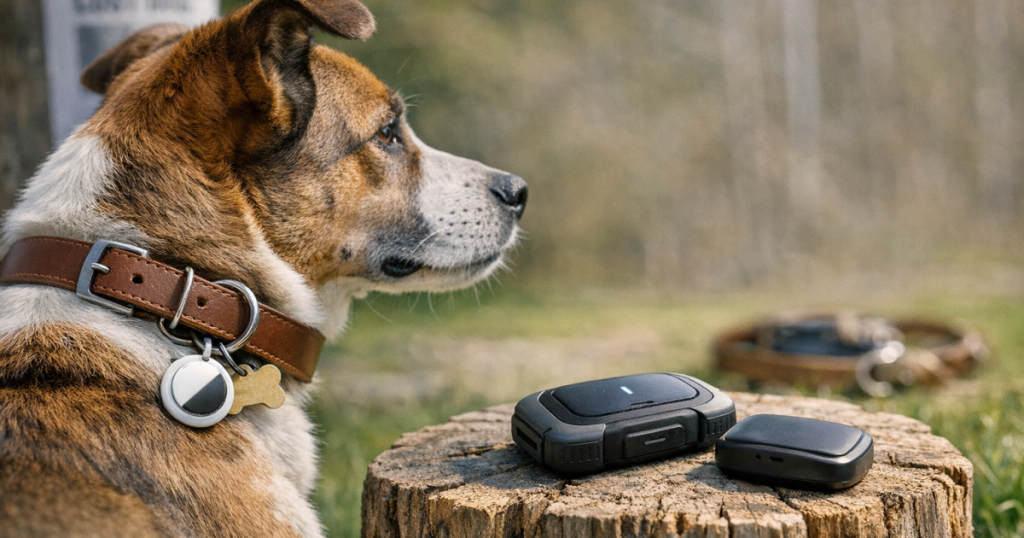
A dangling keyring-style attachment can snag, swing, make noise, or come loose. A snug collar mount designed to hold the tracker flat against the collar is usually the cleaner approach. The mount should match the collar width, sit comfortably, and avoid rubbing the dog’s neck. One recognizable example is the Elevation Lab TagVault AirTag Dog Collar Mount, but the right choice depends on your dog’s collar, size, coat, and activity level.
2. Keep visible ID on the collar
Do not let a Bluetooth tracker replace a readable ID tag. A neighbor who catches your dog may call the phone number on the tag faster than they can figure out a digital tracking device. Make sure your dog’s microchip registration is current, too. A tracker helps you search; identification helps other people return your dog.
3. Test it before you need it
Walk around your block, a nearby park, and a low-traffic area where your dog actually spends time. Notice how quickly location updates appear, whether your phone can find the tag nearby, and where the signal becomes unreliable. This test is not about proving perfection. It is about learning what the tool can realistically do in your normal environment.
4. Build a recovery routine
If your dog gets loose, start with the basics: secure open gates and doors, keep one person at home in case the dog circles back, check the last seen area calmly, and alert nearby people with a clear photo and your contact number. Use the tracker location as a clue, not as absolute truth. If you get a location update, search quietly and avoid chasing, especially if your dog is scared.
When an AirTag dog collar is actually useful
This setup makes the most sense for dogs with lower escape risk who live or travel through populated areas. It can be a reasonable backup for a calm neighborhood dog who occasionally slips out of a door, a city dog who visits crowded parks, or a travel dog whose owner wants one more recovery clue if luggage, crates, or leashes get separated during a trip.
It is less reassuring for dogs who sprint after deer, dig out of rural yards, panic during fireworks, or disappear into woods and fields. In those cases, a true GPS tracker is usually the more appropriate primary tool because the problem is not finding a misplaced item nearby; it is locating a moving animal across changing terrain and coverage conditions.
Size and comfort also matter. Small dogs may be bothered by extra bulk on a narrow collar. Heavy-coated dogs may tolerate the mount well but make tag placement harder to inspect. Rough-and-tumble dogs need a mount that stays put during rolling, wrestling, swimming, or squeezing under fences. Whatever you use, check the collar fit and skin contact regularly.
How it fits into a stronger lost-dog plan
The best recovery plans use layers. A Bluetooth tag can be one layer, but it should sit alongside prevention, identification, and fast local outreach. For many owners, that means a secure harness or collar, a visible ID tag, a current microchip, recent clear photos, a practiced recall routine, and a written plan for who does what if the dog bolts.
If your neighborhood uses community alert tools, set them up before there is an emergency. Ring’s pet-related neighborhood visibility can be useful when neighbors may have camera footage or recent sightings. Our step-by-step guide to using Ring Search Party for a lost dog explains how to turn local awareness into practical search steps without relying on a tracker alone.
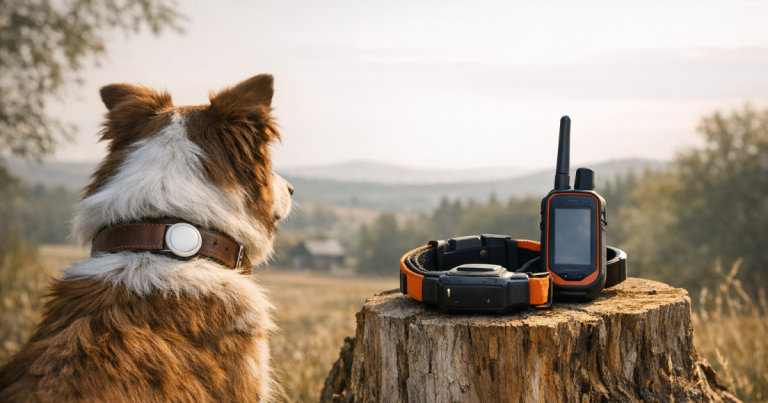
For higher-risk dogs, consider a GPS dog tracker as the primary locator and keep the Bluetooth tag as a backup. GPS trackers still have limits: they depend on their own network design, battery state, fit, and coverage conditions. But they are designed around pet location in a way that Bluetooth item trackers are not.
Helpful questions
Is an AirTag safe to put on a dog?
Many owners attach one to a collar, but it should be secured in a purpose-made mount and checked often for comfort, chewing risk, rubbing, and collar fit. It should not be loose enough to snag or easy for the dog to remove and chew.
Can I track my dog live with an AirTag?
No. An AirTag is not a live GPS pet tracker. It can show locations based on nearby device detection and close-range Bluetooth finding, but it is not designed to provide continuous live movement tracking for a loose dog.
Is it better than nothing?
Often, yes, especially in populated areas. But “better than nothing” is different from “enough.” If your dog has a serious escape history, treat Bluetooth as a backup and evaluate a GPS tracker, physical containment, training support, and stronger identification.
Practical takeaway
An AirTag can be a smart extra layer for some dogs, particularly in busy neighborhoods where the Find My network is more likely to help. It is not a standalone lost-pet recovery system, and it should not give a false sense of security for dogs who run far, move fast, or escape in places with few nearby devices.
Use it for what it does well: nearby finding, last reported clues, and backup visibility. Pair it with visible ID, an updated microchip, prevention habits, and a GPS tracker when your dog’s behavior or environment calls for more reliable location support.