An escape scare can happen in one sharp movement: a dog plants their feet, reverses out of a flat collar, and suddenly the leash is attached to nothing. For dogs who slip collars on walks, the best martingale collars are properly fitted limited-slip collars that tighten only enough to reduce backing out, not enough to choke or restrain a panicked dog by force.
Behavioral evaluation for panic-based bolting, repeated fence escapes, or collar-related injury should be handled by a licensed veterinarian or credentialed dog trainer in line with local animal welfare rules and safety requirements.
The short answer for collar escape artists
A martingale collar is most useful for dogs who can reverse out of a standard flat collar during leashed walks. It is not a fence, a tie-out tool, a crate collar, or a substitute for training. The safest choice is a well-sized limited-slip collar that cannot tighten smaller than the dog’s neck, paired with calm handling, secure ID, and a recovery plan if your dog gets loose anyway.
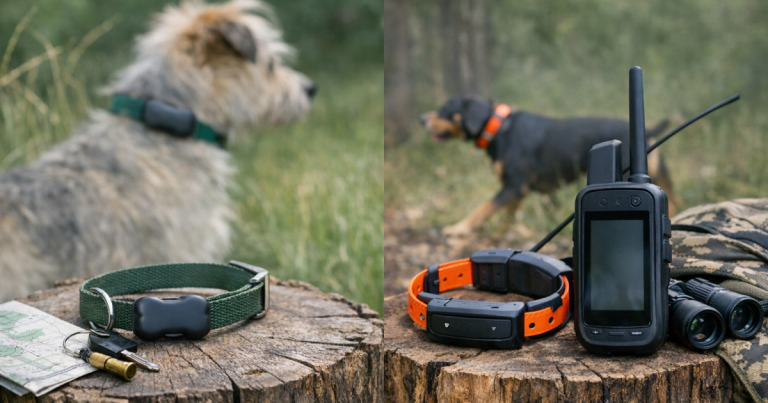
For a dog who slips loose near traffic, wildlife, trailheads, or open gates, the collar is only one layer. A visible ID tag, a properly attached leash, and a tracker setup you have already tested are part of the same escape-prevention routine. If your dog wears a tracker on walks, make sure the device sits where it can work reliably; this guide to positioning a dog GPS collar for better signal is a helpful next step.
How martingale collars help, and where they do not
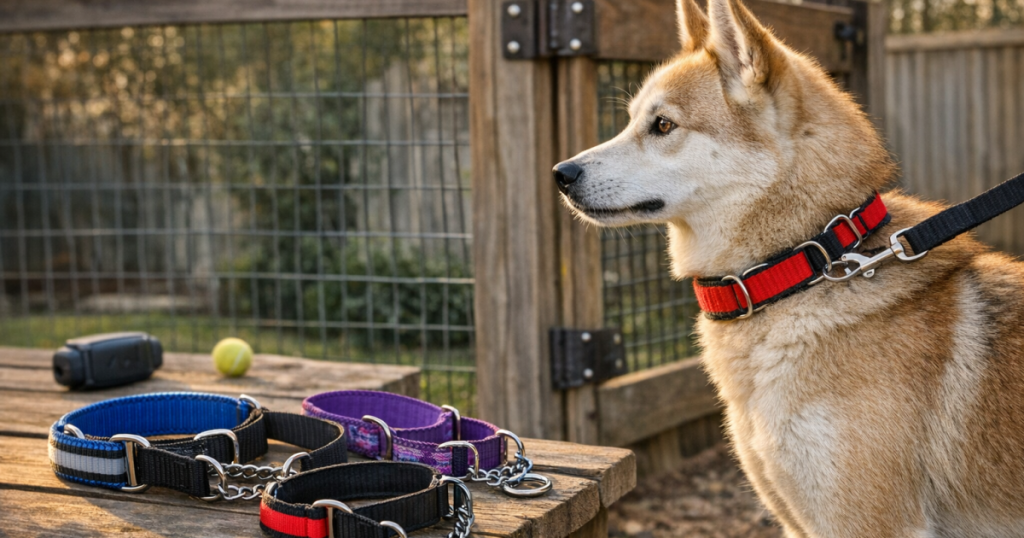
A standard flat collar keeps the same size all the time. That works for many dogs, but dogs with narrow heads, thick necks, loose skin, or a habit of pulling backward can sometimes slide out of it. A martingale has a main collar loop and a smaller control loop. When the leash tightens, the collar narrows within a limited range.
That limited range is the key. A properly adjusted martingale should close enough to remove slack but stop before it compresses the throat. If the two metal or fabric connection points touch when pressure is applied, the collar is usually too loose or incorrectly sized. If it keeps tightening with no clear stop, it is not being used as a true limited-slip safety collar.
Martingales are most helpful in these scenarios:
- Dogs who back out of flat collars when startled by trucks, bikes, fireworks, or other dogs.
- Long-necked breeds and mixed breeds whose head is not much wider than the neck.
- Newly adopted dogs who are still learning neighborhood sounds and leash pressure.
- Travel days, vet visits, and parking-lot walks where one mistake can create a serious lost-dog situation.
They are less useful for fence jumpers, door dashers, diggers, and dogs who bolt when off leash. Those dogs need layered prevention: gate manners, supervised yard time, barriers that match the behavior, and recovery tools. If you rely on virtual fences or tracker alerts, spend time with setting reliable safe zones on a dog tracker before you need them in a real escape.
Collars worth shortlisting by escape scenario
No collar can be called escape-proof for every dog. Coat type, neck shape, panic level, leash angle, and fit all change the result. The following examples are recognizable martingale-style options to consider as starting points, not guarantees.
For a simple walking setup: PetSafe Martingale Collar
The PetSafe Martingale Collar is a familiar, straightforward limited-slip option for owners who want a basic martingale for supervised leash walks. It makes sense for dogs whose main issue is backing out of a flat collar rather than extreme pulling, chewing, or rough field use. As with any martingale, the fit matters more than the brand name: check that it opens wide enough to go on comfortably and closes only to the safe stopping point.
For dogs who respond to a little leash feedback: Max and Neo Stainless Steel Chain Martingale Collar
The Max and Neo Stainless Steel Chain Martingale Collar uses a chain control loop, which some handlers like because it gives clearer movement and sound when leash pressure changes. That can be useful for calm leash communication, but it should not be used for jerking, corrections, or leaving on an unattended dog. Choose this style only if you are comfortable checking the closing point carefully.
For owners who want a fabric-loop style: LupinePet Originals Martingale Collar
The LupinePet Originals Martingale Collar is a recognizable fabric martingale option for everyday walks. Fabric-loop designs can feel quieter than chain-loop collars, which some noise-sensitive dogs may prefer. The same safety rule applies: it belongs on the dog during supervised use, not as an all-day collar in a crate, dog park, or rough play situation where the loop could snag.
For active walks and trail routines: Ruffwear Web Reaction Collar
The Ruffwear Web Reaction Collar is a martingale-style collar from a brand many dog owners already associate with outdoor walking gear. It can fit well into a trail or travel routine when paired with a harness, ID tag, and a tracker, but it still should not be treated as off-leash insurance. For recall practice away from traffic, a long line is often the safer training tool; our Ruffwear Rogue Long Line review explains how a long line can support cleaner recall sessions without giving a dog full freedom too soon.
Fit checks before the first walk
Most martingale problems come from using the right idea with the wrong fit. Do these checks indoors first, when your dog is calm and you are not juggling traffic, distractions, or a trailhead parking lot.
Step 1: Start with the dog’s actual neck shape
Look at where the collar will sit. Some dogs have thick coats, loose skin, or a neck that narrows sharply behind the ears. Others have a head and neck that are almost the same width. A martingale is meant to address that slipping problem, but only if the collar sits high enough and is adjusted to the dog in front of you.
Step 2: Adjust the open size
When relaxed, the collar should sit comfortably without gaping so far that it can rotate, drop low, or catch the jaw. You should be able to put it on without forcing it over the ears. If the collar has a buckle, open and close it several times before you use it outside so the movement feels familiar.
Step 3: Test the closed size by hand
Clip the leash to the martingale ring and gently pull until the collar closes. The control loop should still have room left before the hardware or fabric ends meet. The collar should not cinch indefinitely. If it can tighten smaller than the dog’s neck, stop and readjust or choose another size.
Step 4: Practice the escape motion safely
With your dog indoors or in a fenced area, stand facing them and apply light backward leash pressure, similar to what happens when a dog tries to reverse away. Do not yank. You are checking whether the collar removes slack without choking, twisting, or riding into the dog’s jaw.
Step 5: Add redundancy for high-risk moments
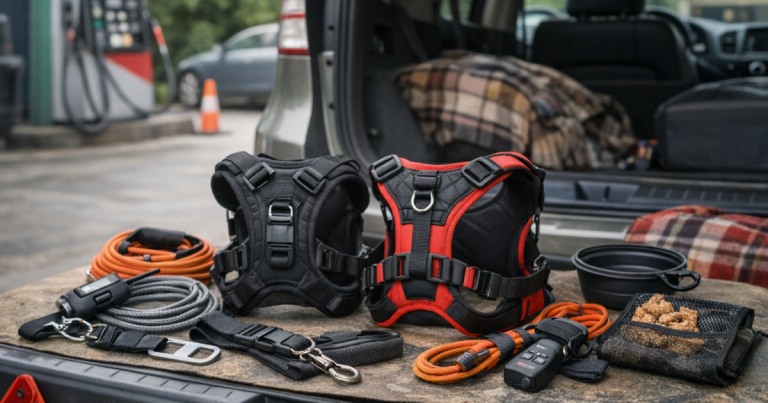
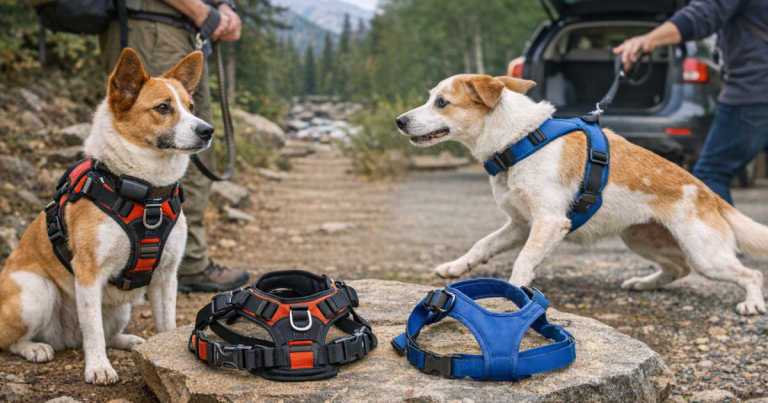
For newly adopted dogs, airport or hotel stops, busy sidewalks, and trailhead transitions, consider a backup connection: one leash to the martingale and one to a well-fitted harness, or a safety strap between collar and harness. This is especially useful during the first few weeks with a dog whose startle triggers you do not know yet.
When a martingale is the wrong answer
A martingale collar can reduce one common escape route, but it can also create problems when used in the wrong setting. Do not leave a martingale on a dog in a crate, kennel, or unsupervised yard. The extra loop can catch on wire, brush, furniture, fencing, another dog’s jaw, or play equipment. For unattended ID, use a flat breakaway-style setup or another safer arrangement recommended for your dog’s situation.
Skip a martingale as the primary tool if your dog lunges hard into the leash, has a neck injury, coughs with collar pressure, or panics when anything tightens around the neck. A well-fitted harness may be the better everyday walking choice, with the martingale used only as a backup ID or secondary safety point if your trainer or veterinarian agrees.
Also be realistic about the word “prevent.” Collars can reduce collar-slipping, not stop a dog from climbing a fence, digging under a gate, slipping through a screen door, or disappearing after a leash clip fails. Escape prevention works best as a routine: secure exits, rehearse wait cues, use physical backups, keep ID readable, and test your tracker before the stressful day arrives.
Main points
- Choose a martingale for dogs who back out of flat collars, not as a universal escape solution.
- Fit is the safety feature: the collar must stop tightening before it presses dangerously on the neck.
- Use martingales for supervised leash walks only, not crating, tie-outs, rough play, or unsupervised yard time.
- For high-risk dogs, pair the collar with a harness backup, ID tag, tested tracker, and training plan.
- Match the collar style to the dog’s behavior: fabric loops for quiet simplicity, chain loops for clearer leash feedback, and outdoor-oriented designs for trail routines.
Common questions
Are martingale collars safe for escape-prone dogs?
They can be safe for supervised leash walks when correctly fitted. They are not safe as unattended collars because the control loop can snag and tighten.
Can a dog still slip out of a martingale collar?
Yes. A poor fit, wrong size, loose adjustment, extreme panic, or leash angle can still lead to escape. Test the fit before using it outside.
Should my dog wear a martingale or a harness?
Many escape-prone dogs do best with both during high-risk situations: a martingale to reduce backing out and a secure harness as a backup leash point.
Is a martingale collar good for a fence jumper?
Not by itself. Fence jumping is a containment and behavior problem, so focus on secure fencing, supervision, training, and recovery tools rather than collar style alone.
Can my dog wear a GPS tracker with a martingale?
Sometimes, but the tracker should not interfere with the control loop or collar movement. Many owners use a separate flat collar or harness-mounted setup for tracking.
Why it matters
The right martingale collar can turn a near-miss into an ordinary walk, but only when it is treated as one layer of prevention. For an escape-prone dog, the real goal is not just keeping the leash attached. It is building a calmer, more redundant system around the dog: equipment that fits, habits that reduce door and gate mistakes, and recovery tools ready before the one day you need them.