A dog who slips through a gate needs a different recovery setup than a dog ranging through brush with a handler nearby. FitBark GPS 2nd Gen vs Garmin TT 15 is really a class decision: consumer cellular lost-pet tracking versus Garmin’s sporting-dog radio tracking and training ecosystem. Both can show where a dog is, but they get that location back to you in very different ways.
Quick Buying Links
FitBark GPS 2nd Gen
Better for everyday pet owners who want lightweight cellular lost-pet tracking with health context and safe-place alerts
Garmin TT™ 15 Dog Device
Better for sporting-dog handlers already using compatible Garmin handheld gear and needing radio tracking plus training functions
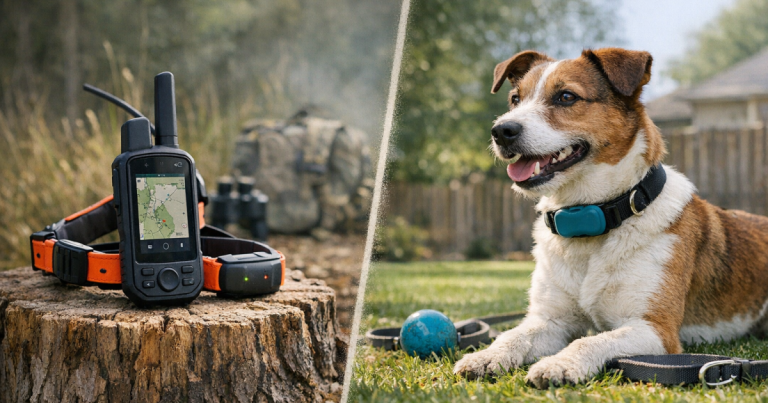
The important split is simple. FitBark is a lightweight collar attachment built around GPS, cellular, Wi-Fi and health monitoring. Garmin’s TT 15 Dog Device is a GPS/GLONASS tracking and training collar that works through compatible Garmin handheld equipment over VHF radio. That makes the right choice less about brand loyalty and more about your dog’s actual escape pattern.
The short version
Choose the FitBark GPS 2nd Gen if your priority is a small everyday pet tracker for home, neighborhood walks, sitters, travel routines and ordinary lost-dog scares where cellular and Wi-Fi coverage are part of the plan. It weighs 0.56 oz, fits pets from 5 lb, attaches to flat collars up to 1.5 inches wide, and requires an in-app subscription. FitBark’s official store shows plans from $4 to $10 per month depending on billing term.
Choose the Garmin TT 15 Dog Device if you are building around Garmin’s compatible handheld system for sporting-dog tracking and training. Garmin lists the TT 15 as a GPS/GLONASS dog tracking and training device with VHF radio range up to 9 miles, 20 to 40 hours of battery life, and training functions that include 18 levels of continuous and momentary stimulation plus tone and vibration when used with a compatible tracking handheld.
Neither option is a magic shield against every lost-dog scenario. FitBark depends on cellular, Wi-Fi and related coverage for its location service. Garmin depends on compatible handheld equipment and radio operation rather than a phone-app cellular link. The best setup is the one that matches where your dog gets loose, how fast you can respond, and what gear you are willing to carry.
Side-by-side differences that matter
- Tracking purpose: FitBark is a pet location plus health tracker collar attachment. Garmin TT 15 is a GPS/GLONASS tracking and training device with collar.
- Communication method: FitBark uses an embedded LTE Cat M1 cellular connection, Wi-Fi and Bluetooth. Garmin uses VHF radio to a compatible Garmin handheld, with ANT wireless at close range.
- Subscription and equipment: FitBark requires a paid in-app subscription for location service. Garmin does not state a cellular subscription, but it requires compatible Garmin handheld equipment for tracking and training functions.
- Battery figures: FitBark lists up to 4 weeks in Wi-Fi and cellular daily-walk use, and up to 6 hours in live tracking. Garmin lists 20 to 40 hours of battery life.
- Weight: FitBark weighs 0.56 oz. Garmin lists 7.3 oz for the transmitter and antenna without collar, and 10.0 oz total with collar.
- Fit basis: FitBark fits pets from 5 lb and flat collars up to 1.5 inches wide. Garmin’s shared fit basis is a minimum neck circumference of 9.5 inches, and it ships with a 1-inch collar strap.
- Water protection: FitBark is IP67, submersible up to 1 meter for up to 30 minutes. Garmin is rated 1 ATM, with pressure equivalent to 10 meters.
- US availability: FitBark’s official store shows Ready to ship with Add to cart. Garmin’s official US indexed content shows estimated availability of 5-8 weeks for the TT 15 Dog Device.
Where FitBark makes more sense
FitBark’s strongest case is the everyday lost-pet situation: a door dasher, a fence tester, a small dog traveling with family, or a dog who spends time with a sitter. Its low weight is the biggest comfort difference in this comparison. At 0.56 oz, it is far easier to imagine on a small pet than a 10.0 oz collar-and-device setup.
FitBark also fits the owner who wants location tracking alongside health, activity, sleep and wellness context. The evidence pack identifies it as a consumer pet location and health tracker with safe-place alerts and location history, rather than a sporting-dog training tool. That distinction matters because a suburban escape is usually a phone-in-hand search, not a field-handler session with a dedicated handheld.
The trade-off is that FitBark is not a radio tracking collar. Its location service requires a paid in-app subscription and depends on cellular and Wi-Fi coverage. FitBark’s official page references Verizon, AT&T and T-Mobile coverage, and its location technologies include on-board GPS, mobile phone GPS, Wi-Fi APIs and cell-tower data. That is useful for many US households, but it is still a coverage-dependent system.
If your dog’s escape pattern starts with a deer, rabbit or trail distraction, technology should sit inside a broader prevention plan. Our guide to preventing wildlife chases from becoming lost-dog emergencies pairs well with a lightweight tracker decision because the first few seconds after a chase often matter more than any spec sheet.
Where Garmin TT 15 makes more sense
Garmin’s TT 15 is built for a different owner workflow. Its verified role is sporting-dog tracking plus remote training through compatible Garmin handheld equipment. Garmin lists a high-sensitivity GPS/GLONASS receiver, VHF radio range up to 9 miles, and training functions that include stimulation, tone and vibration when paired with a compatible tracking handheld.
That makes the Garmin more relevant for handlers who already think in terms of handheld tracking, field range, collar-based training functions and dog work away from ordinary neighborhood coverage. It is not trying to be the tiniest pet tag on a house collar. It is a more substantial collar/device system designed around Garmin’s tracking equipment.
The weight and hardware commitment are the main friction points for ordinary pet owners. Garmin lists 7.3 oz for the transmitter and antenna without collar and 10.0 oz with collar. That is a very different fit conversation from a 0.56 oz attachment. For dogs who are practicing structured off-leash recall, the decision also overlaps with training gear selection; this breakdown of GPS training collars for off-leash recall practice can help place Garmin-style systems in the right training context.
There is also a travel and compliance boundary. The evidence pack notes that radio-frequency rules and licensing requirements vary by country, and that US radio products are not authorized for European use. For US owners who travel internationally, that is not a minor footnote; it affects where this kind of radio-based gear belongs.
Battery life: weeks on paper versus field-day runtime
The battery comparison is not one clean winner because the figures describe different kinds of use. FitBark’s official runtime examples are scenario-based: up to 4 weeks for Wi-Fi and cellular daily-walk use, but up to 6 hours in live tracking. That is a good reminder that live tracking is the demanding mode, especially during the kind of search that raises your heart rate.
Garmin lists 20 to 40 hours of battery life for the TT 15. In editorial terms, that better matches a working-day or field-session rhythm, while FitBark’s longer daily-use figure suits routine wearing between emergencies. The comparison only becomes fair when you name the mode: casual monitoring, live lost-dog tracking, or handheld-based field tracking.
Coverage and range: two different promises
FitBark does not give a fixed local radio range because its system is built around GPS, cellular, Wi-Fi and Bluetooth. For many pet owners, that is convenient: the device is meant to work as part of a phone-centered recovery routine. The limitation is that the service depends on the relevant networks and coverage conditions.
Garmin gives a VHF radio range figure: up to 9 miles. That number belongs to its handheld-radio style system, not to a cellular app tracker. It can be powerful in the right field setup, but it also means carrying and using compatible Garmin handheld equipment. Comparing FitBark and Garmin as if they were two versions of the same phone tracker would be misleading.
Fit, comfort and backup identification
For small dogs, FitBark has the clearer fit advantage based on the verified numbers: pets from 5 lb, flat collars up to 1.5 inches wide, and a 0.56 oz device. Garmin’s TT 15 starts from a minimum neck circumference of 9.5 inches and comes with a 1-inch collar strap, but its total listed weight with collar is 10.0 oz.
For larger sporting dogs, Garmin’s size may be less of an obstacle, but comfort still matters. A tracking collar that rubs, shifts or gets left behind because it is too bulky is not helping your recovery plan. Whether you choose the small cellular tracker or the handheld-based radio system, pair it with plain physical identification. A tracker can lose power or coverage; an engraved tag can still speak for your dog. Here is how to back up a GPS collar with physical ID tags without making the collar setup complicated.
Straight answers
Is FitBark a training collar like the Garmin TT 15?
No. The verified evidence describes FitBark GPS 2nd Gen as a pet location and health tracker. Garmin TT 15 is the device in this comparison with listed remote training functions when used with a compatible tracking handheld.
Does Garmin TT 15 work like a standalone cellular tracker?
No. Garmin TT 15 is not described as a standalone app-and-cellular lost-pet tracker. Its tracking and training functions depend on compatible Garmin handheld equipment and VHF radio communication.
Which one is lighter?
FitBark is much lighter. Its verified weight is 0.56 oz. Garmin lists 7.3 oz for the transmitter and antenna without collar, and 10.0 oz total with collar.
The cleaner choice for your dog’s risk profile
Pick FitBark GPS 2nd Gen if your main fear is the everyday lost-pet scare: the loose gate, the vacation rental door, the sitter handoff, the small dog who should not carry much weight, or the dog whose routine benefits from safe-place alerts and health/activity context. The subscription is part of the deal, and the system depends on cellular and Wi-Fi coverage, but its size and consumer lost-pet focus fit ordinary family recovery planning well.
Pick Garmin TT 15 Dog Device if you are intentionally building around Garmin’s compatible handheld ecosystem for sporting-dog tracking and training. Its listed VHF range, GPS/GLONASS receiver, 20 to 40 hour battery figure, and training functions belong to that world. It is the wrong purchase if what you really want is a tiny standalone phone-app tracker for a house collar.
The most reassuring answer is also the least flashy: match the device class to the escape risk. A fence-jumper in a neighborhood, a small dog on family trips, and a sporting dog working at distance are not asking for the same tool. FitBark is the cleaner everyday pet-tracking choice; Garmin TT 15 is the more appropriate pick for handlers who need Garmin radio tracking and training functions through compatible handheld gear.
Quick Buying Links
FitBark GPS 2nd Gen
Better for everyday pet owners who want lightweight cellular lost-pet tracking with health context and safe-place alerts
Garmin TT™ 15 Dog Device
Better for sporting-dog handlers already using compatible Garmin handheld gear and needing radio tracking plus training functions