Panic makes every direction feel urgent, but most missing dogs do not move randomly for long. Understanding lost dog behavior helps you slow the search down, read the situation, and check the places your dog is most likely to choose first.
The goal is not to cover the most ground as fast as possible. It is to think like a frightened, overstimulated dog: Where would they feel hidden, quiet, familiar, and safe?
What to know first
- Many dogs stay close at first, especially if they escaped from home, a parked car, a campground, or a familiar walking route.
- A scared dog may ignore their name, avoid people they love, or move away from direct approach.
- Search quiet hiding places before busy open spaces: under decks, behind sheds, in brush, near creeks, and around outbuildings.
- Food, scent, calm voices, and stillness usually work better than chasing.
- If your dog has been missing for hours, organize your search in layers rather than repeatedly walking the same obvious streets.
If your dog has just gone missing, pair the behavior guidance below with a time-based checklist like a first 72-hour recovery plan. The first few hours matter, but steady, organized action beats frantic searching.
Why a missing dog may not act like your normal dog
Owners often say the same painful sentence after a sighting: “He looked right at me and ran.” That does not mean your dog has forgotten you. It usually means the dog is operating on survival instincts instead of household routines.
A dog that is loose in traffic, strange smells, loud voices, weather, or unfamiliar territory may switch into a defensive mode. Friendly dogs can become wary. Velcro dogs can avoid touch. Food-motivated dogs may hesitate to come close if people are standing, calling loudly, or moving toward them.
Small dogs may tuck into tight spaces and stay silent. Large dogs may travel farther before settling. Senior dogs, injured dogs, and dogs with poor hearing or vision may become trapped in places they cannot easily leave. Newly adopted dogs, rescue dogs, and dogs missing while traveling may not have a strong local map in their mind, so they may follow cover, scent trails, or quiet edges instead of trying to return directly.
Start where the escape happened
The first search zone is the point of escape. Even if someone saw your dog run down the street, return to the exact place they got loose and look outward in circles. Dogs often bolt, slow down, hide, and then loop back near the scent of home, the car, the gate, or the trailhead.
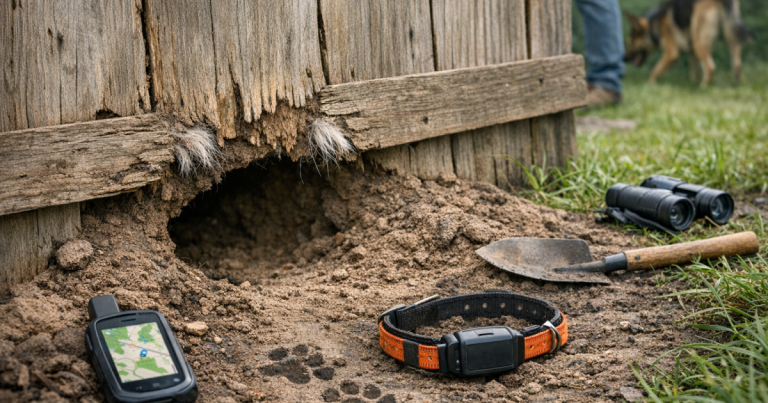
At home, check the property as if you were looking for a cat: under porches, under parked vehicles, behind trash cans, in crawl spaces, inside open sheds, behind stacked firewood, under trailers, and along fence lines. A frightened dog may be within 50 yards and still not make a sound.
In a neighborhood, walk the quiet edges before the middle of the road. Look along hedges, side yards, drainage ditches, alleys, school grounds after hours, wooded strips between subdivisions, and the back side of shopping centers. Ask permission before entering private property, and keep your interactions calm and brief so neighbors are more likely to help.
Search by dog type and personality
The social dog
A confident, people-loving dog may approach porches, dog parks, playgrounds, outdoor dining areas, or homes where other dogs live. These dogs are often found by someone before the owner physically catches up. That makes clear ID, microchip registration, and fast local alerts especially important.
The shy or newly adopted dog
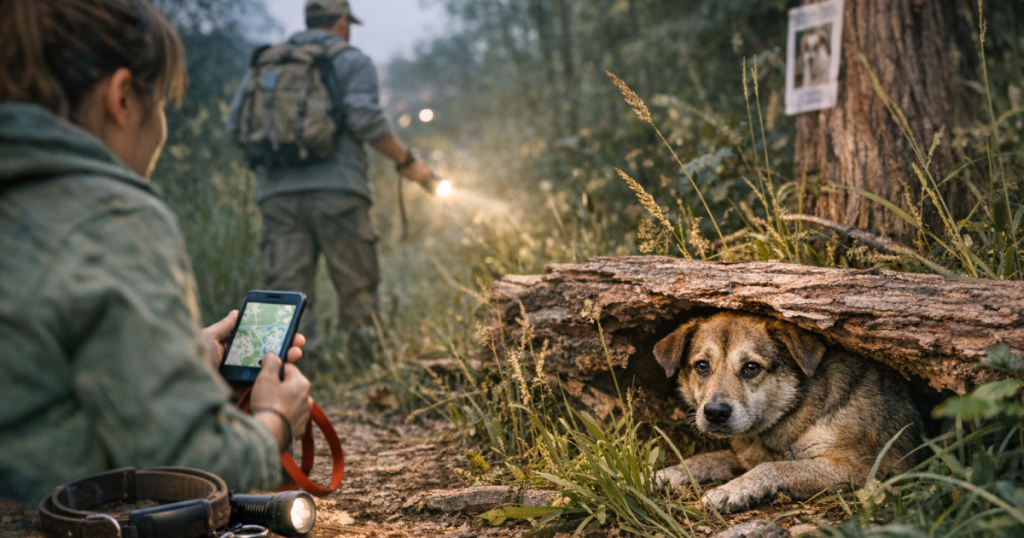
A timid dog is more likely to hide and avoid attention. Search low and quiet: brush piles, culverts, vacant lots, wooded trail edges, barns, under decks, and behind garages. Do not send large groups calling the dog’s name through the area. Too much pressure can push a shy dog farther away.
The door dasher or fence jumper
A dog with an escape habit may follow a familiar route. Check previous destinations first: a neighbor’s dog, a school field, a creek path, a park entrance, a food source, or the place they were found last time. If the escape involved a known weak spot, keep someone near home because repeat escapees often circle back.
The scent-driven dog
Hounds, sporting breeds, and other scent-focused dogs may put their nose down and travel along animal trails, drainage lines, fence rows, and wooded corridors. In rural areas, ask nearby farms, horse barns, construction crews, delivery drivers, and utility workers to watch for movement at dawn and dusk.
Where to search first in common scenarios
If your dog escaped from the yard
Begin with a quiet property sweep, then expand to the closest hiding cover. Check both sides of every fence, not just the direction you think they ran. Look for nose prints on gates, bent grass, disturbed mulch, or fresh paw marks near soft soil.
Leave a familiar scent source near the exit point, such as a used blanket, crate mat, or your worn shirt. Keep the area calm. If people keep rushing to the spot and shouting, a nervous dog may avoid returning.
If your dog bolted during a walk
Mark the location immediately. Search the direction of travel, but also check behind you, because many dogs double back once the initial scare fades. If the leash is still attached, look carefully around brush, benches, fences, and low branches where it could snag.
Tell other searchers not to chase. Instead, ask them to report time, direction, and behavior. A calm sighting is more useful than ten people running after the dog.
If your dog disappeared while traveling
Travel escapes are especially disorienting because the dog may not know the neighborhood, campground, hotel area, or highway exit. Search the last known point, the vehicle, food areas, dumpsters, wooded edges, water sources, and quiet places away from foot traffic.
Call nearby shelters, veterinary clinics, animal control, campground offices, and local police non-emergency lines. In the US, practices vary by city and county, so make multiple calls rather than assuming one agency will notify the others.
If your tracker shows a broad or stale location
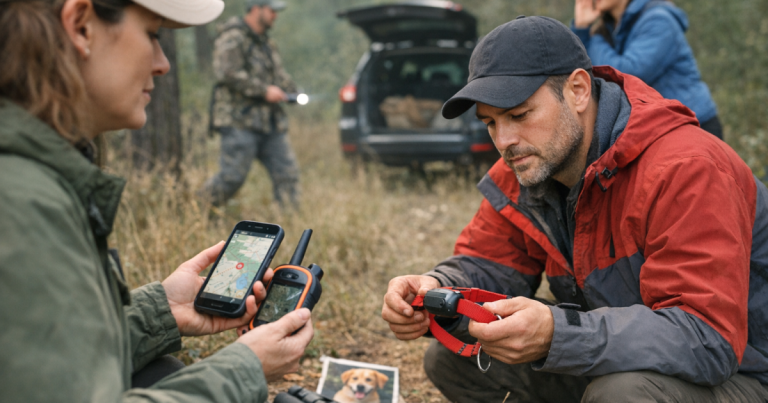
A GPS or network-based tracker can be a huge help, but it is not a promise that the dog is exactly under the dot. Buildings, tree cover, weak cellular coverage, battery state, and update intervals can affect what you see. Treat the location as a search zone, then look for logical cover inside that zone.
If the dot jumps around, avoid sprinting from point to point. Stand still, refresh when possible, and compare the location with real-world features: fences, creek beds, parking lots, wooded lots, and places a scared dog could actually reach.
How frightened dogs respond to people
One of the hardest parts of recovery is accepting that calling can backfire. A loose dog may read direct eye contact, fast movement, clapping, whistling, and multiple people approaching as pressure. Even a beloved owner can look threatening when the dog is overwhelmed.
If you see your dog, lower your body, turn slightly sideways, avoid staring, and speak softly. Some owners have success sitting or lying down and letting the dog approach. Tossing small bits of smelly food away from your body can create a low-pressure path back toward you.
Do not grab too early. Wait until the dog is close enough to secure calmly, and use a slip lead or leash loop if one is available. If the dog is in traffic or another dangerous area, prioritize blocking routes and slowing vehicles over chasing.
Use sightings like clues, not commands
A sighting is a clue to build a pattern. Ask for the exact time, direction of travel, speed, body language, and whether the dog looked panicked, tired, curious, or settled. “Seen near the park” is less useful than “crossed behind the baseball field toward the creek at 6:40 a.m.”
Map every confirmed sighting. After a few reports, you may see a corridor: a tree line, railroad edge, drainage ditch, golf course boundary, or row of backyards. Dogs often move along these quieter routes because they provide cover and fewer direct encounters.
When sightings cluster in one area, stop flooding the neighborhood with searchers. Set up a calm feeding station if allowed, monitor from a distance, and consider tools that let you watch without pushing the dog away. For a dog that keeps appearing at odd hours, trail cameras can help confirm patterns before you attempt a safe capture.
Daytime, nighttime, and weather patterns
Many missing dogs move more at dawn, dusk, and overnight, when streets are quieter. During the heat of the day, they may rest in shade, under structures, near water, or in thick vegetation. In cold or wet weather, check protected places: open garages, barns, sheds, porches, culverts, and dense evergreen cover.
Night searching requires restraint. A flashlight beam can catch eyeshine, but groups of people walking and calling can also push a scared dog farther away. Move slowly, listen for tags or brush movement, and keep one person stationed near the escape point or feeding area when possible.
Water matters too. Dogs may follow creeks, drainage canals, retention ponds, irrigation ditches, or lake edges. In suburban areas, those features often connect neighborhoods in ways humans do not notice from the road.
Mistakes that can stretch a search longer
- Chasing after a sighting: This can move the dog out of a predictable area and make future sightings harder.
- Changing the food station too often: If a dog has started visiting one quiet location, consistency helps build confidence.
- Relying only on social posts: Online alerts help, but physical flyers, door knocking, and direct calls still reach people who are not in local groups.
- Assuming silence means distance: A frightened or trapped dog may be close and quiet.
- Letting too many helpers improvise: Give helpers one job: check a zone, distribute flyers, monitor a road, or report sightings without approaching.
Build a calm search pattern
Start with the last known point. Search close hiding places. Expand by cover, water, and quiet corridors. Collect sightings. Re-check likely spots at different times of day. This layered approach fits real lost dog behavior better than simply walking farther and farther away.
Keep a written log with times, locations, who searched where, who was contacted, and which sightings are confirmed. A simple notebook or shared note can prevent duplicated effort and help you notice patterns when you are tired.
If your dog is recovered, do a quiet health check and contact your veterinarian if there are injuries, limping, heat stress signs, vomiting, breathing changes, or unusual behavior. Then update microchip details, ID tags, and recovery backups while the scare is still fresh. Night escapes are a reminder that visible identification matters, and glow-in-the-dark ID backups can make a returned dog easier for someone to identify in low light.
Helpful questions
How far do lost dogs usually go?
It depends on the dog, terrain, fear level, and whether they are chased. Many stay surprisingly close at first, while scent-driven, athletic, or panicked dogs can cover more distance. Start near the escape point, then expand based on sightings and natural travel corridors.
Should I call my dog’s name while searching?
Use your voice carefully. Soft familiar phrases can help if the dog is calm, but loud calling from multiple people can scare a nervous dog away. If you spot your dog, lower your body and let them come toward you.
Where do lost dogs hide in suburbs?
Common suburban hiding spots include under decks, behind sheds, in brushy drainage areas, around schools or parks after hours, beneath parked vehicles, along fence lines, and near creeks or retention ponds.
What should I do if someone sees my dog?
Ask them not to chase or call. Get the exact time, location, direction of travel, and behavior. Then adjust your search map and send one calm person to assess the area quietly.
Can a GPS tracker guarantee recovery?
No tracker is foolproof. A tracker can narrow the search area and speed up decisions, but coverage, battery state, terrain, and update timing can limit accuracy. Use it alongside sightings, flyers, ID, and calm search tactics.
What stands out
A lost dog is not just a dog in the wrong place. It is a dog making instinctive choices under stress. The fastest recovery often comes from searching the places that feel safe to the dog: close cover, quiet edges, familiar scent points, water routes, and low-traffic hiding spots.
Move with purpose, not panic. Keep people from chasing, turn sightings into a map, and let your dog’s likely state of mind guide where you look next.