An escape-prone dog does not need a dramatic opening to get away; a loose collar at the curb, a startled spin in a parking lot, or a guest opening the door can be enough. A two-leash setup gives you a backup connection while you move through those risky moments with more control and less panic.
The goal is not to restrain your dog with force. It is to create redundancy, slow down the moment, and keep one mistake from becoming a lost-dog emergency.
What to know first
A dual-leash routine is most useful for dogs who have already slipped a collar, backed out of a harness, bolted from a car, lunged at wildlife, or panicked in noisy places. It can also help during short transition points, such as moving from the front door to the car, crossing a busy parking lot, or entering a vet clinic.
- Use two separate attachment points, not two leashes clipped to the same ring.
- Keep the backup leash slightly loose so it does not create constant pressure.
- Practice in quiet places before using the system in high-distraction settings.
- Pair the leash setup with ID tags, a properly fitted collar or harness, and a realistic recovery plan.
- Do not use it as a substitute for training, fence repairs, or calmer door routines.
When a two-leash setup makes sense
The clearest sign is a dog who has defeated one piece of gear before. Some dogs reverse out of flat collars. Some tuck their elbows and wiggle backward out of harnesses. Others do not escape the gear itself, but they hit the end of the leash so suddenly that the handler loses grip.
This setup is also useful for dogs in temporary high-risk phases: a newly adopted dog, a foster dog, a dog recovering after a move, or a normally steady dog traveling in an unfamiliar city. During these periods, your dog may not respond the way they do at home. A second leash gives you more time to respond if they freeze, spin, or try to flee.
It is not the right answer for every walk. If your dog walks calmly on familiar neighborhood routes, you may only need the second leash for transitions and higher-risk situations. For a dog with severe fear, reactivity, or panic pulling, work with a qualified positive-reinforcement trainer so the leash system supports behavior work rather than simply containing the problem.
Choose two secure attachment points
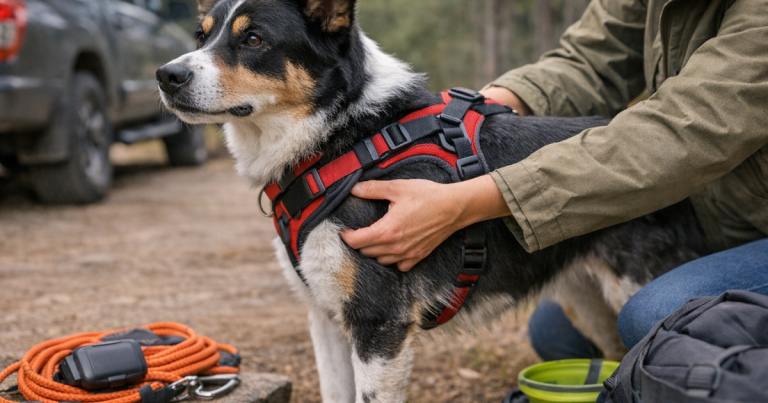
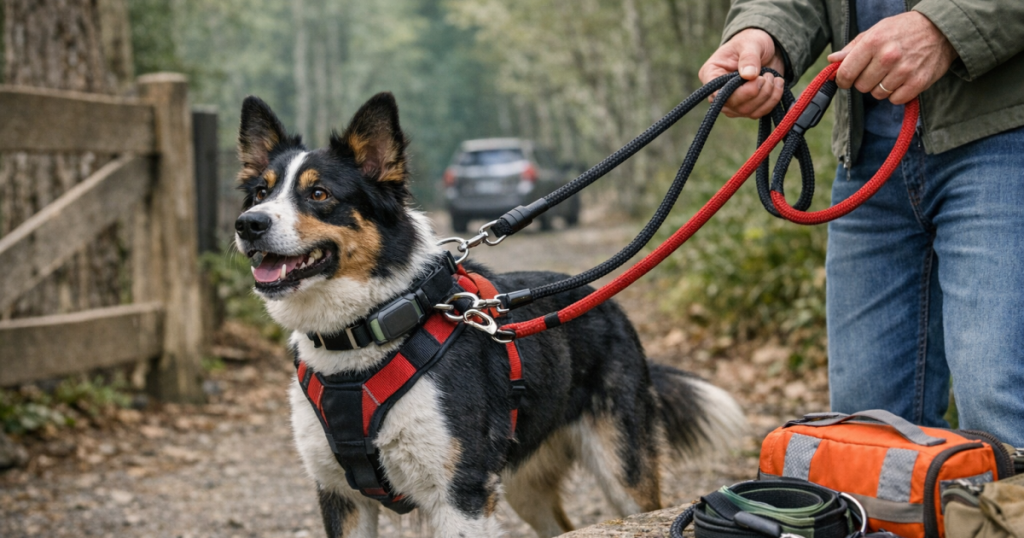
The safest version uses two independent points of contact. Common setups include one leash on a well-fitted harness and one leash on a flat collar, or one leash on a front-clip harness point and the second on a rear harness point if the harness is designed for that use. The key is separation: if one clip fails, one buckle opens, or one piece of gear shifts, you still have another connection.
For many escape-prone dogs, a harness plus collar pairing is the easiest starting point. The harness handles most of the walking pressure, while the collar leash acts as a quiet backup. If your dog has a narrow head, thick coat, or a history of backing out of collars, make sure the collar fit is checked carefully before trusting it as the secondary connection.
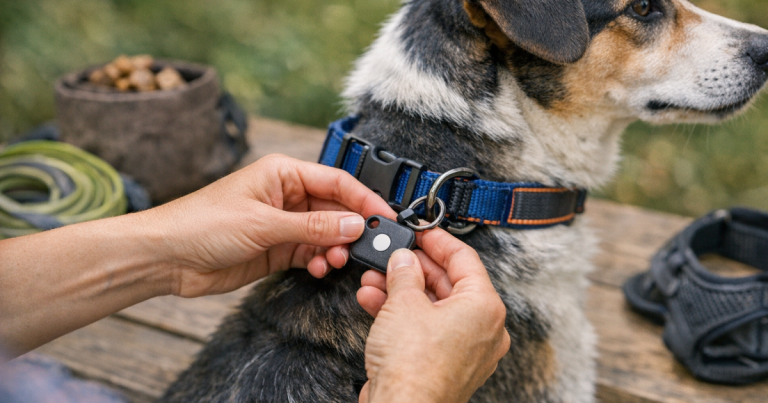
Fit matters more than the number of straps. A loose harness can rotate, rub, or slide over the shoulders. A collar that is too loose can slip over the ears; one that is too tight can be uncomfortable and unsafe. If your dog also wears a tracker, follow a careful fit routine so the tracking collar is not crowded or mistaken for the primary restraint. This walkthrough on how to fit a GPS dog collar safely is a useful next step if your dog wears both walking gear and tracking gear.
Set the leash roles before you leave the house
Before you open the door, decide which leash is the steering leash and which one is the safety leash. Most handlers find it easiest to walk primarily from the harness while keeping the collar leash loose in the other hand or attached to a hands-free belt only if they can still release and manage it safely.
Primary leash
The primary leash is the one you use for normal communication: slowing down, turning, rewarding a check-in, or guiding your dog away from a trigger. It should feel familiar and predictable to the dog.
Backup leash
The backup leash should not be tight all the time. If both leashes are constantly pulling in different directions, your dog may feel trapped and become more frantic. Let the backup leash form a soft safety line. It becomes active only if your dog slips, spins, or surges.
Your grip
Hold each leash with the loop around your wrist only if you can do so without risking injury. Many handlers prefer a thumb-through grip with the leash folded in the palm, which gives control without wrapping the leash tightly around fingers. Avoid holding coffee, a phone, or keys in the leash hand when moving through escape points.
Practice the system in low-stakes places
Do not wait until the vet parking lot or a busy trailhead to see how the setup feels. Start indoors with your dog calm. Clip both leashes, feed a few treats, walk a short hallway, turn around, and unclip. Keep the first sessions boring and easy.
Next, try a fenced yard or quiet driveway. Practice the movements you will need in real life: opening a door, turning back toward the house, stepping out of a car, pausing at a curb, and rewarding your dog for looking back at you. The goal is for the gear to feel normal before adrenaline enters the picture.
If the leashes tangle, shorten one slightly and keep both clips on the same side of your dog’s body when possible. For small dogs, use lightweight leashes so the setup does not feel like a pile of hardware. For large dogs, avoid bulky handles that make it hard to separate the two lines quickly.
Use it for the riskiest moments first
Escape-prone dogs often get away during transitions rather than during the middle of an ordinary walk. That is where this setup earns its place.
- Before walks: Clip both leashes before the door opens, then ask for a pause or check-in before stepping out.
- When guests arrive: Use the leashes only if your dog is already secured behind a barrier or calmly managed. For repeated bolting at the entry, build a safer door routine rather than relying on leash reflexes alone.
- At the car: Clip the second leash before opening the crate, seat belt, or door. Parking lots are full of sudden noises, dropped food, and moving vehicles.
- At the vet or groomer: Keep the backup leash on until your dog is inside a secure room or being transferred safely to staff.
- On trails: Use the second connection near trailheads, road crossings, wildlife areas, and places where another dog may appear suddenly.
Avoid common mistakes
The most common mistake is treating two leashes like extra braking power. If both lines are tight and your dog is leaning into them, the setup can increase frustration and make handling clumsy. Think of the second leash as a seat belt, not a steering wheel.
Another mistake is attaching both leashes to the same collar ring. That may feel stronger, but it does not solve the problem of collar slip, buckle failure, or a clip that opens under awkward pressure. Redundancy only helps when the failure points are separate.
Do not let the second leash drag on the ground. A trailing leash can wrap around legs, snag on shrubs, or trip the handler. If you need hands-free help, use gear designed for leash handling and practice in quiet spaces first.
Finally, do not skip identification because you feel more secure. A leash system lowers risk, but it does not erase it. Your dog should still have visible ID, current microchip information, and, for many escape-prone dogs, a tracking plan that matches your environment.
Fit it into a bigger escape-prevention plan
A leash backup is one layer. The stronger plan includes secure doors, gates, collars, harnesses, ID, and recovery habits. If your dog has already escaped, write down where it happened and what came right before it: a delivery, a squirrel, a loose fence board, a car door, a thunderclap, or another dog rushing the sidewalk.
Patterns matter. A fence-jumper needs different planning than a door-darter. A fearful rescue who freezes and backs out of gear needs a different approach than a confident dog who chases rabbits. The better you understand the behavior, the less you have to rely on last-second strength.
It also helps to know what to do if the worst happens. Many lost dogs do not run in a straight line or come when called, especially when scared. Keep a recent photo handy, know who to call nearby, and review where lost dogs usually hide, circle back, or travel first. This guide to how lost dogs behave and where to search first can help you make calmer decisions if a leash, gate, or door routine fails.
Things readers ask
Can I use two leashes on one harness?
You can if the harness has two attachment points designed for leash use, but it is not as redundant as using two separate pieces of gear. If the harness slips off or a buckle opens, both leashes may be lost at once.
Should the second leash be longer or shorter?
Keep it long enough to stay slightly loose during normal walking, but not so long that it drags or tangles. Many handlers use a standard leash length and adjust their grip instead of changing leash size.
Is this safe for small dogs?
Yes, if the gear is lightweight and well fitted. Small dogs can be overwhelmed by heavy clips, thick lines, and dangling hardware, so comfort and freedom of movement matter.
Will this stop my dog from pulling?
No. It can prevent a slipped-gear emergency, but it is not a pulling cure. Use reward-based leash training, calmer routes, and shorter sessions to address the pulling itself.
Do I need a tracker if I use two leashes?
For many escape-prone dogs, a tracker is still a sensible backup. Leashes reduce the chance of escape, while ID and tracking tools help if prevention fails.
What to remember
The best leash setup is the one you can use calmly and consistently. Clip to two independent points, assign each leash a role, practice before stressful outings, and focus on the moments when escapes actually happen: doors, cars, gates, parking lots, and sudden surprises.
For an escape-prone dog, prevention is rarely one product or one habit. It is a layered routine that gives you more than one chance to keep your dog safe.