Campgrounds are full of small distractions that matter: open tailgates, kids running between sites, unfamiliar smells, loose tent doors, and roads that look quiet until they are not. A campsite lost-dog plan is a five-minute arrival routine that gives every person a job before your dog has a chance to bolt. It does not make a tracker foolproof or a leash optional, but it does turn panic into a sequence you can actually follow.
The best time to plan for a missing dog is before the tent poles, camp chairs, and snack bags scatter across the site. Once the dog is already nervous or overstimulated, even sensible people start improvising. Improvising is charming around a campfire; it is less charming when your dog is heading toward the bathhouse.
Before you unload the cooler
Handle these checks while your dog is still secured in the vehicle, crate, or on a leash held by one responsible person. The point is not to create a complicated emergency binder. It is to remove the first wave of confusion.
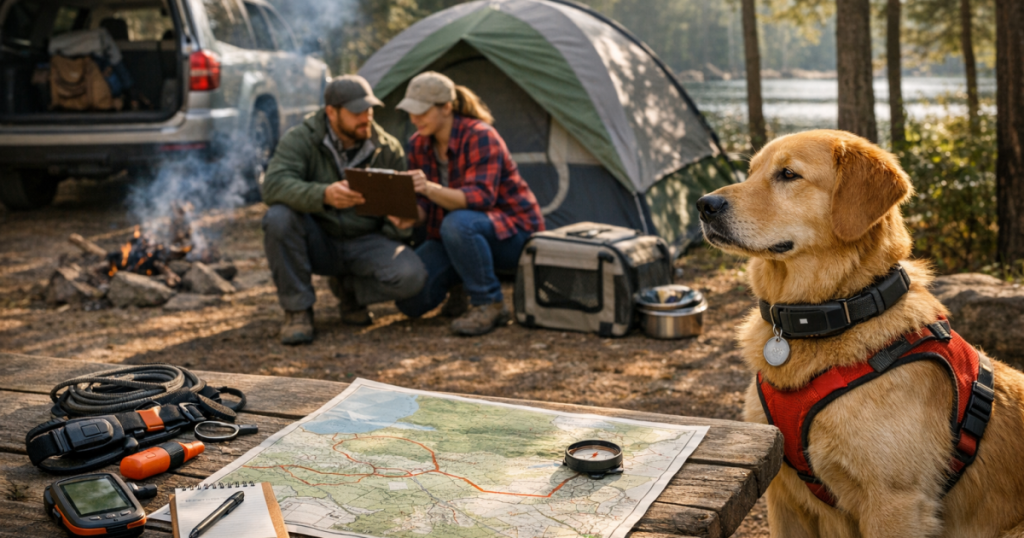
- Name one handler. One person controls the leash or crate door until the site is set. No handoffs during unloading.
- Pick a rally point. Choose one obvious place, such as the picnic table, site post, or vehicle tailgate, where everyone returns if the dog slips away.
- Identify the danger zones. Look for roads, water, steep drop-offs, neighboring dogs, dumpsters, camp stores, and trailheads.
- Check identification. Confirm the collar, tags, microchip number access, and tracker are all current before the dog exits.
- Agree on the first call. Decide who contacts campground staff, who watches the last-seen spot, and who checks nearby loops.
A plan that starts with the site, not the gear
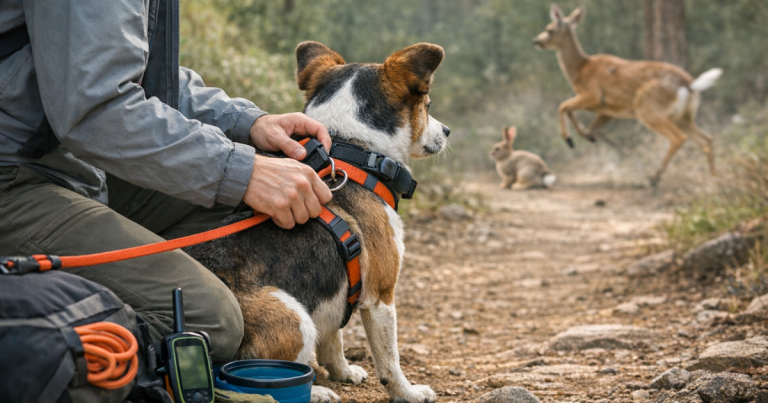
A good campground routine begins with geography. Stand at your parking spot and look at the site from your dog’s height and habits. A confident scent-driven dog may aim for the woods. A nervous dog may dive under an RV, behind a restroom building, or toward the car. A social dog may head straight for another campsite with food or a dog on a tie-out.
Walk the edge of the site before you clip your dog to anything. Check for gaps under temporary fencing, loose picnic-table legs that could tangle a leash, sharp stakes, low branches, and paths that lead away from the campground loop. If you are near water, treat the shoreline as a high-risk boundary, even if your dog usually avoids swimming. Fear changes behavior fast.
This is also the right moment to decide where your dog will rest. A supervised long line can give a calm dog some room, but it should not become a set-and-forget babysitter. Avoid attaching a leash to light chairs, coolers, tent poles, or anything a startled dog can drag. For some dogs, a crate, x-pen, or resting in the vehicle with safe temperature management will be less stressful than trying to monitor every movement while you set camp.
Set the identification layer before the tracker layer
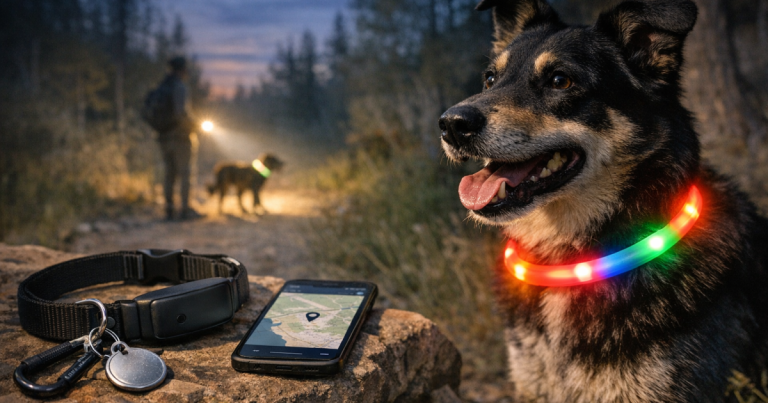
GPS is helpful because it can show movement, direction, and last known position. It is not a substitute for plain identification. Campgrounds often include patchy cellular coverage, tree cover, steep terrain, and busy weekends when staff and neighbors are moving in every direction. If a person catches your dog, a readable tag with your phone number is still the fastest handoff.
Before your dog steps out, confirm that the ID tag is readable, the collar cannot slide over the head, and the contact number is one you will actually answer at camp. If you use a separate GPS collar, keep a backup ID collar on the dog as well, fitted so it does not interfere with breathing, shoulder movement, or the tracker mount. For a deeper setup routine, use this guide to back up your dog’s GPS collar with physical ID tags.
Then check the tracker like a recovery tool, not a lucky charm. Make sure it is charged, attached securely, and reporting from the campground area before you relax. If your tracker depends on cellular service, understand that remote campgrounds can be inconsistent. If the app allows shared access, make sure the second adult can see the dog’s location too. One dead phone should not collapse the whole plan.
Give every person a job before the leash comes off
The first few minutes after a dog slips away are easy to waste. People yell different names, run in opposite directions, or chase the dog into thicker cover. Decide roles while everyone is calm.
- The caller: Uses a calm voice, familiar cue, or high-value food to draw the dog back without crowding.
- The watcher: Stays at the last-seen point and keeps eyes on direction of travel for as long as possible.
- The mapper: Checks the tracker, drops a pin, notes time and direction, and shares updates.
- The notifier: Contacts campground staff, nearby campers, park rangers, or trailhead personnel, depending on the location.
Chasing is usually the worst first move unless the dog is in immediate danger from traffic or terrain. Many dogs interpret pursuit as pressure and move farther away. A better first response is to reduce noise, keep one familiar person visible, and create a reason to return: food, an open car door, a known blanket, or the dog’s usual recall routine.
Write the first 10 minutes on one note
You do not need a formal document. A note in your phone or on a small card in the glove box is enough. The first 10 minutes should include the dog’s name, description, collar color, tag number if relevant, your phone numbers, campsite number, campground office number, and the nearest road or trail name.
Add a simple sequence: stop unloading, secure any other pets, mark last seen, check tracker, call campground staff, search quiet hiding spots, then widen the circle. Start close. Dogs that panic at camp often tuck under decks, vehicles, brush, bathhouse ramps, wood piles, or neighboring trailers before they run a mile.
If you are camping with friends, share the note before the trip. If someone else may watch your dog while you shower, cook, or leave for a supply run, rehearse the alert routine with them. The same logic applies at home and on the road, so it is worth knowing how to test escape alerts before leaving your dog with a sitter.
Build a search kit that lives near the door
Your search kit should be reachable without unpacking half the vehicle. Keep it near the driver’s seat, in a daypack, or beside the crate. At minimum, include a slip lead, flashlight or headlamp, high-value treats, a recent photo, a portable charger, water, a small towel, and a paper note with key contacts. A paper backup matters when batteries drop or phones lose signal.
A basic canine first-aid setup also belongs in this plan. A dog found after running through brush, gravel, cactus, thorns, or cold water may have small injuries you do not notice immediately. Your job is not to play veterinarian in the woods; it is to stabilize, prevent further injury, and get appropriate help. Use this checklist to pack a dog first-aid kit for lost-pet searches before the trip.
Adjust the plan for your dog’s escape style
Not every dog runs for the same reason. A plan that fits the dog in front of you will work better than a generic campground rule.
Door dashers
Park so the vehicle door opens toward the inside of the campsite, not directly toward the campground road when possible. Keep the leash clipped before any door opens. Ask kids and guests to wait until the handler says the dog is secure.
Collar slippers
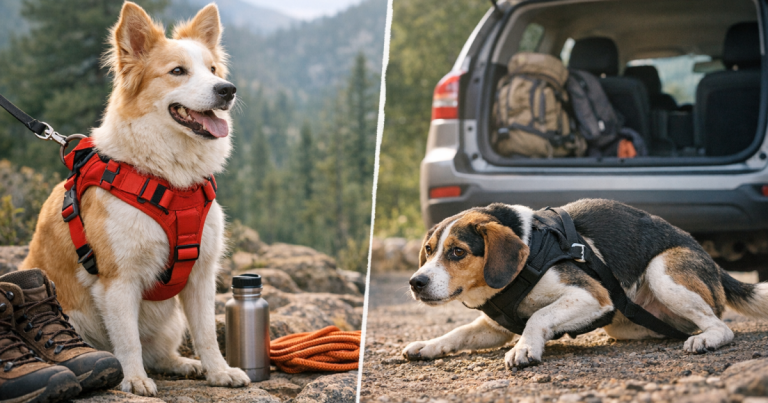
Use gear that fits the dog’s body shape. Narrow-headed dogs, deep-chested dogs, and anxious dogs can back out of ordinary collars or harnesses with surprising efficiency. Check fit after the dog has walked, sniffed, and relaxed, because fur compression and movement can change how gear sits.
Scent followers
Keep food waste sealed and watch the edges near dumpsters, grills, and wildlife paths. These dogs may not look panicked; they simply follow one interesting smell into the next loop.
Noise-sensitive dogs
Plan for generators, fireworks, thunderstorms, slamming RV doors, and late arrivals. A quiet covered crate, vehicle rest period, or calm walking route away from the main loop can prevent the bolt before it starts.
When the campground is remote
Remote camping changes the plan. Cellular-based trackers may update slowly or not at all in weak coverage. Dense trees, steep hills, and canyon terrain can make any location signal less consistent. That does not mean a tracker is useless, but it means you should pair it with old-fashioned recovery steps: last-known location, direction of travel, visible ID, staff alerts, and nearby search grids.
Before dark, identify the nearest ranger station, campground host, trailhead kiosk, and road access points. If your dog disappears, give helpers a clear description rather than a flood of emotion: size, color, collar, temperament, whether to approach, last-seen time, and direction. If your dog is fearful, tell people not to chase. A calm sighting report is more useful than a heroic sprint through brush.
Straight answers
Should I let my dog off leash once the campsite is set up?
Only where it is allowed, appropriate for the site, and realistic for your dog’s recall. Campgrounds are full of temptations and surprises, so many reliable-at-home dogs still need a leash, long line, or enclosed rest area at camp.
What should I do first if my dog slips out at a campground?
Stop everyone from scattering. Mark the last-seen spot, keep one calm caller visible, check the tracker if you use one, and notify campground staff quickly. Search close hiding spots before assuming the dog has traveled far.
Is a GPS tracker enough for camping?
No. A tracker can be extremely useful, but it can be limited by battery level, fit, terrain, and network coverage. Physical ID, a secure leash setup, current contact details, and a first-response plan are still part of the recovery system.
Why it matters
A campsite lost-dog plan is less about fear and more about reducing friction at the exact moment people usually freeze. Before you unpack, choose the handler, scan the site, confirm ID, check the tracker, assign roles, and keep the search kit easy to grab. Those small steps make the campground feel less chaotic for you and safer for the dog who has no idea that site 42 ends where the woods begin.