A nighttime walk can turn stressful fast: a leash clip slips, a dog spots a rabbit, or a campground path disappears into shadow. LED dog visibility lights sit in the prevention layer of your safety plan. They help people see your dog sooner, but they do not tell you where your dog went if visibility is lost.
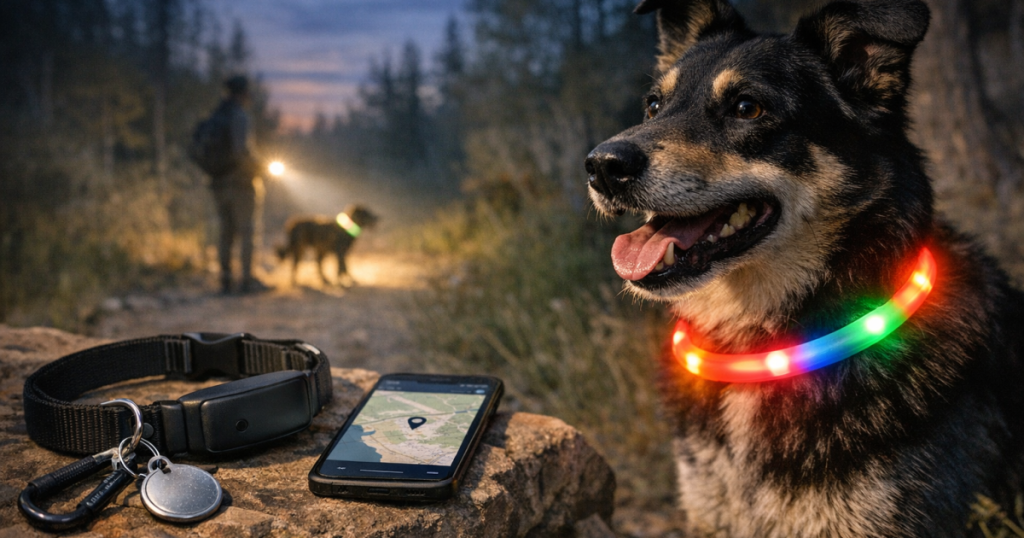
The Nite Ize NiteHowl Rechargeable LED Safety Necklace is best thought of as a visibility aid, not a recovery device. It can make your dog easier to spot in a dark yard, along a roadside shoulder, or around a campsite loop. A GPS tracker, physical ID, recall practice, and leash management still do different jobs.
The short version: visibility helps prevent the first bad minute
The most important minute in many lost-dog scares is the one before the dog is truly gone. If a driver sees your dog near the road, if a friend can pick out a moving light near the trailhead, or if you can spot your dog crossing the edge of a campground, you may avoid a search entirely.
A lighted necklace supports that first-minute prevention. It is useful when your dog is still nearby and line of sight matters. A GPS tracker supports the next stage: finding a dog that is out of sight, around a bend, behind trees, across a field, or moving through a neighborhood where you cannot simply follow with your eyes.
That distinction matters. Visibility gear reduces certain risks; it does not create a location history, communicate over cellular or satellite networks, or replace a tracker alert. For nighttime walks, the strongest setup is layered: visible dog, attached leash, readable ID, charged tracker, and a recovery routine the household already understands.
Where the NiteHowl necklace fits in a nighttime routine
A rechargeable LED necklace belongs in the same mental category as reflective trim, a safety vest, or a light clipped to a leash. It makes your dog stand out in low light, which is valuable in ordinary situations that owners sometimes underestimate.
- Suburban sidewalks: A glowing ring can help approaching drivers, cyclists, and neighbors notice the dog before they notice you.
- Apartment parking lots: Many escapes happen during quick potty breaks, when owners skip the full walking setup because they expect to be outside for only two minutes.
- Campgrounds: A moving light is easier to pick out between picnic tables, tents, RVs, and tree shadows.
- Trailhead dusk: The last half mile often feels familiar, but changing light can make a brown, black, or brindle dog blend into brush.
- Fenced yards: If your dog is let out after dark, a lighted collar helper can make fence-line pacing or gate interest more obvious.
For these scenarios, LED dog visibility lights are practical because they are simple. Charge the device, fit it comfortably, turn it on before the walk, and confirm you can see your dog from several angles. The simplicity is a strength, as long as you do not ask the light to do the job of a tracker.
Step 1: separate “being seen” from “being found”
Before adding any gear to your dog’s collar area, decide what problem you are solving. Night visibility is about being noticed by humans. Tracking is about locating a dog when your eyes, voice, and flashlight are no longer enough.
A GPS dog tracker is the more relevant tool when your dog has a history of door dashing, fence jumping, bolting after wildlife, or slipping away during travel. GPS trackers still have limits, including battery status, network dependence, terrain, fit, and update behavior. But they are built around location recovery in a way a light is not.
Bluetooth item trackers sit somewhere else in the plan. They can help in some close-range or network-assisted situations, but they are not the same as GPS. If you are using an Apple tag on a collar as a backup, it is worth understanding what Bluetooth trackers can and cannot do before relying on one for a rural hike or a fast-moving escape.
Step 2: build a collar and harness setup that does not fight itself
Dogs do not care that humans love layered gear. They care whether the setup rubs, clanks, catches, or feels strange enough to scratch at. A visibility necklace should not interfere with the collar, harness, leash clip, tracker attachment, ID tag, or your ability to handle the dog quickly.
Check the setup on your actual dog, not just on the kitchen counter. A thick-coated dog may hide part of the light. A small dog may have limited neck space once a collar, tag, and tracker are already present. A deep-chested dog on a front-clip harness may need the light positioned so it does not tangle with the leash.
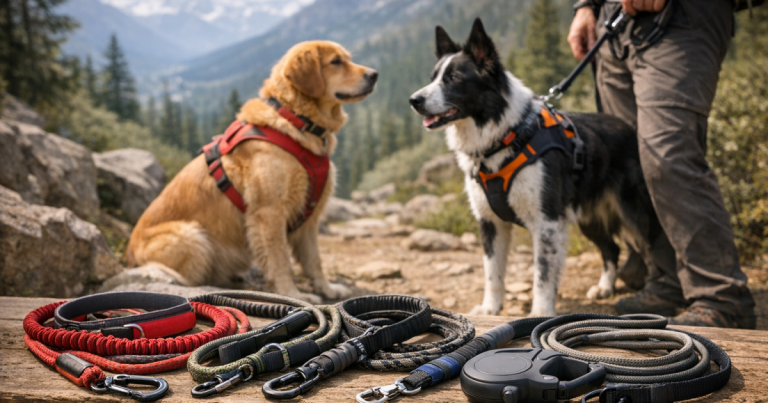
For recall practice after dark, pair visibility with physical control. A bright dog that is twenty feet away on a long line is easier to manage than a bright dog running freely toward a road or trail junction. If you are working on safer off-leash behavior, a reflective harness and long line can make practice sessions easier to see and easier to interrupt before they become a chase.
Step 3: run a driveway test before you trust it on a walk
A new light should be tested in boring conditions first. Put it on your dog before the walk, step outside, and look at the setup the way someone else would see it: from the front, behind, across the street, and at dog height if possible.
- Check comfort: Your dog should be able to walk, sniff, turn, and lower their head without the necklace shifting into the mouth or catching on other gear.
- Check visibility angles: Make sure the light is not completely hidden by fur, a coat, a rain jacket, or a harness strap.
- Check charging habits: Store the light where you will remember to recharge it, not buried in a travel bin that only gets opened on weekends.
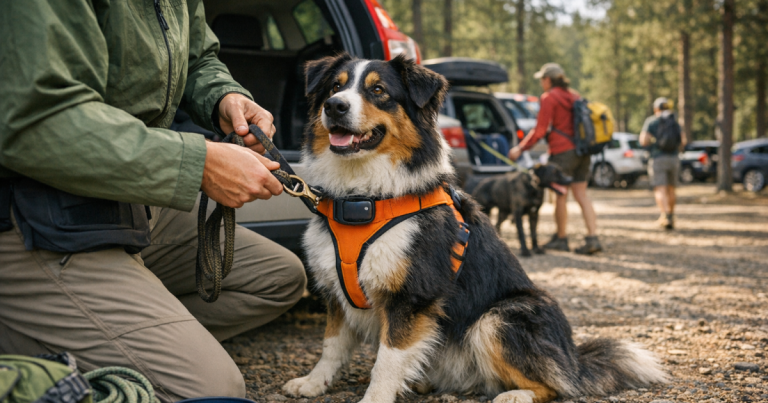
- Check leash handling: Clip and unclip the leash with the light in place so you know your fingers can find the hardware in the dark.
- Check your backup plan: Confirm your dog is also wearing ID and that the tracker, if used, is attached and active before you leave.
This short test is also a good time to notice whether the light changes your dog’s behavior. Some dogs ignore new gear. Others shake, scratch, freeze, or try to mouth anything unfamiliar. Give your dog a calm introduction at home before making the first use a cold, dark, high-stimulation walk.
Step 4: use it differently for neighborhoods, trails, and travel
Neighborhood walks
In neighborhoods, the main value is visibility around vehicles, driveways, cyclists, and other pedestrians. Keep your dog close near road crossings, even if the light makes them easy to see. A driver noticing your dog earlier is helpful; it is not a reason to relax leash control.
Trail walks after dusk
On trails, visibility helps your group stay oriented, but terrain can break line of sight quickly. Curves, brush, creek beds, and elevation changes can hide a lit dog almost as fast as an unlit one. Treat the necklace as an added visual cue, not permission to loosen your recall standards.
Hotels, cabins, and campsites
Travel creates unfamiliar exits: hotel room doors, cabin decks, RV steps, campground loops, and parking areas where a dog may not understand the boundaries. Use the light for every nighttime potty trip, even the quick ones. If you rely on a tracker during travel, also take time to test your dog tracker at a hotel or campsite before you need it under pressure.
Step 5: know when a light is not enough
A lighted necklace is not enough when the problem is distance, speed, terrain, or lack of human witnesses. If your dog bolts after deer, slips a collar, jumps fences, or runs when scared, visibility may help for a few seconds and then disappear behind obstacles. That is when a tracker, updated ID, current photos, and a practiced search plan matter more.
It is also not a substitute for training support. A dog that panics at fireworks, chases wildlife, or ignores recall near traffic needs management, conditioning, and safer routines. Gear can reduce risk, but it cannot make a frightened or highly motivated dog predictable.
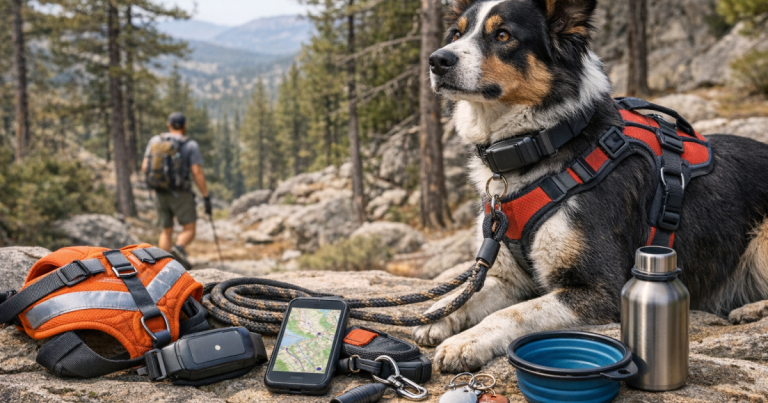
Think in layers rather than gadgets. The light helps the dog be seen. Reflective materials help the dog and handler stand out. A leash or long line maintains physical control. ID helps a finder contact you. A GPS tracker can support active recovery if your dog gets beyond sight. Each layer should earn its place without being asked to do everything.
Main lessons
The NiteHowl Rechargeable LED Safety Necklace makes sense for dog owners who walk after dark, travel with dogs, camp, or want an easier way to keep visual contact in the yard. Its role is prevention and awareness: helping you, neighbors, drivers, and walking partners notice your dog sooner.
For lost-dog prevention, the better question is not whether a light or a tracker is “better.” They solve different problems. A light is most useful while your dog is visible or nearly visible. A tracker becomes more important when your dog is out of sight, moving through unfamiliar areas, or likely to cover distance before anyone can intervene.
The safest nighttime routine is the one you will actually follow: charge the light, check the fit, attach the leash before opening doors, keep ID current, verify tracker status, and treat quick potty breaks with the same respect as full walks. Most scares begin in ordinary moments, and ordinary routines are exactly where simple visibility gear can help.