The first hour after a dog slips out feels chaotic, but a calm plan helps you find a lost dog faster and with fewer risky mistakes. Start close, keep your voice steady, and organize the search before everyone scatters in different directions.
Most successful recoveries are not dramatic rescues miles away. They come from fast local action, clear communication, repeated shelter checks, and making it easy for the dog to be identified when someone spots or secures them.
In brief
- Search the area closest to the escape point first, including porches, sheds, yards, alleys, parking lots, and quiet hiding spots.
- Keep one person at home or at the place your dog last saw you, because many dogs circle back.
- Use a calm, familiar voice and avoid chasing, especially if your dog is frightened or in traffic.
- Send clear information to neighbors, shelters, veterinarians, animal control, local social media groups, and microchip registries.
- If your dog wears a tracker, use it as one tool, not a guarantee; battery, terrain, cell coverage, and update frequency can all affect recovery.
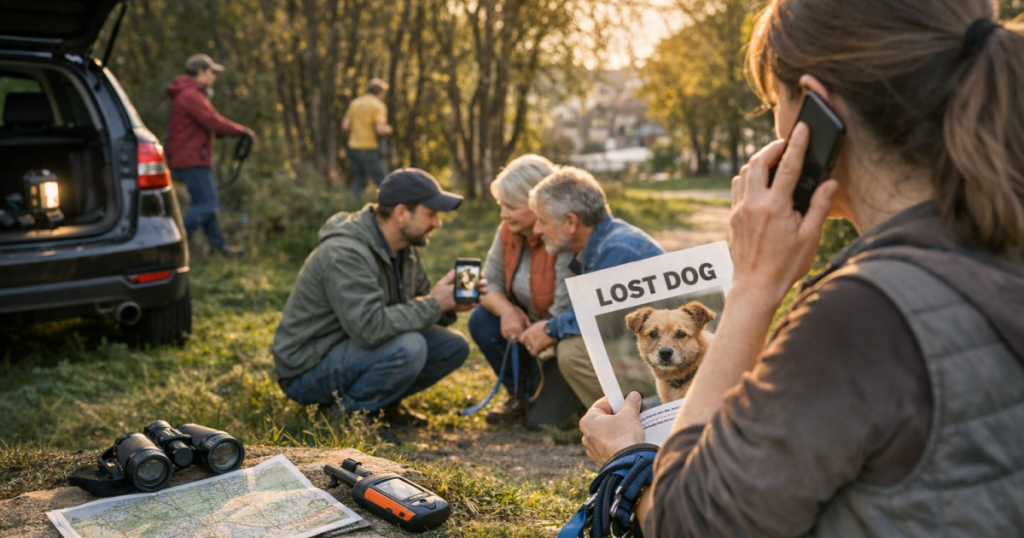
Step 1: Stop, assign roles, and protect the return point
Before the whole household runs in separate directions, take 60 seconds to assign jobs. One person should stay at the escape point or at home with the door, gate, or garage open only if it is safe and controlled. Put out your dog’s bed, a worn T-shirt, water, and a familiar blanket. Avoid leaving a full bowl of food unattended if it may attract wildlife or other loose dogs.
Someone else should start a close-range search. Another person can begin calls, texts, and online posts. If you have children, elderly relatives, or anyone who may panic, give them a simple job such as watching the front window or answering the phone. Calm coordination beats frantic mileage.
Make a quick written note of the time, exact escape point, direction last seen, collar color, ID status, and any unusual behavior. A frightened dog may not act like their usual self, so include details such as “skittish with strangers,” “will come for cheese,” or “do not chase.”
Step 2: Search close before expanding the radius
Many dogs are found within a short distance of where they disappeared, particularly if they are older, small, shy, injured, newly adopted, or overwhelmed by noise. Start with a slow search within the nearest few blocks before driving across town.
- Check under decks, porches, parked cars, trailers, stairwells, and low shrubs.
- Ask neighbors to look inside garages, sheds, fenced yards, and pool areas.
- Walk fence lines, drainage areas, school fields, apartment courtyards, and alleyways.
- Look toward familiar routes: the dog park, a regular walking loop, a friend’s house, or the car.
- For rural properties, check barns, wooded edges, culverts, livestock pens, and access roads.
Call softly rather than yelling. A panicked dog may freeze, hide, or keep moving if they hear urgent voices. Try familiar sounds: a treat pouch, a food container, your normal recall cue, a squeaky toy, or the sound of your car door opening if your dog associates it with rides.
Step 3: Do not chase a scared dog
Chasing is one of the easiest ways to push a lost dog farther from home. Even affectionate dogs can switch into survival mode after a loud truck, fireworks, a collision, or hours alone outside. If you see your dog, lower your body, turn slightly sideways, avoid hard eye contact, and speak in a relaxed voice.
If the dog hesitates, sit down or kneel. Toss high-value treats away from your body first, then closer over time. Some dogs come faster if you pretend to ignore them. If your dog is moving near traffic, assign one person to keep visual contact from a distance while another calls animal control or local police non-emergency for traffic assistance when appropriate.
For a loose dog that is not yours, do not grab at the collar unless the dog is clearly safe to handle. Take a photo, note the direction of travel, and report the sighting with an exact location, time, and behavior.
Step 4: Use a GPS tracker carefully if your dog is wearing one
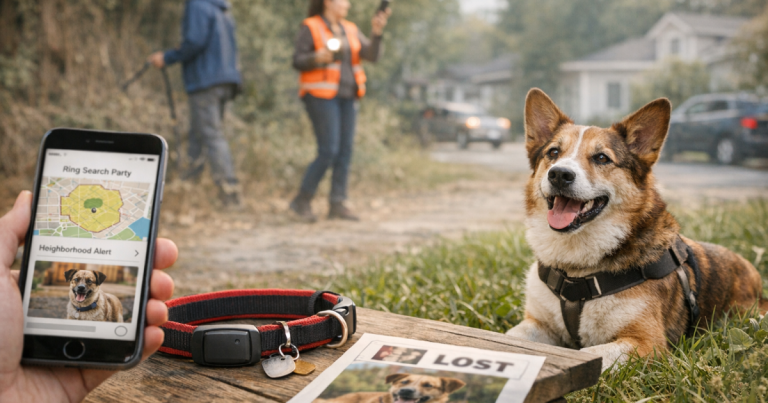
If your dog has a GPS tracker, open the app immediately and screenshot the last known location before the battery dies or the signal changes. Share access or screenshots with only the people helping the search. Send one person to the newest location while another stays near home, because dogs often move in loops.
Tracker data needs interpretation. A location pin may lag behind your dog’s actual movement, bounce slightly in dense neighborhoods, or stop updating in weak cellular areas. In rural terrain, canyons, heavy tree cover, or remote hiking areas, coverage limits matter. Battery status also matters; a device that was not charged before an escape may give you only a short window.
If this scare shows you need a stronger prevention setup, the GPS dog tracker buying guide for safer escapes and recoveries explains the trade-offs between tracker types, subscriptions, coverage needs, and real recovery use cases.
Step 5: Build a clear sighting network
Once the immediate area has been checked, widen the search by creating a tight information loop. The goal is not just to tell people your dog is missing; it is to tell them exactly what to do if they see the dog.
- Text nearby neighbors with a photo, your phone number, the escape time, and “please do not chase.”
- Post in neighborhood apps, local Facebook groups, community boards, and lost-pet pages for your city or county.
- Call local shelters, animal control, nearby veterinarians, emergency vet clinics, and humane societies.
- Update your dog’s microchip record as lost and verify that your phone number is current.
- Ask mail carriers, delivery drivers, school crossing guards, park staff, and maintenance crews to watch for sightings.
Every report should include four pieces of information: where, when, direction of travel, and whether the dog looked calm, scared, injured, or willing to approach. A vague “seen near Main Street” is less useful than “seen at 7:40 a.m. behind the gas station on Main and 4th, moving north along the fence line.”
Step 6: Make a flyer that people can read in three seconds
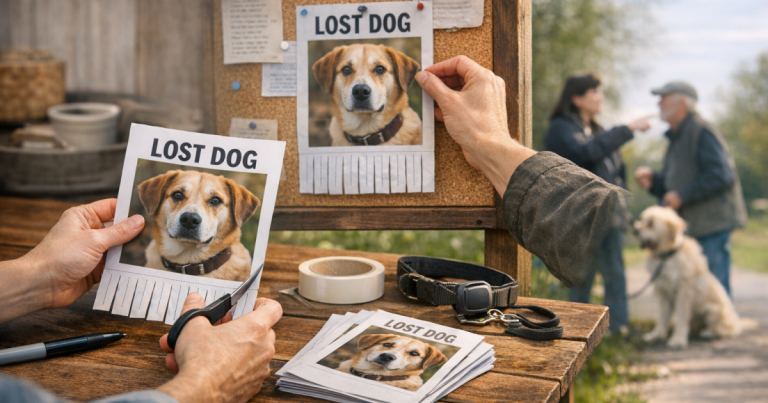
A lost dog flyer should be simple and high contrast. Use one large, recent photo of your dog standing or facing the camera. Include “LOST DOG” at the top, your dog’s name only if you want people calling it, your phone number in large type, the nearest cross streets, and a short handling note such as “shy, do not chase, call with location.”
Post flyers at intersections, trailheads, dog parks, schools, coffee shops, laundromats, gas stations, apartment mail areas, and vet offices. Ask permission where needed. In many US towns, utility poles, street signs, and public property have posting rules, so use legal, respectful placement and remove flyers after recovery.
Carry flyers while searching. Handing one to a dog walker, contractor, or store clerk often works better than hoping an online post reaches the right person.
Step 7: Check shelters in person, then check again
Calling shelters is important, but in-person checks are often more reliable. Descriptions can be misunderstood, intake photos may not show markings clearly, and a dirty or frightened dog may look different from the photo on your phone.
Visit the shelter or animal control facility that serves the area where your dog was lost, then ask which other agencies take strays from nearby cities or counties. Bring photos, proof of ownership, microchip information, vet records if available, and your ID. Repeat checks daily at first, because a dog may be picked up days after the escape.
Do not assume a collar or microchip will solve everything. Collars can slip, tags can break, and microchip records can be outdated. Redundancy is the recovery advantage: visible ID, current chip registration, recent photos, community alerts, and, when appropriate, tracking technology.
Step 8: Adjust the plan for your dog’s behavior
A social Labrador that bolted after a squirrel is not the same search as a newly adopted rescue who slipped a harness in a parking lot. Tailor the recovery plan to temperament and setting.
For friendly, food-motivated dogs
Focus on fast neighborhood alerts, places with people, and familiar destinations. Ask people to call, crouch, and offer treats only if the dog is approaching willingly. Friendly dogs may be taken in by a neighbor before they ever reach a shelter.
For shy or newly adopted dogs
Reduce pressure. Do not form a loud search party. Ask people to report sightings without approaching. If sightings become consistent in one area, a local animal control officer, rescue group, or experienced lost-dog volunteer may help advise on humane trapping options that follow local rules.
For hiking or rural escapes
Mark the last known point and leave a familiar scent item there if it is safe and permitted. Notify park rangers, trail groups, nearby property owners, and local animal control. Search roads, trailheads, creek beds, and places where a dog might follow people, water, or animal scent.
For door dashers and fence jumpers
Expect movement along familiar walking routes and gaps in fencing. Ask neighbors to check camera footage from doorbells or security systems. Once your dog is home, repair the escape point before the next potty break.
Step 9: Search differently at night
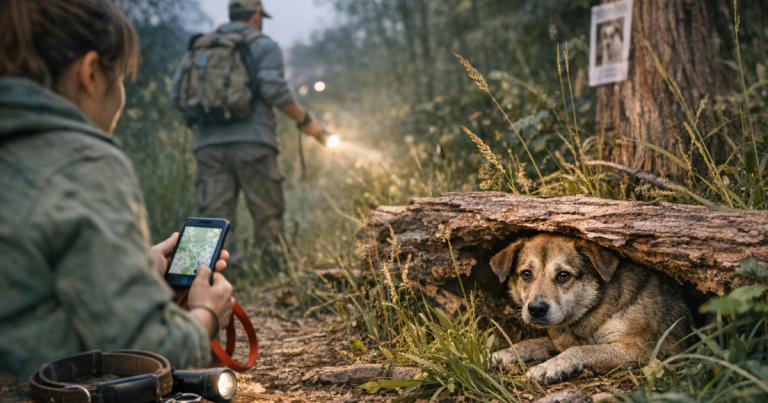
Night can be useful because streets get quieter and a hiding dog may be more willing to move. Bring a flashlight, reflective clothing, a charged phone, and another adult when possible. Walk slowly and listen for tags, movement in brush, barking, or whining.
Use quiet calling, not shouting. Pause often. Shine your light low under cars, porches, bushes, and stairwells. If your dog is dark-coated, small, or lost near traffic, visibility is a real issue for both the dog and the searchers. For routine night-walk prevention after recovery, the NiteHowl Rechargeable LED Safety Necklace review looks at a visibility add-on that can make dogs easier to see in low light.
Step 10: Keep records and update everyone
As sightings come in, write them down in one place. Include the caller’s name, phone number, time, exact location, direction of travel, and confidence level. Plot sightings on a map if the dog remains loose for more than a few hours. Patterns matter: the dog may be circling a food source, bedding down in a quiet area, or moving along a creek, rail line, fence, or trail.
Update your posts with confirmed sightings and remove outdated assumptions. If someone reports “I think I saw this dog yesterday,” thank them and ask for details without arguing. False leads are frustrating, but every respectful conversation keeps the search network willing to help.
What not to do during a lost-dog search
- Do not post “reward, no questions asked” without considering scam calls; ask for a current photo or specific location detail before meeting anyone.
- Do not put your full home address online unless you are comfortable with the privacy risk.
- Do not send strangers into private yards or dangerous areas.
- Do not assume silence means failure; many dogs hide for hours before moving.
- Do not punish your dog when they return. Make coming back the safest, happiest option.
When your dog is back home
Offer water, quiet, and a calm space. Check paws, nails, eyes, coat, and body for cuts, ticks, limping, burrs, or soreness. If your dog was hit, overheated, very weak, vomiting, having trouble breathing, or missing overnight in extreme weather, contact a veterinarian promptly.
Then close the escape gap. Was the collar too loose? Did a guest leave a door open? Did a harness back out during a walk? Did a fence gate fail? Recovery is emotional, but prevention is practical. Update the microchip record, refresh ID tags, take new photos, and practice a calmer door routine.
If you are considering a tracker after the scare, use the Dog Tracker Comparison Database to review tracking method, coverage dependency, subscription structure, attachment style, size, and intended use before deciding what fits your dog’s routine.
Questions people ask
How far do lost dogs usually go?
It depends on temperament, fitness, terrain, weather, and whether the dog is chased. Many stay close at first, while confident or frightened dogs can travel miles, especially along roads, trails, creeks, or fence lines.
Should I put food outside for my missing dog?
A familiar scent item and water can help at the return point. Food may help in some cases, but it can also attract wildlife, loose dogs, or cats, so use it carefully and monitor the area.
Is a GPS tracker enough to recover a lost dog?
No tracker is foolproof. GPS can be extremely helpful, but recovery still depends on battery status, coverage, fit, whether the tracker stayed attached, and how quickly people respond to the location.
What should I say in a lost-dog social post?
Use a clear photo, nearest cross streets, time missing, direction last seen, collar or harness details, your phone number, and a direct instruction such as “do not chase; call with exact location.”
When should I call animal control?
Call right away if your dog is near traffic, appears injured, is hard to approach, or may enter unsafe property. Also call to file a lost report and ask which shelters handle strays from that area.
Why it matters
A lost dog search is stressful because it combines fear, time pressure, and incomplete information. The best response is steady and layered: protect the return point, search close, alert the right people, track sightings, check shelters repeatedly, and avoid actions that push a scared dog farther away.
Most owners wish they had prepared before the escape. A current ID tag, updated microchip, recent photos, tested collar fit, safer gate habits, and a realistic recovery plan can turn a terrifying moment into a manageable one. The goal is not perfection. It is giving your dog more ways to get home.